Outdoor Lighting Design Without Light Pollution
Meta description: ALTA Integra, a lighting consultant, on how outdoor lighting design can meet healthy-building standards while eliminating light pollution and wasted energy.
As a lighting consultant, ALTA Integra defines light pollution-free outdoor lighting design as placing, aiming, and shielding exterior light so that it illuminates only the intended area — nothing more — reducing glare, wasted energy, and disruption to people, wildlife, and the night sky. Like air, water, and land pollution, light can become a pollutant when it is emitted in excess or misdirected, and it is a design problem building owners and architects can largely solve at the source.
What Is Light Pollution?
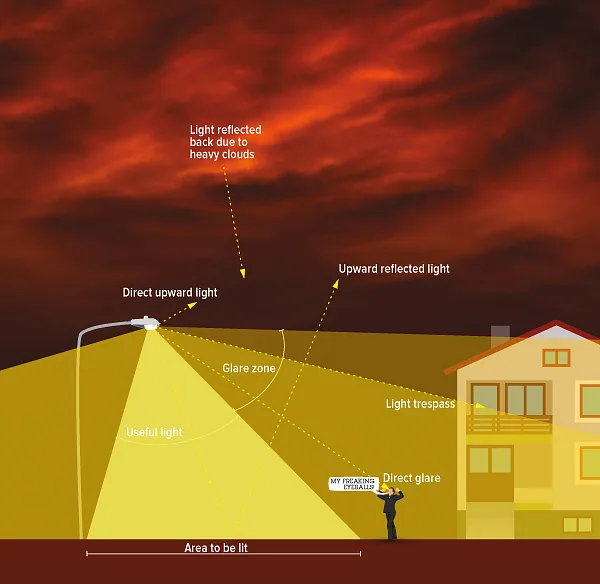
Light pollution, or photopollution, is anthropogenic light at night produced by excessive light emission and incorrect lighting directivity and placement. Left unaddressed, it can affect human health, disrupt ecosystems, and disturb the night view. Light pollution is generally described through four components:
Glare — excessive brightness that causes visual discomfort
Skyglow — light that illuminates the night sky above an occupied area
Light trespass — light spilling onto places it was never intended to reach
Clutter — clusters of overly bright, confusing, and excessive light sources
(Components illustrated by Anezka Gocova, in "The Night Issue," Alternative Journal 39:5, 2013.)
Light pollution has grown alongside rapid industrial development. Its sources range from exterior and interior building lighting, advertising and commercial signage, offices and factories, to street lights and park lighting. In practice, a large share of outdoor lighting in use at night is inefficient, too bright, poorly directed, inadequately shielded, and emits far more light than the task requires — which means light pollution is very often also an energy waste problem.
How Light Pollution Affects Health, Ecosystems, and the Night Sky
Before artificial lighting, life on Earth relied on natural light sources — the sun, moon, stars, and fire — and darkness at night was simply part of the environment. Modern artificial lighting has removed that constraint, but excessive light emission carries real costs, including:
Increased energy consumption
Disruption of ecosystems and wildlife behavior
Negative impacts on human health
Effects on crime and perceived security
Loss of visibility of the night sky
Without necessarily realizing it, light pollution shapes the daily behavior and wellbeing of people living and working near it. Awareness of these effects is growing, and scientists, environmentalists, architects, building owners, and governments increasingly work to minimize it.
Principles of Light-Pollution-Free Outdoor Lighting Design
Building physics offers a clear, practical set of ways to reduce light pollution without sacrificing the function of outdoor lighting:
Use covers or reflectors so fixtures direct light efficiently onto the area meant to be lit
Position and aim fixtures so the light beam is directed downward, not toward the sky
Minimize or eliminate the use of upward-facing spotlights
Use plantings to reduce stray light reflection
Reduce reliance on high-glare yellow sodium lamps in favor of better-shielded, better-directed fixtures
Using lighting efficiently — even at the scale of a single building or neighborhood — reduces light pollution while also cutting energy consumption, so the two problems tend to improve together rather than trading off against each other.
Why This Matters for Healthy Building Design
Outdoor lighting design sits squarely inside healthy building practice: it affects circadian light exposure for occupants and neighbors, energy performance, and a building's relationship to its surrounding environment. A lighting design reviewed against light-pollution criteria — proper shielding, correct aiming, appropriate brightness for the task — is both a healthy-building measure and, generally, an energy-efficiency measure, since better-directed light usually means less wasted light.
Assessing a Project's Outdoor Lighting Design
A practical outdoor lighting review looks at each fixture against the four light-pollution components above: is glare visible from typical viewing angles, does any light escape upward toward the sky, does light spill past the property line onto neighboring space, and are fixtures grouped or specified in a way that creates visual clutter rather than clear, purposeful illumination. Reviewing a lighting plan against these four questions before installation is far less costly than retrofitting fixtures afterward, and it gives a project a clear, defensible basis for claiming its outdoor lighting design is genuinely light-pollution-conscious rather than only nominally so.
Frequently Asked Questions
What exactly counts as light pollution?
It is excessive, misdirected, or poorly shielded artificial light at night, commonly broken into four components: glare, skyglow, light trespass, and clutter.
Does reducing light pollution mean using less light overall?
Not necessarily — it means directing the light that is used more precisely, so it reaches only the intended area instead of spilling upward or sideways.
Why does light pollution matter for a building's health rating?
Because outdoor lighting affects occupants' and neighbors' light exposure at night, and inefficient outdoor lighting typically also wastes energy — both are factors healthy and green building assessments consider.
What is the simplest first step for a project to reduce light pollution?
Correct fixture aiming and shielding — pointing light downward and covering or reflecting it onto the intended area — addresses most sources of glare, skyglow, and trespass without added cost.
Are yellow sodium lights worse for light pollution than LED?
Sodium lighting tends to scatter more broadly and is harder to shield precisely; properly shielded, correctly aimed, and appropriately bright LED fixtures generally offer better control over where light goes.
Sources referenced in the original article: Wikipedia, "Light pollution"; International Dark-Sky Association, darksky.org.
Suggested internal links: Lighting Engineering Design (service page), Healthy Building Advisory & Certification, "Energy-Efficient City Lighting Design."