How Noise Negatively Affects Health and Environment
Meta description: ALTA Integra, an acoustic consultant, on how noise pollution harms human health and the environment — the psychological, physiological, and ecological effects explained.
As an acoustic consultant, ALTA Integra treats noise as a measurable design and public-health concern, not just a nuisance — it negatively affects both human health and the environment through documented psychological effects (annoyance, aggressiveness, sleep disruption), physiological effects (hearing loss, cardiovascular strain), and ecological effects (disruption of species that rely on sound, such as marine mammals).
What Is Noise?
Under environmental protection law, noise is defined as vibration of any frequency broadcast through air or other mediums [1]. Indonesia's Minister of Environment Decree KEP-48/MENLH/11/1996 defines noise more specifically as unwanted sound from activities, at a level and duration that can cause health issues and reduce environmental comfort [2]. Noise is present in virtually every human activity and is generally classified as either occupational (working) noise or environmental noise, both of which can affect human wellbeing [3].
Professor Colin H. Hansen offers a complementary definition: noise is sound that is unpleasant and unwanted, produced by variations of pressure or oscillation in an elastic medium — water, air, or solid objects — due to a vibrating surface or turbulence in a circuit [4]. Taken together, these definitions describe noise as unwanted, disruptive sound generated by human activity through the vibration of objects in the environment.
Where Environmental Noise Comes From
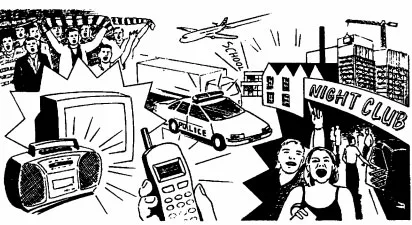
UNESCO identifies the principal sources of environmental noise as industrial machinery, construction sites, radio and television, vehicles, human activity, and household equipment. Research on this topic, including the study "Noise Pollution: A Major Catalyst to Climate Change and Human Health Catastrophe," has found that noise indirectly affects climate change while also reducing human health quality [5]. The European Commission's Science for Environment Policy unit has similarly identified that environmental noise from machinery and transportation — buses, trucks, cars, motorcycles, planes, trains, and ships — can contribute to circulatory and cardiac problems [6].
Psychological Effects of Noise Exposure
Frequent noise exposure produces measurable psychological effects, drawing on research by Muhammad Attique Khan Shahid and Huma Bashir [8]:
Annoyance and aggressiveness. Annoyance is the emotional response to unwanted, disruptive conditions. Low-frequency noise at high intensity is especially disruptive and can directly or indirectly shape a person's behavior — producing aggressiveness (increased irritability and rougher conduct) or defensiveness (difficulty accepting feedback, since unwanted sound can register as an intrusion). Both effects reduce a room's perceived comfort and its functional quality for listening or communication.
Speech interference. Noise exposure reduces the ability to communicate clearly by muffling speech [9]. Speech interference can cause misunderstanding, since the information intended by a speaker may not reach the listener accurately. A documented example is disruption to learning in schools: research titled "Analisa Performa Kebisingan Terhadap Siswa Sekolah Dasar di Ruang Kelas" found that noise affects the concentration of primary-school students and can obscure a teacher's delivery of material due to ambient noise around the school environment [10].
Sleep disturbance. Sleep is a basic human need, and the National Sleep Foundation publishes recommended sleep durations that vary by age group [11]. When sleep needs go unmet, concentration and energy levels suffer for days afterward. Continuous noise exposure can reduce sleep quality, mood, and performance; the World Health Organization (1999) recommends no more than 30 dB inside a bedroom to prevent negative sleep effects, since insufficient sleep can reduce cognitive function and produce broader psychological effects.
Reduced task performance. Muhammad Attique's research, published in the Peak Journal of Physical and Environmental Science Research, found that tasks requiring concentration can be disrupted by the shock of impulsive noise, while continuous noise exposure can affect memory retention and slow the completion of work.
Physiological Effects of Noise Exposure
Physiological effects of noise relate directly to the body, and include:
Hearing loss. Noise-induced hearing loss is an increase in hearing threshold caused by damage to the ear's soft hair cells from noise exposure, and it can affect any age group. Kuntodi classifies deafness from noise into three types [12]:
Acoustic trauma — from a single or rare high-intensity exposure, such as an explosion, that exceeds the ear's physiological threshold and can damage the eardrum and soft hair cells
Temporary deafness — its likelihood rises with the frequency of the exposing noise, and can produce tinnitus, a marker of damage that can reduce hearing sensitivity up to 4,000 Hz
Permanent deafness — can result, alongside age-related factors, from continuous exposure to high-intensity noise, based on levels and risk documented by the New England Hearing Instrument [13]
Cardiovascular effects. Beyond hearing loss, prolonged noise exposure — 20 years of aircraft noise exposure in one dataset of 2,401 participants from Sweden, the United Kingdom, and the Netherlands — has been associated with increased risk of heart failure and stroke. Traffic noise exposure carries a similar association, in addition to aircraft noise [6]. Noise is considered a cardiovascular risk factor because it can activate hormonal and nervous-system responses that raise blood pressure and heart rate [8].
Environmental Effects of Noise
Noise also affects the environment beyond human health. Offshore exploration is one documented example: drilling activity generates substantial noise vibration from heavy equipment, which can affect marine life — particularly sea mammals that rely on echolocation to find food, communicate, and reproduce. Sustained disruption of this kind can make it harder for affected species to find food and reproduce within a radius of up to 100,000 square meters, with the potential, if left unaddressed, to contribute to species decline in affected areas [14].
Why Acoustic Design Matters
Because noise carries measurable psychological, physiological, and environmental costs, controlling it at the source and through building design — rather than treating it as an unavoidable side effect of density and activity — is a core part of acoustic engineering. Whether the concern is workplace noise, residential comfort, or environmental protection near a sensitive site, the underlying physics and health evidence are the same ones summarized above.
Frequently Asked Questions
What is the legal definition of noise in Indonesia?
Under Ministerial Decree KEP-48/MENLH/11/1996, noise is unwanted sound from activity, occurring at a level and duration that can cause health issues and reduce environmental comfort.
What psychological effects does noise exposure cause?
Documented effects include annoyance, increased aggressiveness or defensiveness, speech interference, sleep disturbance, and reduced concentration and task performance.
Can noise exposure cause permanent hearing loss?
Yes — continuous exposure to high-intensity noise can cause permanent noise-induced hearing loss, in addition to acoustic trauma from a single intense exposure and temporary threshold shifts such as tinnitus.
Is there a recommended maximum noise level for sleeping?
The World Health Organization (1999) recommends no more than 30 dB inside a bedroom to avoid negative effects on sleep quality.
Does noise affect anything beyond human health?
Yes — documented environmental effects include disruption to marine mammals that rely on echolocation, particularly from offshore drilling and industrial noise sources.
Harisma Khoirun Nisa, ALTA Integra, 2016
References (preserved from the original article): [1] Environmental Regulation Division on Environment and Health Protection, "Guideline Noise Assessment," Prescribing noise conditions for environmental authorities for petroleum activities, 13 March 2015. [2] KEP-48/MENLH/11/1996, "Baku Tingkat Kebisingan," Menteri Negara Lingkungan Hidup, Indonesia, 1996. [3] M. C. Barrientos, D. C. Lendrum and K. Steenland, "Occupational Noise," World Health Organization Protection of the Human Environment, Geneva, 2004. [4] C. H. Hansen, "Fundamentals of Acoustics," Australia. [5] Ibrahim Imam et al., "Noise Pollution: A Major Catalyst to Climate Change and Human Health Catastrophe," University of Ilorin, Nigeria. [6] Science Communication Unit, "Science for Environment Policy," Thematic Issue: Noise Impact on Health, 14 January 2015. [7] Lawrence K. Wang et al., "Handbook of Environmental Engineering — Advanced Air and Noise Pollution Control," in Noise Pollution, Humana Press Inc., 2005, pp. 441-452. [8] Muhammad Attique Khan Shahid and Huma Bashir, "Psychological and Physiological Effects of Noise Pollution on the Residents of Major Cities of Punjab (Pakistan)," Peak Journal of Physical and Environmental Science Research, 2013, pp. 41-50. [9] LAX Part 161 Study, "The Effects of Noise on People," Burlington. [10] A. Justian, "Analisa Pengaruh Kebisingan Terhadap Performa Siswa Sekolah Dasar di Ruang Kelas," Universitas Indonesia, Depok, 2012. [11] R. Widiyani, "Kebutuhan Tidur Sesuai Usia," Kompas.com, 26 March 2014. [12] P. Kuntodi, "Gangguan Pendengaran Akibat Kebisingan," 23 August 2012. [13] New England Hearing Instrument, Inc. [14] M. Jasny, "Ocean Fact Boom, Baby, Boom: The Environmental Impacts of Seismic Surveys," Natural Resources Defense Council, New York, 2010.
Suggested internal links: Acoustic Engineering Design (service page), "High-End Audio Room Acoustics: The Science," Healthy Building Advisory & Certification.