Audio Quality vs. Room Acoustic Quality: What Really Determines Listening Satisfaction
Title: Audio Quality vs Room Acoustics: What Matters More?
Meta Description: Audio quality and room acoustic quality both shape listening satisfaction — great gear can't fix a room with poor acoustics.
Audio Quality vs. Room Acoustic Quality: What Really Determines Listening Satisfaction
Listening satisfaction depends on two separate factors working together: the quality of the audio equipment producing the sound, and the acoustic quality of the room the sound travels through. Neither one alone is enough — a world-class sound system in a poorly designed room, or a perfect room fed by weak equipment, both fall short of what a listener actually experiences as "good sound." This article by Herwin Gunawan of Alta Integra draws on a real concert case to unpack how the two interact.
Why Audio Quality and Room Acoustic Quality Are Not the Same Thing
Audio quality refers to how faithfully a sound system — speakers, amplifiers, source equipment — reproduces a signal. Room acoustic quality refers to how a space itself behaves acoustically: how it reflects, absorbs, and reinforces sound as it travels from the source to the listener's ear. A recording can be pristine and a sound system can be excellent, but if the room has poor reverberation control, uneven sound pressure distribution, or excessive noise, the listener still won't experience the music as intended. The reverse is also true: a beautifully designed concert hall cannot make a bad recording or a poorly configured audio system sound good.
A Real-World Illustration: A Concert at Jakarta's JCC Plenary Hall
In 2009, a rare opportunity arose to attend Music Odyssey of Addie MS, a concert tracing Addie MS's musical journey — from forming a band with Ikang Fauzi, to becoming a music arranger, to eventually founding the Twilight Orchestra at the encouragement of Indra Bakrie, who believed in his potential even when Addie MS himself doubted there would be an audience for classical music in Indonesia. Music Odyssey was organized by Addie MS's friends to mark both his 30 years of dedication to Indonesian music and his birthday.
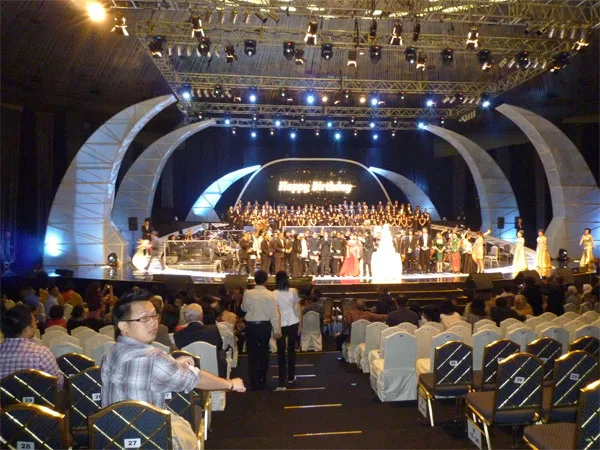
The concert was held at Plenary Hall, Jakarta Convention Center — a round conference room with a large dome-shaped ceiling and a smaller inverted dome at its center. The room has a reasonably good damping factor against echo, but by design it is not really suited to hosting a classical music performance on its own acoustics. To compensate, the concert's production team used an audio system with line-array speakers to distribute sound evenly to the audience.
The orchestra's stage layout, from back to front, placed the choir at the rear, orchestral percussion in front of the choir, then wind instruments, and finally a divided front row: a contemporary band (drums, electric bass, electric guitar, electric piano) on the left, violins on the right, grand piano further forward, and cellos on the far right. The evening's program moved from a young vocalist accompanied by piano, through a run of pop-era songs reflecting Addie MS's pop-arranging years, into a large choral and orchestral finale — a program dense enough that it ran past 11 p.m. without clearly signaling its ending, and much of the audience left before the planned closing pieces.
Listening Without Amplification vs. Listening With Amplification
Every music and audio lover's ideal is to hear music the way it was actually played — that is, to listen in a concert hall with genuinely good acoustics and no audio amplification at all, so what reaches the ear is the sound of the instruments themselves, shaped only by the room. In that scenario, the quality of what an audience hears is determined almost entirely by the acoustic quality of the hall. Unfortunately, JCC's Plenary Hall does not have the acoustic quality needed to support an unamplified classical performance.
An unamplified performance in a genuinely good room delivers sound that is real, clear, and dynamic, without compression — every detail of the instruments comes through untouched by any audio system. Its two main risks are: first, any ambient noise in the room — from the audience, ventilation, or nearby machinery — becomes far more noticeable; and second, if the room's acoustic quality is not adequate, the instruments themselves will sound worse regardless of how well they were played.
A performance with audio amplification, by contrast, inevitably carries the character of the sound system itself — the coloration of the speaker's tweeter and woofer, and mild dynamic compression introduced anywhere between the microphone and the amplifier. At the Addie MS concert, higher frequencies were also noticeably absorbed by the damping material in the room, making it difficult to hear the full clarity and shimmer of the piano.
Comparing a Live Amplified Performance With Home Theater Playback
A further comparison worth making is between a live amplified concert and the same kind of music heard through a good home theater system at home. Counterintuitively, a home theater system's reproduction is often more compressed and lower in resolution than even an imperfect live amplified performance — the live setting still carries more of the original instrumental detail.
At the same time, a live mix is not automatically better in every respect. In the Addie MS concert, the channel balance in the mix was less than ideal: the piano sat lower in the mix than the string section, and vocals were recessed relative to drums and bass. The overall listening satisfaction, then, was limited less by the music itself than by a combination of an imperfect mix and a room whose acoustic quality wasn't built for the performance it was hosting.
What This Means for Anyone Designing or Choosing a Listening Space
Audio quality and room acoustic quality cannot be evaluated in isolation — together they determine whether an audience experiences satisfaction or disappointment. As Addie MS himself said at the concert, he hoped one day to present his performances in a genuinely proper concert hall, noting that Indonesia lacked a truly suitable room for classical music at the time. That observation is exactly why acoustic design matters as much as equipment selection: a hall, studio, or home listening room built with the right acoustic parameters from the start gives every subsequent piece of audio equipment a fair chance to sound as good as it's capable of sounding — which is the principle Alta Integra applies when consulting on listening and performance spaces.
Frequently Asked Questions
Does better audio equipment always improve the listening experience?
Not on its own. If the room has poor acoustics — excessive reverberation, uneven sound distribution, or high background noise — even excellent equipment cannot fully overcome those limitations.
Why do concert halls sometimes need amplification for classical music?
Some multi-purpose venues, like conference-style halls, are not built with the reflective and absorptive surfaces classical acoustic music needs. Amplification, such as a line-array system, compensates by distributing sound evenly, though it introduces its own coloration and compression.
What's the difference between an unamplified and an amplified performance?
An unamplified performance in a well-designed room delivers the instruments' original sound shaped only by the room. An amplified performance always adds some coloration and compression from the microphones, mixer, and speakers.
Is a live concert always better sounding than a home theater system?
Not necessarily in every respect, but live sound generally carries more of the original instrumental detail and dynamic range than a home theater system's more compressed reproduction.
What should someone prioritize when designing a listening or performance space?
Acoustic quality of the room should be addressed at the design stage, alongside — not instead of — audio equipment selection. A room designed for its intended use gives any audio system a genuine chance to perform as intended.
Suggested internal links: Music and Speech Hall, Understanding Room Resonance & Frequency Response, Controlling Reverberation & Echo in a Room