Understanding Room Resonance and Frequency Response
Title: Understanding Room Resonance & Frequency Response
Meta Description: Room dimensions create resonance frequencies that color sound — here's how to calculate them and design a more even response.
Understanding Room Resonance and Frequency Response
Room resonance is the reason two rooms can be built from identical materials yet sound completely different — and it is determined almost entirely by a room's dimensions, not by how much soundproofing is added. This guide, based on the room-acoustics methodology Alta Integra uses on studio and home-theater projects, covers what causes room resonance, how to calculate a room's resonance frequencies, and how acoustic design creates a more even frequency response.
What Causes Room Resonance?
Resonance is a natural physical occurrence: the vibration of an object or mass at a specific frequency, driven by a sound source. In a room, the air particles between two surfaces resonate at specific frequencies whenever a sound source is present in that space.
A common misconception is that simply adding soundproofing material solves resonance problems. It doesn't — resonance is not caused by sound "bouncing" around a room, but by the vibration of air particles trapped between two parallel surfaces. Adding absorption can reduce some effects of resonance, but it does not remove the underlying resonance frequencies created by the room's own dimensions.
Calculating a Room's Resonance Frequencies
A typical listening room has three pairs of parallel surfaces, each of which generates its own set of resonance frequencies:
1. Ceiling and floor
2. Front wall and back wall
3. Left wall and right wall
The fundamental resonance frequency for any pair of parallel surfaces can be calculated with:
Fr = 300 / (2 × L)
where Fr is the resonance frequency, 300 is the approximate speed of sound in meters per second, and L is the distance between the two parallel surfaces. Each fundamental resonance is then followed by a series of harmonics — the second, third, fourth multiple, and so on.
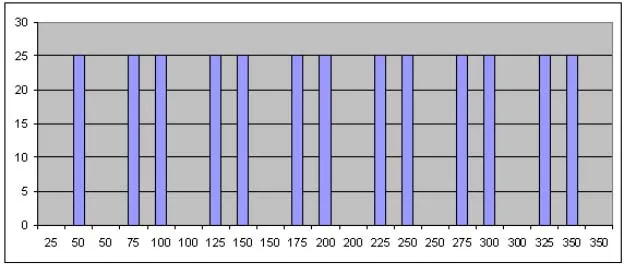
For example, in a room 3 meters wide, the resonance series works out to:
Fr1 = 50Hz, Fr2 = 100Hz, Fr3 = 150Hz, Fr4 = 200Hz, Fr5 = 250Hz, Fr6 = 300Hz, Fr7 = 350Hz.
In a room 6 meters long, the same formula gives a fundamental of Fr = 300 / (2 × 6) = 25Hz, with a much denser harmonic series:
Fr1 = 25Hz, Fr2 = 50Hz, Fr3 = 75Hz, Fr4 = 100Hz, Fr5 = 125Hz, Fr6 = 150Hz, Fr7 = 175Hz, Fr8 = 200Hz, Fr9 = 225Hz, Fr10 = 250Hz, Fr11 = 300Hz, Fr12 = 325Hz, Fr13 = 350Hz.
Notice that the 6-meter room's Fr2 (50Hz) lands on exactly the same frequency as the 3-meter room's Fr1 (50Hz) — and this overlap repeats at 100Hz, 150Hz, 200Hz, 300Hz, and 350Hz. Every frequency where the two series coincide gets reinforced twice over, becoming disproportionately dominant and "thick" sounding compared to frequencies that only occur in one series. This is exactly why a room whose length is a simple multiple of its width tends to sound uneven — certain bass notes boom while others in between sound comparatively thin.
The practical result is that the "natural" sound of a source, amplifier, and speaker chain — each individually well-behaved — becomes audibly unnatural once it passes through a room whose resonance frequencies are heavily concentrated at particular points. That coloration is a form of harmonic distortion introduced by the room itself, often without the listener realizing that the room, not the equipment, is the cause.
How to Get a More Even Frequency Response
To design a room whose resonance frequencies are distributed as evenly as possible, acoustic researcher M.M. Louden developed a reference table of ideal ratios between a room's height, width, and length. Rather than simple whole-number ratios (which create the frequency pile-ups shown above), Louden's ratios are chosen specifically to spread resonance frequencies more evenly across the spectrum.
As a worked example: for a room with a 2.2-meter ceiling height, Louden's Quality-1 ratio recommends a width of 1.4 × 2.2m = 3.08 meters and a length of 1.9 × 2.2m = 4.18 meters. Modeling the resulting resonance frequencies for a room built to roughly those dimensions (height 2.2m, width 3.08m, length 4.18m) shows the resonance frequencies spread fairly evenly across the frequency range, rather than piling up at the same few points — meaning the harmonic distortion introduced by the room itself is substantially smaller than in a room built to simple, non-ideal proportions.
Practical Ways to Approach Ideal Proportions When You Can't Rebuild the Room
Matching a room's exact proportions to a table like Louden's is genuinely difficult in most real buildings. A few practical techniques can help approximate the ideal ratio without a full rebuild:
Build a raised platform on the floor to effectively adjust the room's usable height.
Add a partition wall to adjust the effective length or width toward the ideal ratio.
Design a sloped ceiling, with the ceiling lower near the speakers and rising toward the listening position, rather than a flat parallel ceiling.
Sloped-ceiling and angled-wall examples of this kind of treatment are documented at www.acourete.com for reference — the same category of fix Alta Integra recommends when a client's room dimensions can't be rebuilt from scratch.
Frequently Asked Questions
Does adding soundproofing material fix room resonance?
Not directly. Resonance is caused by air particles vibrating between parallel surfaces at frequencies determined by the room's dimensions — soundproofing can reduce some secondary effects but doesn't eliminate the underlying resonance frequencies.
How do I calculate a room's resonance frequency?
Use Fr = 300 / (2 × L), where L is the distance between a pair of parallel surfaces (e.g., the two side walls, or floor and ceiling). Each fundamental frequency is followed by its harmonic series.
Why do rooms with simple length-to-width ratios sound "boomy" or uneven?
When two dimensions share simple whole-number ratios, their resonance frequency series overlap heavily, reinforcing certain frequencies far more than others and creating an uneven, colored frequency response.
What is the Louden ratio table used for?
It provides height-to-width-to-length ratios chosen to spread a room's resonance frequencies more evenly across the spectrum, reducing the harmonic distortion caused by the room itself.
What if my room's dimensions don't match the ideal ratios and I can't rebuild it?
Techniques such as a raised floor platform, an added partition wall, or a sloped ceiling can shift a room's effective proportions closer to an ideal ratio without full reconstruction.
Suggested internal links: Controlling Reverberation & Echo in a Room, How Room Noise Affects Audiophile Sound Quality, Acoustic Engineering Design