Upper-Room UVGI: Air Disinfection Systems for Healthy Buildings
Upper-room UVGI (ultraviolet germicidal irradiation) is an air-disinfection technology that installs germicidal UV-C fixtures near the ceiling to inactivate airborne pathogens circulating through a room's upper air layer, without exposing occupants below to harmful UV levels. It remains a design option ALTA Integra, a healthy building consultant, recommends for hospitals, schools, transit hubs, and other high-occupancy spaces where indoor air quality is a health priority.
Why Indoor Air Disinfection Became a Building Design Priority
The COVID-19 pandemic put indoor air disinfection under an unusually intense spotlight. Because indoor environments concentrate aerosols — the tiny pathogen-laden droplets released when an infected person coughs, sneezes, or even speaks — they are especially prone to outbreaks. An unpublished study by Fears et al. found that SARS-CoV-2 could remain infectious while suspended in aerosol form for up to 16 hours, and swab tests taken from exhaust outlets in a patient room in Singapore returned positive results, suggesting airflow can displace virus-laden droplets well beyond the immediate vicinity of an infected person. That body of evidence pushed air disinfection — and UV light in particular — back into focus for building designers.
What Makes UV-C Different From Other UV Light
Not every wavelength of UV light can inactivate germs. Most research points to UV-C — UV light with a wavelength between 200 and 254 nanometers — as the most effective band for germicidal use, which is why it is commonly called germicidal UV (GUV). Scientists have studied UV-C's germ-killing potential since the 19th century; Niels Finsen, a Faroese scientist, won the 1903 Nobel Prize in Medicine for his work using UV-C in phototherapy against lupus and tuberculosis. UV-C cannot be sourced from sunlight, since the ozone layer absorbs almost all of it before it reaches the ground. Health care facilities have used GUV to disinfect room air for roughly 70 years, with pathogen-kill rates that can exceed 99.9% for airborne organisms such as measles and tuberculosis.
Why Upper-Room UVGI Outperforms Portable Air Cleaners
Portable UVGI air cleaners and robots are the most common way people encounter this technology today, but they are a relatively weak tool against airborne disease: most deliver only 1–2 air changes per hour (ACH) — a measure of how much room air is exchanged or treated per hour. Portable units mounted in patient rooms are effective at killing germs, but mainly when the room is unoccupied, and it is often impractical to regularly empty spaces such as 24-hour airport lounges, waiting rooms, stores, and restaurants.
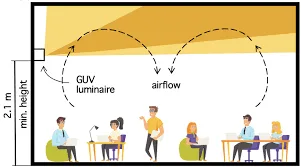
An IES report found that upper-room UVGI is a substantially more effective way to disinfect air in an occupied room, delivering the equivalent of roughly 6–12 ACH. Because the fixtures are mounted overhead — IES recommends a minimum height of 2.1 meters from floor to the bottom of the fixture — occupants below receive very little UV-C exposure. In the installation reviewed in the IES report, healthcare workers and patients received no more than one-third of the current UV-C daily safety limit. Even accidental exposure to UV-C tends to produce only a mild, temporary sunburn-like effect, since UV-C's short wavelength is absorbed by the outer layer of dead skin cells and cannot penetrate to living tissue the way UV-A or UV-B can.
The Research Behind Upper-Room UVGI
Upper-room UVGI's track record goes back decades. In 1941, William F. Wells studied its effectiveness in preventing measles among students in Philadelphia day schools: 53.6% of susceptible students in schools without upper-room UVGI became infected, compared with only 13.3% in schools that had it installed. A similar pattern showed up during the 1957–1958 flu pandemic, when McLean measured a 1.9% infection rate in an irradiated ward at a Veterans Hospital tuberculosis unit, versus 18.9% in a non-irradiated ward.
In 2009, the U.S. Centers for Disease Control and Prevention (CDC) published its first basic guidelines on the design parameters for upper-room UVGI in healthcare settings, building on a 1997 University of Colorado study that evaluated the technology's ability to contain the spread of tuberculosis.
Designing an Effective Upper-Room UVGI System
Ventilation design has a direct effect on how well upper-room UVGI performs. A proper design ensures air circulation reaches the room's optimum air change rate and promotes enough mixing to bring contaminated air up into the treated upper zone, while still maintaining indoor comfort. The other critical variable is UVGI dose — the product of UV irradiance and exposure time. Because air moves through a room continuously, unlike a static surface, irradiance needs to be high enough to deliver an adequate dose despite that constant movement. Room configuration, fixture placement, and how effectively airflow carries contaminated air into the upper room are the remaining parameters that determine whether a UVGI installation performs as designed.
FAQ
What is upper-room UVGI?
It's an air disinfection method that installs germicidal UV-C fixtures near the ceiling, so airborne pathogens are inactivated as room air mixes up into the treated upper zone, while occupants below remain safely shielded from direct UV exposure.
Is upper-room UVGI safe for occupied rooms?
Yes, when installed at the recommended height (at least 2.1 m from floor to fixture). Documented installations have kept occupant exposure to no more than a third of the current daily UV-C safety limit.
How does upper-room UVGI compare to portable air cleaners?
Portable units typically deliver only 1–2 air changes per hour and work best in unoccupied rooms. Upper-room UVGI can deliver the equivalent of roughly 6–12 ACH continuously, even while a room is occupied.
Is upper-room UVGI a new technology?
No — its use for airborne disease control dates back to studies in the 1940s and 1950s, with CDC guidelines for healthcare settings published in 2009 based on further research from the late 1990s.
What building factors affect how well upper-room UVGI works?
Ventilation rate and mixing, UVGI dose (irradiance × exposure time), fixture placement, and room configuration all affect whether contaminated air is adequately exposed to the treated zone.
Suggested internal links: Healthy Building Advisory & Certification · Green Building Advisory & Certification · Bioclimatic Passive Design