Noise Criteria (NC): A Background Noise Rating Standard
Part of ALTA Integra's Acoustics 101 lesson series.
Noise Criteria (NC) is a building standard that expresses the background noise level in a space — measured across a whole range of frequencies — as a single number. It exists because sound pressure level (SPL) varies by frequency, and reporting eight or more separate frequency-band numbers isn't practical for comparing rooms or setting design targets. This lesson explains how NC is derived, and how it relates to the other common background-noise metric, the overall A-weighted equivalent sound pressure level (LAeq, overall), measured in dBA.
What NC Represents
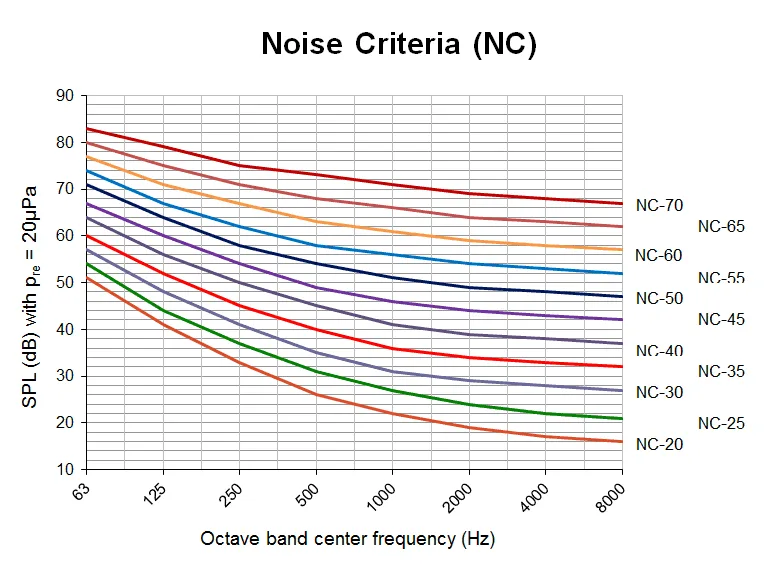
NC was developed by mechanical, electrical, and plumbing (MEP) engineers working alongside other building professionals and acoustic engineers under the American National Standards Institute (ANSI). Each NC number corresponds to one specific curve spanning the octave-band center frequencies from 63 Hz to 8,000 Hz. These curves closely mirror the equal-loudness contours used elsewhere in acoustics — NC essentially simplifies those contours into a building-noise rating tool.
How an NC Rating Is Determined
To find the NC rating of a measured background noise, the sound pressure level is first measured and averaged over time at each frequency band — this time-averaged value is called the equivalent SPL, or Leq. Those Leq values are then plotted onto an NC graph and connected with a line.
The rule for reading the result: the lowest NC curve that the measurement line does not cross is the room's NC rating. For example, if a measurement line's peak crosses the NC 40 curve but stays under NC 45, the result is reported as NC 45 — unless a full graph is available, which could allow a more precise (and typically lower) reading, such as NC 41.
NC ratings are useful because they let you compare a measured background noise level directly against a project's recommended maximum — though the applicable maximum varies by country and by project type, so it's important to check the specific local regulation that applies.
NC vs. dBA (LAeq, Overall)
Some standards express maximum background noise not as an NC number but in dB(A) or dBA. This value — the overall A-weighted equivalent sound pressure level, or LAeq, overall — is the total of A-weighted sound pressure levels measured across the same 63 Hz–8,000 Hz octave-band range NC uses, but it allows more flexibility in exactly which frequency range is included. A-weighting is applied because it approximates how the human ear perceives relative loudness across frequencies.
To calculate LAeq, overall from a set of octave-band Leq measurements: each Leq value is converted into an A-weighted intensity ratio using its band's weighting value, the ratios are summed, and the sum is converted back from a logarithmic intensity ratio into decibels.
Worked example: converting eight octave-band measurements into A-weighted intensity ratios and summing them yields a total of 36,384. The base-10 logarithm of 36,384 is 4.56. Multiplying 4.56 by 10 gives an LAeq, overall of 45.6 dBA for that measurement set.
Why NC Ratings Matter in Practice
In real projects, NC ratings are most often used as a design target rather than just a post-construction measurement. HVAC systems, in particular, are one of the biggest contributors to a room's background noise level, since mechanical, electrical, and plumbing equipment generates continuous low-to-mid frequency noise that can dominate a space if left unchecked. Setting an NC target early — before HVAC equipment is selected and ductwork is routed — gives the project team a clear, single-number benchmark to design against, rather than trying to retrofit noise control after equipment is already installed and a room already feels noisy in use. This is why NC targets so often appear directly in mechanical specifications, alongside the dBA limits used interchangeably in other project documents — and why ALTA Integra's acoustic engineers set NC targets as a standard part of HVAC design review.
Frequently Asked Questions
What is Noise Criteria (NC)?
NC is a single-number rating, developed under ANSI by MEP and acoustic engineers, that represents a room's background noise level as one curve spanning frequencies from 63 Hz to 8,000 Hz.
How do you read an NC rating from a graph?
Plot the measured sound pressure level at each octave band, connect the points, and identify the lowest NC curve on the graph that the resulting line does not cross — that curve's number is the NC rating.
What is the difference between NC and dBA (LAeq, overall)?
NC expresses background noise as a curve-based rating across a fixed frequency range, while dBA (LAeq, overall) is a single decibel value derived by summing A-weighted sound pressure levels, with more flexibility in the frequency range used.
Why is A-weighting used when calculating LAeq, overall?
A-weighting adjusts measured sound pressure levels to better match how the human ear perceives loudness at different frequencies, making the resulting single number more representative of actual perceived noise.
Do all countries use the same maximum NC or dBA limits?
No. Recommended maximum background noise levels vary by country and by project type, so it's important to check the specific local regulation that applies to a given project.
Suggested internal links: Background Noise: Why Is It a Serious Problem?, Sound Pressure Level (SPL), Noise Control Performance Indices & Ratings.