Solving Noise Leakage at My Way Karaoke, Pamanukan
This case study documents how Alta Integra measured, analyzed, and proposed a solution for sound leakage at My Way Karaoke in Pamanukan, a venue located close to surrounding residential housing and a hotel. The project is a real, dated example of how acoustic measurement translates into a targeted, cost-effective noise-control solution — kept here in its original 2010 timeframe, since the value of the case study is in what was actually measured and solved, not when it is being read.
Introduction: The Problem
Sound leakage is one of the outcomes entertainment venues most want to avoid, especially venues located close to residential settlements. That was exactly the situation at My Way Karaoke in Pamanukan: leaking noise was disturbing both the surrounding residential community and hotel guests nearby. The venue's management contacted Alta Integra for consultation. The measurement and analysis that followed were carried out at the client's request, in direct connection with the leaked sound audible around the source location. The target of the measurement was clear and specific: reduce sound leakage levels to within 55dB, in line with the noise regulations of the Republic of Indonesia.
Measurement Results (January 26, 2010)
Measurements were taken on-site between 5:00 p.m. and 6:00 p.m. Readings at the source and at multiple points around the venue showed how far and how loudly the sound was traveling:
Speaker: 120dB
Middle Hall: 110dB – 115dB
Kitchen (closed door): 70dB
Rear Hallway: 80dB – 85dB
Left Hallway: 80dB
Front Parking Lot: 75dB
Hotel Parking Lot: 78dB
Zincalum Roofing: 99dB
Concrete Roofing: 88dB
Ceiling below the Zincalum Roofing: 106dB
Acoustic Analysis
The measurement results showed that the greatest sound leakage occurred at the surface of the zincalum roof, reaching 99dB, with the leaked energy concentrated predominantly at low frequencies — the frequency range that is hardest to block with lightweight materials. Based on this finding, Alta Integra estimated that noise disturbance above the 55dB threshold could still be heard up to a radius of approximately 158 meters from the venue — well beyond the venue's own boundary, and enough to explain the complaints from both nearby residents and hotel guests.
Acoustic Solution
Based on the measurement and analysis, Alta Integra recommended two specific interventions targeted directly at the leakage path identified:
1. Replacing the zincalum roof with a concrete deck — addressing the roof surface identified as the largest single source of leakage.
2. Installing a high-mass sound insulation material, such as Acourete Mat Resin — adding the mass needed to further block low-frequency energy from transmitting through the remaining structure.
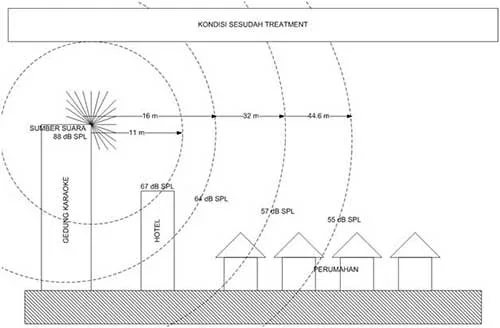
Projected results, estimated after these two measures were applied, showed a substantial improvement across every measured point:
Speaker: 120dB
Middle Hall: 110dB – 115dB
Kitchen (closed door): 58dB
Rear Hallway: 68dB
Left Hallway: 69dB
Front Parking Lot: 60dB
Hotel Parking Lot: 66dB
Zincalum Roofing (treated): 89dB
Concrete Roofing: 75dB
Ceiling below the Zincalum Roofing: 94dB
With these changes, the estimated noise-disturbance radius dropped from roughly 158 meters down to about 45 meters — a reduction of more than two-thirds, bringing the venue much closer to compliance with the 55dB regulatory target and significantly reducing the disturbance to neighboring residents and hotel guests.
Closing
This report reflects the corrective measures Alta Integra recommended for the specific conditions found on-site at My Way Karaoke. It remains a useful, real-world illustration of a broader principle in acoustic consulting: identify the actual leakage path through measurement first, then apply a targeted structural and material fix, rather than a generic noise-reduction package. The same measurement-led approach — identifying which surface, frequency range, and path are responsible for a leak before recommending a fix — continues to underpin how Alta Integra approaches karaoke, entertainment-venue, and mixed-use noise-control consultations today.
Frequently Asked Questions
What caused the noise leakage at My Way Karaoke?
Measurement identified the zincalum roof as the largest single leakage path, with sound energy concentrated at low frequencies that lightweight roofing does not block effectively.
What solution did Alta Integra recommend?
Replacing the zincalum roof with a concrete deck, combined with installing a high-mass sound insulation material (Acourete Mat Resin), to add the mass needed to reduce low-frequency transmission.
How much did the noise disturbance radius improve?
The estimated disturbance radius above the 55dB regulatory threshold dropped from about 158 meters to about 45 meters after the recommended treatment.
Why was 55dB the specific target for this project?
55dB was the compliance threshold under the relevant Indonesian government noise regulation applicable to this venue and its surrounding residential context.
Is this measurement-led approach still how Alta Integra handles noise-leakage cases?
Yes — identifying the specific leakage path and frequency range through on-site measurement, then recommending a targeted structural fix, remains the core method Alta Integra applies to entertainment-venue and karaoke noise-control consultations.
Related reading: Acoustic Design Consultation Services · How Acoustic Noise Parameters Are Measured · Green Building Advisory & Certification