Office Building HVAC Noise Control in Jakarta Barat
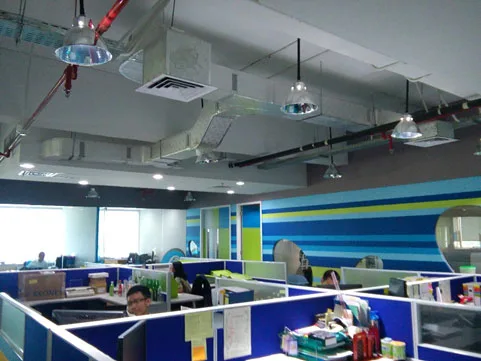
Alta Integra resolved an HVAC ducting and diffuser noise problem in a 394.842 sqm open-plan office in Jakarta Barat, where noise levels were exceeding the recommended standard for open-plan offices. The client, a joint-venture manufacturing equipment company, has been kept unnamed in this case at their request to keep the case study professional.
The Problem
The office used an open-plan layout without a ceiling, served by a semi-central HVAC system running on multiple compressor units and associated HVAC machinery. Workers in the space were disturbed by noise coming from the system's ducting and diffusers. Measurement confirmed the noise exceeded 55 dBA, the recommended noise threshold for open-plan office spaces — a benchmark used because sustained noise above this level measurably interferes with concentration, communication, and comfort in shared workspaces.
How Alta Integra Approached the Fix
Alta Integra was appointed to resolve the noise problem originating from the HVAC ducting and diffusers, following a structured process:
Measuring noise in the open-plan space to characterize the problem
Studying the HVAC system's design drawings for the building and room
Gathering acoustic data for every relevant HVAC component
Building an acoustic model and running a noise simulation
Validating the simulation against field measurements to confirm there was no discrepancy
Developing a solution design and running continuous simulation to verify it
Why Modeling and Simulation Matter for HVAC Noise
HVAC noise problems are rarely fixed correctly by trial and error, because ducting and diffuser noise depends on airflow velocity, duct geometry, and structural transmission paths that interact in ways that are difficult to predict without modeling. Validating a simulation against real field measurements before finalizing a design — as was done in this case — reduces the risk of a fix that looks correct on paper but underperforms once installed.
Frequently Asked Questions
What noise level is recommended for open-plan offices?
55 dBA is the recommended threshold used in this case, based on standards for open-plan office noise.
What caused the noise problem in this office?
Noise from the HVAC system's ducting and diffusers, driven by the design and placement of the air conditioning system relative to the open-plan, ceiling-less office layout.
How was the noise problem diagnosed?
Through field noise measurement, review of the HVAC system's design drawings, and acoustic data collection, followed by modeling and simulation validated against the field measurements.
Why wasn't the client's name disclosed?
The client requested confidentiality to keep the case study professional, so only the project type and location are described.
Related reading: Acoustic Engineering Design, Green Building Advisory & Certification, Thermal Energy Modeling.