Transmission Loss Improvement of Sound Insulation Panels with Viscoelastic Material in Periodic Configuration
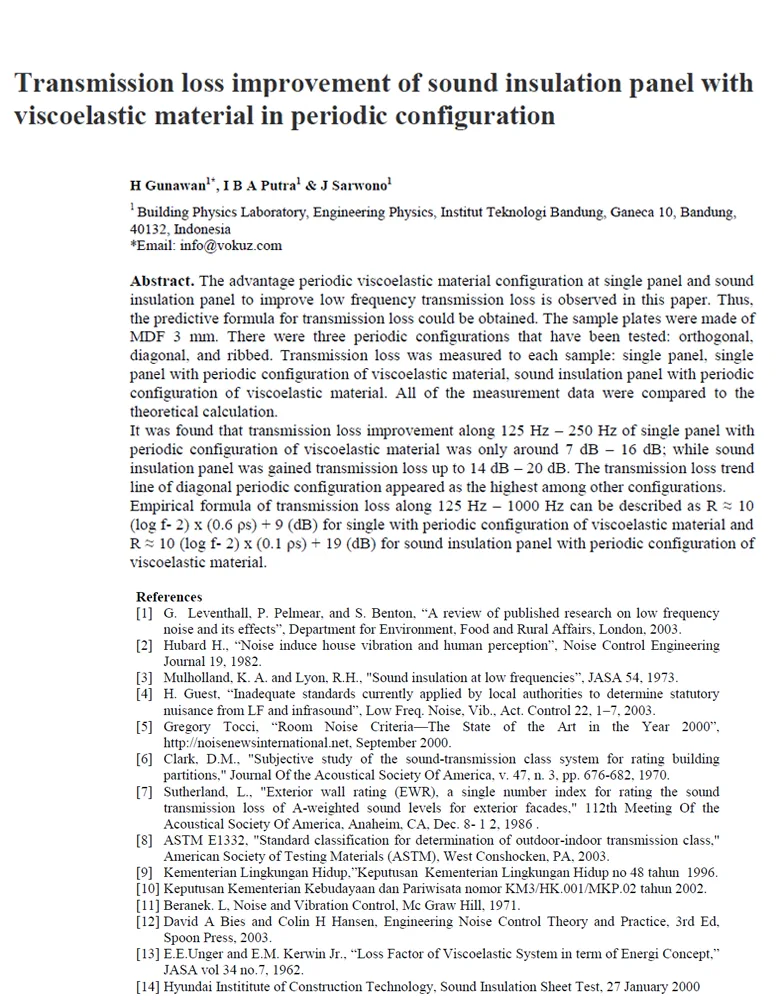
At RECAV 2017, Alta Integra submitted a research paper measuring how adding a viscoelastic material layer, arranged in a periodic configuration, improves the transmission loss of a sound insulation panel. The paper, titled "Transmission Loss Improvement of Sound Insulation Panel with Viscoelastic Material in Periodic Configuration," was authored by Herwin Gunawan, with I.B. Ardhana Putra and Joko Sarwono as co-authors.
About RECAV 2017
The Regional Conference on Acoustics and Vibration (RECAV) 2017 combines research paper publication with a hands-on workshop in the fields of acoustics and vibration. Alta Integra submitted two room-acoustics-related papers to RECAV 2017 for presentation: this transmission loss study, and a separate paper on splaying walls to modify acoustic mode distribution in small rooms.
What the Paper Studied
The research examined how a viscoelastic material — one that combines the properties of an elastic solid and a viscous fluid, able to absorb and dissipate vibration energy as heat — affects the transmission loss of a sound insulation panel when arranged in a periodic (repeating) configuration. Three material arrangements were tested: orthogonal, diagonal, and striped configurations.
Transmission loss was measured across three sample types: a single panel, a single panel fitted with viscoelastic material, and a sound insulation panel incorporating viscoelastic material. Measured results for each sample were then compared against theoretical calculations to validate the transmission loss prediction equation.
Key Findings
The calculations showed a clear difference in transmission loss between the sample types. In the 125–250 Hz frequency range, the single panel sample achieved transmission loss of 7 dB–16 dB, while the sound insulation panel (incorporating the viscoelastic material) achieved a notably higher 14 dB–20 dB over the same range — demonstrating that the viscoelastic layer measurably improves the panel's ability to block sound transmission at these frequencies.
Why This Research Still Matters
Presenting this paper at RECAV 2017 reflects Alta Integra's continued commitment to grounding its acoustic consulting work in tested research rather than convention alone. The transmission loss principles examined here continue to inform how the firm specifies sound insulation panels for partitions in studios, performance spaces, and other sound-isolation-critical environments.
Frequently Asked Questions
What is transmission loss in acoustics?
Transmission loss is a measure, typically expressed in decibels, of how effectively a partition or panel blocks sound from passing from one space to another. A higher transmission loss value means less sound gets through.
What is a viscoelastic material, and why use it in a sound insulation panel?
A viscoelastic material combines the properties of an elastic solid and a viscous fluid, allowing it to absorb and dissipate vibration energy as heat rather than simply transmitting it onward — which can raise a panel's transmission loss when arranged correctly.
What material configurations were tested in this study?
Three periodic configurations were tested: orthogonal, diagonal, and striped arrangements of the viscoelastic material within the panel.
How much did transmission loss improve in the study?
In the 125–250 Hz range, a single panel measured 7 dB–16 dB of transmission loss, while the sound insulation panel with viscoelastic material measured 14 dB–20 dB over the same range.
Who authored this paper?
Herwin Gunawan was the paper's first author, with I.B. Ardhana Putra and Joko Sarwono as co-authors, presented at RECAV 2017.
Related reading: ALTA Integra's Room Acoustics Research at RECAV 2017, Splaying Wall Acoustics Research at RECAV 2017, Noise Control Performance Indices and Ratings Explained.