Reverberation and Echo: How Sound Decays in a Room
Part of ALTA Integra's Acoustics 101 lesson series.
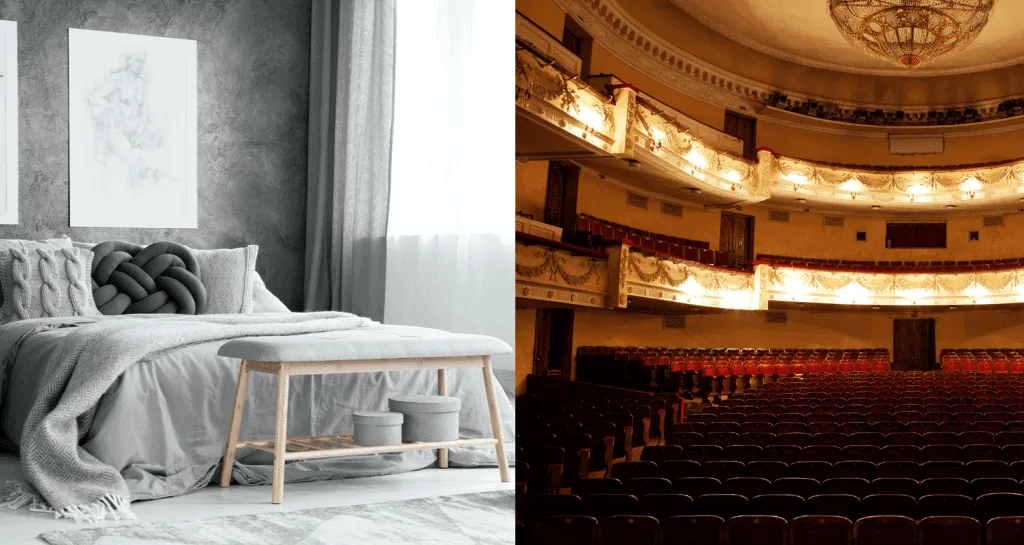
Reverberation is what makes sound in a large concert hall decay for seconds after it stops, while the same sound in a small bedroom dies out almost instantly. Both reverberation and echo come from the same underlying cause — reflected sound — but they are distinct phenomena with different design implications, and this lesson explains both.
What Reverberation Time Actually Measures
When sound is generated in an enclosed space with reflective surfaces, it bounces repeatedly before its energy fully dissipates, and this string of reflections is what we perceive as reverb. According to ISO 3382-1:2009, reverberation time is formally defined as the time required for sound in an enclosure to decrease by 60 decibels after the source stops emitting — commonly written as RT60. For example, if a 110 dB sound source in a room takes 5 seconds to decay to 50 dB, that room's reverberation time is 5 seconds.
The Sabine Equation: What Controls Reverberation Time
Reverberation time can be calculated using the Sabine equation, derived by Wallace C. Sabine, and it depends on three variables: the room's volume (V), the total absorption coefficient of its surfaces (α_tot), and its total surface area (S_tot). Larger rooms have a greater tendency toward longer reverberation, all else equal — which is intuitive, since a bigger volume gives sound more distance to travel between reflections.
Surface material matters just as much as room size. If every surface in a room is highly absorptive, sound energy is absorbed on each reflection and dissipates quickly, giving a short reverberation time. Since real rooms almost always combine multiple materials, the Sabine equation's total absorption coefficient accounts for every material's individual absorption coefficient weighted by its share of the room's total surface area.
Live Rooms and Dead Rooms
Acousticians commonly describe rooms along a spectrum from "live" to "dead," based on their reverberation time. A live room has a long reverberation time and suits unamplified music performance — an RT60 around 2.0 seconds is a typical example. A dead room has a short reverberation time, around 0.6 seconds, and is the kind of space you'd find in a recording studio, where absorptive materials are used deliberately to keep reflections to a minimum.
DIN 18041:2004 provides recommended reverberation time targets by room type and volume, which acousticians use as a design reference — though achieving a specific target in practice usually requires computer simulation rather than manual calculation, given how many variables interact.
The Longest Reverberation Time Ever Measured
Several historic buildings are known for unusually long reverberation times, including the Taj Mahal and Gol Gumbaz in India, Hamilton Mausoleum in Scotland, and Tombo Emmanuelle in Oslo, Norway — any sufficiently large cathedral can offer a taste of this experience firsthand.
The most extreme documented case, however, is Inchindown, a WWII-era oil storage tank in Scotland's Cromarty Firth that once supplied naval fuel and could hold 25.5 million liters across a space 240 meters long, 9 meters wide, and 13.5 meters high. UK acoustical engineer Trevor Cox, writing in *The Sound Book: The Science of the Sonic Wonders of the World*, documented using a gunshot as an impulse source inside the tank and measuring a reverberation time of 112 seconds at 125 Hz, 30 seconds at mid-frequencies, and an average of 75 seconds across all frequencies — the longest reverberation time ever recorded.
When Reverberation Becomes an Audible Echo
A distinct echo occurs when the human ear can clearly separate the original direct sound from its reflection — which requires the reflected sound to arrive with sufficient delay and magnitude. Human hearing generally starts to perceive a distinct echo at a delay of about 0.1 seconds or more.
Using the speed of sound in air at room temperature (roughly 343 m/s), that 0.1-second threshold works out to a travel distance of about 343 × 0.1 ≈ 34 meters. In practical terms, a room with parallel reflective surfaces at least 34 ÷ 2 = 17 meters apart may need a specific echo mitigation strategy, not just general reverberation control.
Controlling Echo Without Killing Reverberation
Applying a highly absorptive material is a reliable way to prevent echo, and it works well in shorter-reverberation spaces like auditoriums. But for a concert hall or another room that intentionally needs a long reverberation time, absorption alone isn't the right tool — a diffuser is typically used instead. A diffuser is an acoustic panel designed to scatter sound into many reflected directions across its working frequency range, breaking up any single strong reflection into a wash of smaller ones that blend into reverb rather than registering as a distinct echo. Balancing reverberation and echo control this way is a core part of the room acoustics design work ALTA Integra performs for concert halls, auditoriums, and performance venues.
Frequently Asked Questions
What is reverberation time (RT60)?
RT60 is the time required for sound in a room to decrease by 60 decibels after the source stops, as defined in ISO 3382-1:2009.
What determines a room's reverberation time?
The Sabine equation shows it depends on the room's volume, its total surface area, and the total absorption coefficient of its surfaces — larger, harder-surfaced rooms tend toward longer reverberation.
What's the difference between a "live" room and a "dead" room?
A live room has a long reverberation time (around 2.0 seconds is typical) and suits unamplified music. A dead room has a short reverberation time (around 0.6 seconds) and suits recording or speech-focused spaces.
How is an echo different from reverberation?
Reverberation is the general decay of sound through many overlapping reflections. An echo is a single reflection distinct enough — with roughly 0.1 seconds of delay or more — for the human ear to hear it as a separate repeat of the original sound.
How do you fix an echo without ruining a room's intended reverberation?
Absorptive material removes echo but also shortens reverberation, which works for short-RT spaces like auditoriums. For rooms that need to keep a long reverberation time, diffusers scatter the reflection into many smaller ones instead of removing it.
Suggested internal links: Noise Control Performance Indices & Ratings, Sound Pressure Level (SPL), Acoustic Design for Meeting Rooms, Offices, and Classrooms.