Noise Control Performance Indices and Ratings Explained
Part of ALTA Integra's Acoustics 101 lesson series.
Noise control in building acoustics covers several distinct strategies for bringing background noise down to a targeted noise criteria (NC) or dBA level, and each strategy is measured with its own performance index. This lesson walks through the core ratings — transmission loss, STC, OITC, IIC, and damping loss factor — so you know what each one actually measures and when it applies.
Airborne Noise Between Rooms: Transmission Loss and STC
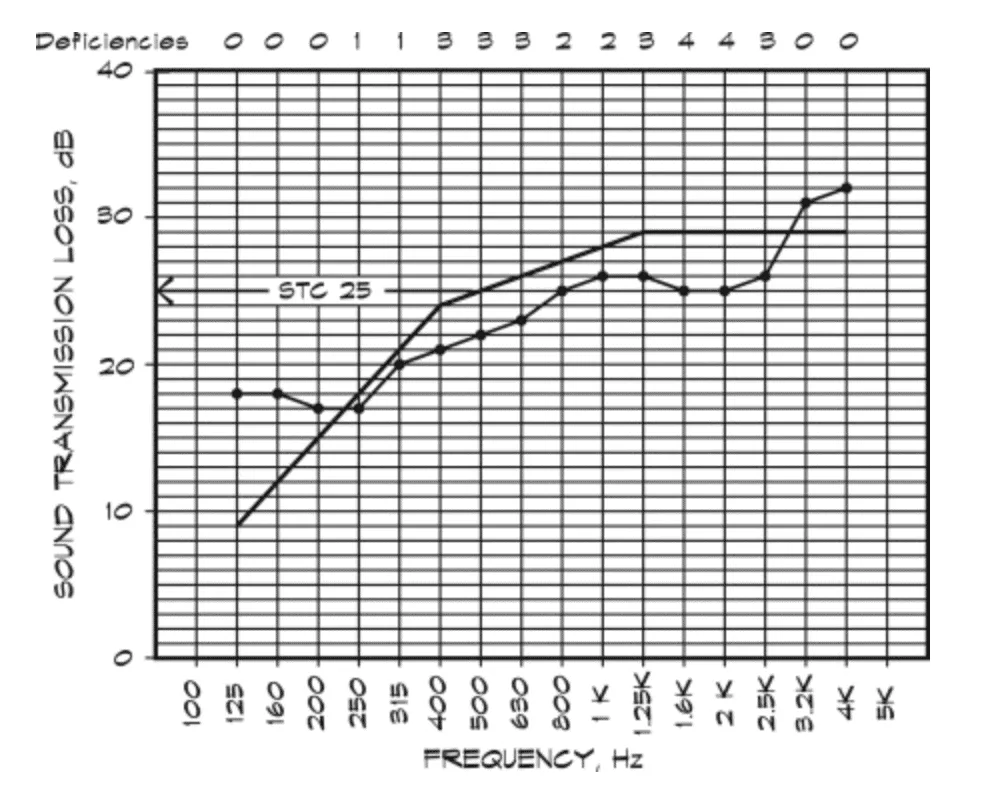
The airborne noise insulation performance of a vertical partition between two rooms is defined as the difference in sound pressure level between the source room and the receiver room — a value called sound transmission loss (TL). TL is measured in a laboratory according to ASTM E90, typically reported as 16 separate values across standard frequencies from 125 Hz to 4,000 Hz, per ASTM E413.
As a simple illustration: generate 100 dB of sound at 250 Hz in a source room, then measure 65 dB of that same sound in the adjacent receiver room. The transmission loss of the partition between them at 250 Hz is 100 dB − 65 dB = 25 dB.
Because comparing 16 separate frequency values is impractical for everyday specification, the sound transmission class (STC) condenses those laboratory-measured TL values into a single rating number, representing the overall airborne sound insulation performance of a partition. STC's main limitation is that it only accounts for the frequency range of human speech (125 Hz–4,000 Hz) — it doesn't reflect how well a partition handles low-frequency noise well below that range.
Once a partition is actually installed, its real-world performance is measured again and reported as field sound transmission class (FSTC). FSTC values usually come in lower than the laboratory-predicted STC, because on-site construction imperfections create sound leakage paths that a lab test doesn't capture.
Facade and Exterior Noise: OITC
For facades and facade elements — exterior walls, windows, and doors — the relevant rating is the outdoor-indoor transmission class (OITC). It was created specifically because exterior noise sources like traffic, aircraft, and railways skew toward lower frequencies than typical interior airborne noise such as human speech. OITC is calculated across a wider range, 80 Hz to 4,000 Hz, in one-third octave bands, per ASTM E1332-90.
STC remains the more commonly used rating for comparing general soundproofing performance, but when a project's dominant noise problem is low-frequency — a neighbor's bass-heavy music, or noise from low-flying aircraft — OITC is the more relevant rating to specify for exterior barriers.
Impact and Structure-Borne Noise: IIC
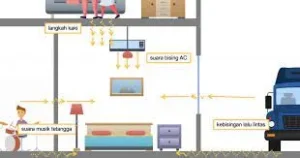
Not all airborne-sounding noise is actually airborne in origin. Footstep noise heard in a room below, for instance, is structure-borne: it starts as a physical impact on a floor and radiates as vibration through the building structure before becoming audible airborne sound in the room below.
The relevant index here is impact insulation class (IIC), defined under ASTM E989. It rates how well a floor-ceiling assembly resists transmitting impact noise — such as footsteps or an object dropped on the floor above — and is derived from sound attenuation measurements at 16 standard frequencies from 100 Hz to 3,150 Hz. A higher IIC number means better performance at blocking impact noise transmission.
Vibration and Damping Loss Factor
For structure-borne noise and vibration in solid materials more broadly, damping loss factor is the key measurement used in material testing. It is defined as the ratio between the energy a material dissipates per radian of vibration and the total energy associated with that vibration. The higher a material's loss factor, the more vibration energy it dissipates, and the better its damping performance — though loss factor is not a fixed material constant, since it varies with both vibration frequency and temperature.
Choosing the Right Index for the Job
The practical takeaway: match the index to the noise path. Use TL and STC for airborne noise between interior spaces, OITC for facades facing low-frequency exterior noise, IIC for impact noise through floor-ceiling assemblies, and damping loss factor when evaluating a material's ability to control structure-borne vibration. ALTA Integra's acoustic consultants apply this same index-to-noise-path matching when specifying insulation for client projects.
Frequently Asked Questions
What is the difference between TL and STC?
Transmission loss (TL) is the raw laboratory-measured value at each of 16 standard frequencies. STC condenses those 16 values into a single overall rating number for easier specification and comparison.
Why isn't STC enough for facades?
STC only reflects the speech-frequency range (125 Hz–4,000 Hz), while exterior noise sources like traffic and aircraft skew lower. OITC was created specifically to rate facade performance against that lower-frequency exterior noise.
Why is field-measured FSTC usually lower than lab-tested STC?
FSTC is measured after construction, where sound leakage paths from installation imperfections reduce real-world performance compared to the idealized conditions of a laboratory test.
What does IIC measure, and why is it different from STC?
IIC (impact insulation class) rates how well a floor-ceiling assembly blocks structure-borne impact noise like footsteps, as opposed to STC, which rates airborne noise transmission through a vertical partition.
What does a material's damping loss factor tell you?
It indicates how effectively a material dissipates vibration energy as heat rather than transmitting it further — a higher loss factor means better vibration damping performance, though the value changes with frequency and temperature.
Suggested internal links: Sound Pressure Level (SPL), Noise Criteria: A Background Noise Rating Standard, Reverberation and Echo.