Splaying Wall Acoustics Research at RECAV 2017
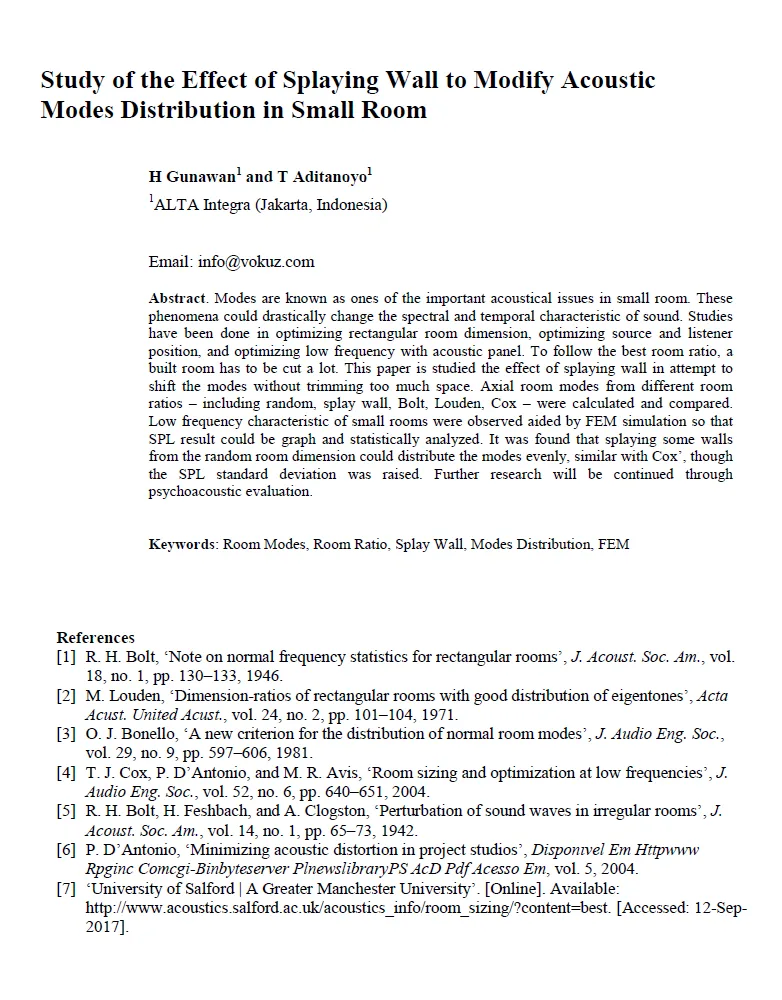
At RECAV 2017 in Bali, Alta Integra acoustic consultant Herwin Gunawan, together with co-author Teguh Aditanoyo, presented a paper studying how splaying — angling — a room's walls can modify the distribution of low-frequency acoustic modes in small rooms. The paper, titled "Study of the Effect of Splaying Wall to Modify Acoustic Modes Distribution in Small Room," was one of two room-mode and sound-insulation-related papers Alta Integra sent to the conference that year.
About RECAV 2017
The 2017 Regional Conference on Acoustics and Vibration (RECAV) combines research paper publications and workshops in acoustics and vibration. It was organized by the Indonesian Acoustics and Vibration Association with the Society of Acoustics Singapore (SAS), in collaboration with the Acoustical Society of America (ASA), the International Commission on Acoustics (ICA), Sepuluh Nopember Institute of Technology (ITS) and Bandung Institute of Technology (ITB). RECAV 2017 was held on 27–28 November 2017 in Denpasar, Bali, with speakers including Jeong Guon Ih (President Emeritus, Acoustical Society of Korea), Wong Siong Gan (President, Society of Acoustics Singapore) and Prof. Kazuya Takeda (Vice-President, Acoustical Society of Japan).
The Research: Modifying Acoustic Modes with Splayed Walls
Room modes are resonant low-frequency standing waves that build up between a room's parallel surfaces — one of the main reasons small rooms often sound uneven at bass frequencies, with some notes booming and others disappearing depending on where you sit. The paper tested whether splaying a wall (angling it away from parallel) could reduce this unevenness without needing extra floor space, comparing several room-ratio methods — a random-ratio method, the splayed-wall approach, and the Bolt, Louden and Cox methods — against each other.
Low-frequency sound characteristics in each configuration were analyzed using the Finite Element Method (FEM), a standard technique for modeling how sound pressure distributes through a space. The resulting sound pressure level (SPL) data identified which room-ratio method performed best for controlling modes in small rooms.
Why Room Modes Matter in Small-Room Acoustics
Room modes are largely unavoidable — what varies is how severe and audible they are. In small rooms, mode-related bass buildup and cancellation tend to be more pronounced, which is why room ratio and wall splaying are studied as design-stage solutions rather than after-the-fact fixes.
Alta Integra's Ongoing Acoustic Research
Presenting this research at RECAV 2017 reflects an ongoing commitment at Alta Integra to contribute to acoustics research publications and to keep its acoustic, lighting and thermal consulting practice grounded in current science rather than convention alone.
Frequently Asked Questions
What is a room mode in acoustics?
A room mode is a resonant standing wave that forms between a room's parallel surfaces, most noticeable at low (bass) frequencies, causing certain notes to sound louder or quieter depending on position in the room.
What is a splaying wall, and how does it help room acoustics?
A splaying wall is a wall angled away from parallel with the opposite surface. Angling walls this way was studied as a method to modify and potentially reduce uneven low-frequency mode distribution in small rooms.
Who authored this research?
The paper was authored by Herwin Gunawan, Alta Integra's acoustic consultant, with co-author Teguh Aditanoyo, and presented at RECAV 2017 in Bali.
What method was used to analyze the room modes?
The Finite Element Method (FEM) was used to model low-frequency sound characteristics, with sound pressure level (SPL) data compared across several room-ratio methods.
Related reading: Acoustic Engineering Design · Acoustics Hong Kong 2012 Conference · Karaoke Room Acoustic and Lighting Design