Professional Music Studio Design and Build
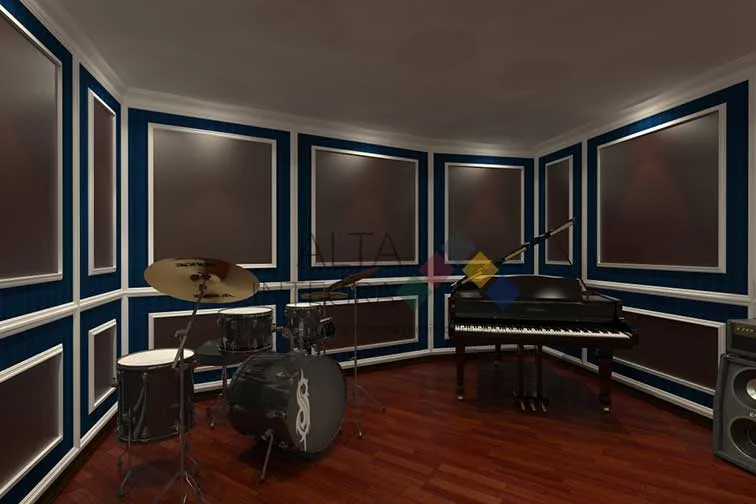
Professional music studio design and build, carried out by ALTA Integra as acoustic consultant, is the process of engineering a recording and production space — the studio area, control room, and supporting rooms — so that acoustics, lighting, and interior layout all support the same goal: capturing and shaping sound accurately, while keeping the people making it comfortable and creative for long sessions. A well-designed studio is one that gets out of the way of the music, not one that fights it.
The Two Core Spaces in a Music Studio
A professional music studio is generally organized around two connected but acoustically distinct spaces:
Studio area — where creating, arranging, practicing, and recording happen. Most studios need two different types of studio space: a live studio for full-band or ensemble recording, and an isolated booth for vocals or individual instruments that need acoustic separation.
Control room — where recording, editing, mixing, and mastering take place. Larger-capacity studios typically add dedicated editing and mastering rooms alongside the control room.
Every one of these rooms depends on high-quality acoustic design and a correctly proportioned room layout. Beyond acoustics, the right choice of decoration and furniture, together with correct lighting, measurably supports the creative process and productivity of the people working in the room.
Alta Integra's Music Studio Design and Build Method
Acoustics design — room ratio, positioning of instruments and monitor speakers, accurate acoustic calculation and panel treatment, and prediction of soundproofing needs.
Lighting design — intensity and color of lighting, choice of light source, and fixture positioning.
Interior design — theme, color, and furniture selected to harmonize with the acoustic treatment.
Digital Audio Workstation (DAW) design — monitor speaker and subwoofer position relative to the operator's listening position.
Music instrument design — equipment configuration, instrument placement, and monitor speaker placement.
Why This Integrated Approach Matters
A comprehensive design gives the room its maximum performance because it creates a harmonized interaction between the player, the instrument, and the studio itself. That translates into practical benefits: it saves the time and cost that typically arise from a faulty first design, and it optimizes room usage, aesthetics, comfort, and the overall enjoyment of playing and creating music in the space.
Key Acoustic Concepts Behind Studio Design
Two textbook concepts explain most of what separates a good studio from a bad one. Room ratio — the proportional relationship between a room's length, width, and height — determines how evenly low frequencies distribute in the space; a poor ratio produces standing waves that make bass response wildly uneven from one spot to another. Reverberation and reflection control, achieved through absorptive and diffusive panel treatment, determines whether a recording captures a clean, controllable signal or picks up unwanted room coloration that is difficult to remove later in the mix.
Materials and Treatment Choices in Studio Design
The materials used inside a studio — absorptive panels, bass traps in room corners, and diffusive surfaces on rear walls — determine how much of the acoustic calculation actually translates into real-world performance. A studio with the right room ratio but no treatment will still suffer from flutter echo and uneven bass response; a studio with excellent treatment but a poor room ratio will still have frequency response problems that treatment alone cannot fully correct. Getting both right together, rather than treating room dimensions and material treatment as separate decisions, is what allows a studio to perform consistently across the full frequency range that musicians and engineers rely on.
Frequently Asked Questions
What is the difference between a live studio and an isolated booth?
A live studio is designed for ensemble or full-band recording with some natural room ambience, while an isolated booth is acoustically isolated for individual instruments or vocals that need a cleaner, more controlled signal.
Why does a control room need separate acoustic design from the studio area?
The control room's monitoring accuracy depends on flat, predictable acoustics so that mixing decisions translate correctly to other playback systems — a different acoustic goal from the studio area, which is optimized for performance and capture.
Does lighting really matter in a recording studio?
Yes — lighting intensity and color affect the mood and focus of the people recording and mixing, which measurably affects creative output during long sessions.
What is a Digital Audio Workstation (DAW) design consideration?
It refers to positioning the monitor speakers, subwoofer, and operator's listening position correctly relative to the room's acoustics, so that what the engineer hears matches what is actually being recorded.
How much does room ratio affect studio sound quality?
Significantly — an unfavorable ratio of length to width to height creates uneven bass response throughout the room, which is one of the most common and expensive-to-fix problems in poorly designed studios.
Related reading: Acoustic Engineering Design, Audiovisual Media Technology Design, Lighting Engineering Design.