Green Building Certification Consultant (Greenship, EDGE, LEED)
A green building certification consultant helps a project team design, document, and manage a building so that it qualifies for a recognized green building certification — such as Greenship (GBCI), EDGE, BGH (Bangunan Gedung Hijau), or LEED — while also functioning as a genuinely healthier, more comfortable, and more energy-efficient building for its occupants. Alta Integra provides this consulting service under a philosophy the firm calls Smart-Green-Adaptive-Comfort: a building designed as one integrated system across acoustics, lighting, ventilation, and climate adaptability, rather than a certification checklist bolted on at the end.
What Green Building Certification Consulting Covers
Alta Integra's green building architecture service designs, renovates, and helps preserve buildings toward green building certification, serving houses, offices, hotels, schools, hospitals, warehouses, and industrial facilities. The consulting scope includes:
Green Building Architecture — strategy and concept design sessions
Green Building Architecture design development and computer energy modeling
Certification project administration
Integrated Project Management
Certification evaluation
Certification training
Which Certification Scheme Applies in Indonesia
Indonesian projects most commonly pursue one of four certification schemes, depending on building type, ownership, and market:
Greenship (GBCI) — Indonesia's own green building rating system, administered by the Green Building Council Indonesia.
EDGE — a resource-efficiency certification widely used for residential and commercial developments across emerging markets, including Indonesia.
BGH (Bangunan Gedung Hijau) — the Indonesian government's regulatory green building designation, distinct from but often pursued alongside voluntary certifications.
LEED — the internationally recognized U.S. Green Building Council system, still relevant for projects with international ownership, financing, or brand standards.
Alta Integra's certification consulting spans all four frameworks, since the right scheme for a project depends on its funding source, regulatory jurisdiction, and target market, not on a one-size-fits-all default.
Integrated Project Management: From Concept to Evaluation
Integrated Project Management is a service that ties design targets — function, productivity, environmental performance, aesthetics, and cost — together across the full project lifecycle, from concept creation through post-occupancy building function evaluation. Implemented well, it benefits investors, occupants, and the surrounding environment simultaneously: an environmentally responsible building that is also comfortable, safe, productive, and energy-conserving tends to perform better financially as well.
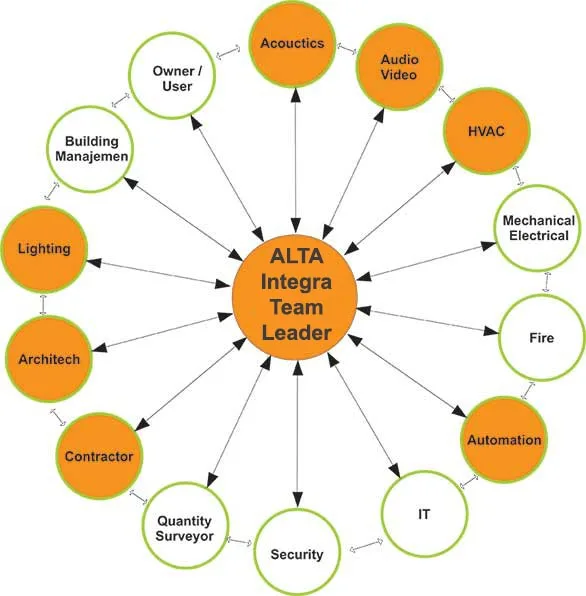
Alta Integra collaborates with a network of architects and technical specialists — covering acoustics, lighting, thermal performance, ventilation, electrical, audio-video, information technology, and automation — to deliver this integrated scope.
The Eight Targets Every Certification Project Has to Balance
A green building certification project is only successful if its targets are clearly defined from the concept stage and consistently evaluated through design development and execution:
Functional — the design concept and building function are derived from the business concept, marketing plan, and financial plan, and cover the building's theme, needs, technology, energy use, durability, safety, and comfort.
Productivity — comfort delivered through acoustics, lighting, and thermal design measurably improves occupant productivity by supporting both physiological and psychological wellbeing.
Energy Renewed — renewable energy elements and efficient air and energy cycles reduce a building's ongoing environmental footprint.
Beauty — the building's form, materials, and character are developed within the constraints of the Integrated Project Management approach.
Security and Safety — the design protects occupants and property against both natural threats such as earthquakes and floods, and human-caused threats such as fire and gas leaks.
Preservation — for projects involving historical buildings, preservation, rehabilitation, restoration, or reconstruction approaches are considered.
Accessibility — the building is designed to be usable by everyone, including children, the elderly, and people with disabilities.
Cost Efficient — costs are planned and controlled transparently from concept through construction, testing, and evaluation, balanced against the other seven targets rather than optimized in isolation.
Standards, Association, and Collaboration
Alta Integra applies measurement and consultation methods based on international standards working procedures, following ISO regulation, and holds membership in relevant international professional associations. Alta Integra collaborates with architects including Atelier Cosmas Gonzali, PDW Architect, and DHTDT Architect, and with contractors including Pembangunan Perumahan Persero (PP), Wijaya Karya (WIKA), Takenaka, and Total Bangun Persada, among others, and remains open to further project collaboration.
Frequently Asked Questions
What is the difference between Greenship, EDGE, BGH, and LEED?
Greenship (GBCI) is Indonesia's own voluntary rating system; BGH is the Indonesian government's regulatory green building designation; EDGE is a resource-efficiency certification common across emerging markets; and LEED is the internationally recognized U.S. Green Building Council system often used by internationally owned or financed projects.
What is Smart-Green-Adaptive-Comfort?
It is Alta Integra's design philosophy for integrating healthy, comfortable acoustics, lighting, and ventilation with a building's ability to adapt to climate change, conserve energy, and remain environmentally responsible.
At what stage should a certification consultant be brought in?
Ideally at the concept and strategy stage, since certification credits tied to energy modeling, daylighting, and ventilation design are far easier and cheaper to achieve when planned from the start rather than retrofitted later.
Does green building certification cost more than conventional design?
Certification adds upfront design and documentation effort, but Integrated Project Management is structured to balance that cost against long-term energy savings and reduced rework from a better-coordinated design.
What building types can pursue green building certification in Indonesia?
Houses, offices, hotels, schools, hospitals, warehouses, and industrial facilities can all pursue certification, with the appropriate scheme depending on building type, ownership, and regulatory jurisdiction.
Related reading: Thermal Energy Modeling, Bioclimatic Passive Design, Healthy Building Advisory & Certification.