Thermal Comfort in Indonesian Building Design
Thermal comfort is the condition in which a person's psychological, physiological and behavioral state allows them to feel comfortable carrying out an activity at a given temperature in a given environment. In theory, humans adapt to thermal change through three mechanisms: behavioral adaptation, physiological adaptation and psychological adaptation — and understanding all three is the starting point for designing buildings that actually feel comfortable in Indonesia's tropical climate.
How the Human Body Adapts to Heat
Behavioral adaptation shows up as a reflex response — for example, fanning oneself when a room feels hot and stuffy. Physiological adaptation is the body's automatic adjustment: if a hand is immersed in ice water for five minutes and then placed in room-temperature water, that water will feel warm by comparison, and vice versa. Psychological adaptation is different again — it is a shift in what a person perceives as a comfortable temperature, shaped by expectation and past experience rather than by the body's direct physical response.
Where Heat Comes From in a Building
Temperature increases in a room come from three broad sources. The first is natural heat, such as solar radiation and geothermal heat. The second is biological heat, generated by humans and animals occupying the space. The third is mechanical or electrical heat, produced by engines, lighting fixtures and other equipment. Heat moves from these sources into a room through three mechanisms: radiation (heat transfer through a light medium), convection (heat transfer through liquids and gases) and conduction (heat transfer through solid materials).
Key Factors That Affect Thermal Comfort
A person's thermal comfort is shaped by their metabolic rate, the clothing they are wearing, room temperature, room air humidity, and air velocity at the surface of the skin. Because these factors interact, thermal comfort research generally studies them together rather than in isolation — which is why organizations such as ASHRAE/ANSI have developed standardized models rather than single-factor guidelines.
Static Thermal Comfort Models: PMV and PPD
One research approach models thermal comfort as static, assuming that a room's ideal temperature should stay fixed regardless of outdoor climate changes across the seasons, and treating occupants as passive rather than adaptive. This approach is built on two indices developed by P.O. Fanger: Predicted Mean Vote (PMV) and Predicted Percentage Dissatisfied (PPD).
Static models are developed by surveying respondents in rooms with artificial, fixed climate conditions. Respondents rate their thermal sensation on a scale from -3 (cold) to +3 (hot), with 0 representing a neutral, comfortable sensation. Fanger's equations combine six parameters — indoor air temperature, mean radiant temperature, relative humidity, air velocity, metabolic rate and clothing insulation — to predict a group's average thermal comfort. The recommended PMV comfort zone falls between -0.5 and +0.5. Because PMV alone does not describe how satisfied respondents actually are, Fanger also developed PPD to quantify the expected percentage of dissatisfied occupants under a given set of conditions.
Adaptive Thermal Comfort Models
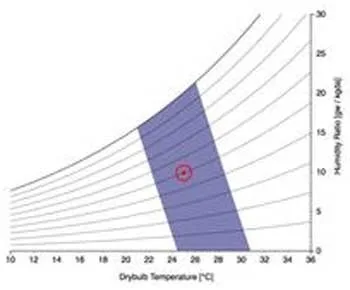
Adaptive models start from a different assumption: that outdoor thermal conditions influence indoor comfort, and that people actively interact with and adapt to their thermal environment — opening or closing windows, switching on cooling or heating, or changing what they wear. This research underpins the adaptive comfort model referenced in ASHRAE 55-2004 and 55-2010, which uses running average outdoor temperature (typically over a 30-day period) as an input, alongside occupant satisfaction data, to define an acceptable indoor temperature range. Adaptive models apply specifically to naturally ventilated buildings without mechanical cooling, generally covering outdoor temperatures from about 10°C to 33.5°C.
Analysis of a database of 160 field studies found that occupants in naturally ventilated buildings accept — and sometimes prefer — a wider range of thermal conditions than occupants in mechanically ventilated and cooled buildings. Research by de Dear and Brager reached a similar conclusion: people accustomed to naturally ventilated buildings tolerate larger temperature swings, due to a combination of psychological, physiological and behavioral self-adjustment. Adaptive models are also standardized internationally through the European EN 15251 and International ISO 7730 standards, though these differ from ASHRAE in one important respect — ASHRAE's adaptive model applies only to buildings without mechanical cooling, while EN 15251 also covers naturally ventilated buildings equipped with mechanical cooling systems.
Thermal Comfort Standards in Indonesia
Indonesia's own thermal comfort standardization is issued as SNI 03-6572-2001. Related guidance for air-conditioning and ventilation system design is set out in SNI 14-1993-03, which is generally referenced alongside comfort bands around 20.8–27.1°C effective temperature for Indonesian conditions. Both standards give Indonesian architects and HVAC engineers a local reference point, though — as researchers in the field have noted — much of the underlying comfort data was adapted from international standards rather than developed from dedicated Indonesian field research covering the country's climate, community characteristics and traditional architecture.
The Future of Thermal Comfort Design in Indonesia
Before designing a building, architects should treat thermal comfort as a core design objective rather than an afterthought. Static models such as PMV and PPD suit buildings with fully controlled, mechanically conditioned interiors. Adaptive models suit buildings — such as many office buildings — whose indoor temperature depends substantially on natural air circulation. The wider challenge for Indonesian architects, designers and HVAC consultants is building out standardization based on dedicated local research: Indonesia's own meteorological and geophysical data, thermal field measurements, behavioral patterns, expectations and traditional architectural practice, rather than standards adopted wholesale from other climates.
Frequently Asked Questions
What is thermal comfort in building design?
Thermal comfort is the condition where a person's psychological, physiological and behavioral state lets them feel comfortable at a given indoor temperature, humidity and air movement level.
What is the difference between static and adaptive thermal comfort models?
Static models (PMV/PPD) assume a fixed ideal indoor temperature regardless of outdoor climate; adaptive models assume occupants adjust their expectations and behavior based on outdoor conditions, and apply mainly to naturally ventilated buildings.
What Indonesian standard governs thermal comfort?
SNI 03-6572-2001 is Indonesia's thermal comfort standard, with SNI 14-1993-03 providing related ventilation and air-conditioning design guidance.
What factors most affect indoor thermal comfort?
Metabolic rate, clothing insulation, air temperature, humidity and air velocity are the core factors studied in both static and adaptive thermal comfort research.
How can architects apply thermal comfort principles in a tropical climate like Indonesia's?
By choosing the comfort model appropriate to the building type — static models for fully mechanically conditioned spaces, adaptive models for naturally ventilated ones — and designing orientation, openings and materials around Indonesia's outdoor temperature range from the outset.
Related reading: Bioclimatic Passive Design for Tropical Buildings · Daylighting & Thermal Comfort Design Strategy · Green Building Advisory & Certification