Room Acoustic Measurement for Sound Production
Sound production room acoustic measurement, conducted by ALTA Integra as acoustic consultant, is the process of testing a recording studio, stage, or hall for the physical acoustic conditions that shape how a performance is captured. It is normally carried out at two points in a project: right after the pre-design phase, as early baseline information for the design team, and again after construction, to confirm that the finished space matches the design intent and to catch any gap between the model and the field result.
Why Measurement Matters for Production Spaces
A production space — whether it is a scoring stage, a foley or dubbing studio, a live-music hall, or a multipurpose auditorium used for speech and presentations — depends on predictable acoustic behavior. If a hall used for speech, music playback, or a live show suffers from a lack of clarity, the cause is rarely obvious just from listening. Objective acoustic parameter measurement gives the design team the accuracy needed to diagnose the problem correctly, rather than guessing at treatments that may not address the real issue.
Reverberation Time as the Core Parameter
Reverberation time (RT) — how long sound persists in a room after the source stops — is the parameter most closely tied to how a space is used. Recommended reverberation time is not a single fixed number; it varies with room volume and with the intended use of the room:
Speech and presentation spaces need shorter, tightly controlled reverberation so that consonants and words stay intelligible.
Music performance spaces can tolerate and often benefit from longer reverberation, which adds warmth and blend to the sound.
Sound production rooms (recording, mixing, dubbing) generally need reverberation that is short and even across frequency, so the room does not add its own "color" to what is being captured.
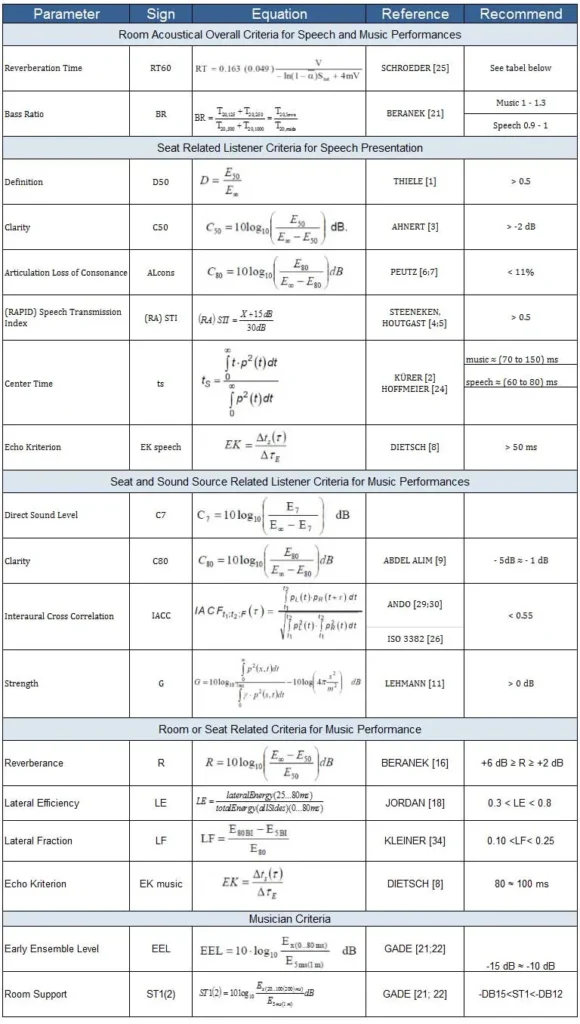
Room acoustics literature expresses this as a recommended mean reverberation time (RT) across the 500 Hz–1000 Hz range as a function of room volume, together with a frequency-dependent tolerance band above and below that recommended value — tighter for speech, somewhat wider for music. Measuring against these bands, rather than against a single arbitrary target, is what allows a measurement report to say precisely where a room falls short.
What a Measurement Report Should Cover
A useful acoustic measurement report for a production space typically documents:
1. Room volume and use case — because the recommended RT band is volume- and use-dependent, not universal.
2. Measured RT by frequency band, compared against the recommended range and its tolerance.
3. Clarity-related metrics where speech intelligibility is a concern, since reverberation alone does not fully explain a "muddy" or unclear room.
4. Field vs. design comparison, when the measurement is taken after construction, to confirm the built room performs as modeled.
From Measurement to Design Action
Measurement on its own does not fix a room — it tells the design team exactly which frequency ranges and which parts of the room are out of tolerance, so that acoustic treatment (absorption, diffusion, or geometry changes) can be targeted rather than applied by trial and error. This is the same logic that underpins acoustic consulting more broadly: measure first, then treat, then re-measure to confirm.
Common Measurement Equipment and Setup
Reverberation-time and impulse-response measurement in a production room typically involves a calibrated measurement microphone, an impulse or swept-sine test signal played through a reference loudspeaker, and analysis software that derives reverberation time, clarity, and related parameters from the captured response. Alta Integra's acoustic measurement work follows this same approach: measurement points are chosen to represent both the main listening or performing position and secondary positions around the room, since acoustic behavior is rarely uniform from one spot to another — a room can measure well at the center and poorly near a corner or wall, which is exactly the kind of detail a single-point measurement would miss.
Alta Integra applies this measurement methodology consistently across sound production, sound reproduction, and general architectural acoustics work, so that a room's acoustic parameters are always assessed against the same recognized reference values.
Frequently Asked Questions
What is sound production room acoustic measurement?
It is the on-site testing of a recording, mixing, dubbing, or performance space's acoustic behavior — most importantly reverberation time by frequency — to check it against recommended values for the room's intended use.
When should a production room be measured?
Ideally twice: once after the pre-design phase to establish an early baseline, and again after construction to confirm the built room matches the design intent.
Why does reverberation time need to match room volume?
Larger rooms naturally sustain sound differently than smaller ones, so the recommended reverberation time — and the acceptable tolerance around it — is expressed as a function of room volume rather than a single fixed number.
Is a longer reverberation time always a problem?
No. It depends on use: longer reverberation can suit music performance, while short, well-controlled reverberation is usually preferred for speech clarity and for production/monitoring rooms.
Can measurement alone fix an unclear-sounding room?
No — measurement diagnoses the problem by identifying which frequencies and parameters are out of tolerance; acoustic treatment based on those findings is what corrects it.
References
This overview draws on established room-acoustics measurement methodology, including reverberation-time analysis frameworks referenced in ISO 3382 (Measurement of the Reverberation Time of Rooms), and foundational work by researchers including L.L. Beranek, H. Kuttruff, W. Ahnert, and M. Barron on auditorium and studio acoustics.
Related reading: Measuring Room Acoustics for Sound Reproduction · Acoustic Design Consultation Services · Acoustic Engineering Design