Hotel and Apartment Design: Why Acoustics, Lighting and Thermal Performance Interact More Here Than Anywhere
Acoustic separation between guest rooms depends on structural and mechanical decisions. Split the disciplines and nobody owns the interface.

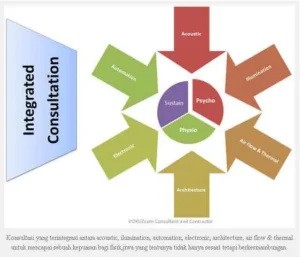
Hotel and apartment buildings, part of the wider hospitality industry, couple their engineering disciplines more tightly than most building types, and that is the practical reason a split consultant team underperforms on them. Acoustic separation between guest rooms depends partly on structural and mechanical decisions made by other disciplines. Lighting and daylighting choices affect both guest experience and thermal load. Ventilation strategy affects comfort and operating cost simultaneously. Assign each to a different consultant working in isolation and nobody owns the interfaces — which is where hospitality projects actually fail.
Hotel and Apartment Design: Five Disciplines and Their Interfaces
| Discipline | Depends on decisions owned by |
|---|---|
| Architectural acoustics | Structure (slab and partition build-up), mechanical (routing), interior (finishes) |
| Noise control | Mechanical (plant location and duct routing), structure (isolation details) |
| Lighting and daylighting | Facade design, interior scheme, thermal strategy |
| Thermal performance and ventilation | Facade, orientation, mechanical sizing |
| Green building certification | All of the above, plus documentation timing |
Read down the right-hand column: not one of these disciplines controls all the decisions its own performance depends on.
What a Hotel and Apartment Building Has to Deliver, and to Whom
A hotel or apartment serves three constituencies with different measures of success. For guests it is a place to rest, work, exercise and socialise. For the surrounding area it is an economic driver bringing retail and tourism activity. For owners it is a long-term asset that has to keep performing years after opening — which is the constituency whose interests are most often traded away at value engineering stage, because operating cost and guest satisfaction arrive after the capital budget closes.
Why Noise Control Carries Disproportionate Weight
Acoustic privacy between rooms and quiet mechanical systems sit close to the top of what determines guest satisfaction, and noise is among the most common sources of hospitality complaint. The reason is structural: a guest who cannot sleep has no workaround available. Every other comfort failure has one — a room too warm can be adjusted, a room too dark can have a lamp switched on — but a guest kept awake by the neighbouring room or the plant above has only the front desk and the review site.
That is why hotel acoustic work spans both room-to-room partition performance and mechanical noise, which travel by different paths and need separate treatment. ALTA Integra's hospitality acoustics work includes noise control at Untitled Club, JW Marriott Hotel Kuningan, Jakarta, and road noise measurement at Hotel Enso.
Thermal Comfort and Daylighting in a Tropical Hospitality Context
Guest comfort depends heavily on two factors easy to underestimate at design stage. Thermal performance work in Indonesia should reference SNI 03-6572-2001, which governs ventilation and air-conditioning system design and carries thermal comfort provisions set for Indonesian conditions, with the frequently quoted comfort band of roughly 20.5–27.1°C effective temperature originating in SK SNI T-14-1993-03 — an energy conservation procedure rather than a comfort standard. For envelope and system performance the current references are SNI 6389:2020 and SNI 6390:2020.
Designing HVAC, glazing and shading around a locally derived comfort band rather than importing temperate-climate assumptions keeps guest rooms and public areas comfortable with less mechanical dependence. Daylighting works alongside it — lobbies and rooms using natural light well cut daytime lighting load and improve guest experience, provided glare and solar gain are controlled at the same time, which is the trade-off covered in our article on daylighting and thermal comfort.
What Success Looks Like
A hospitality project succeeds when targets are defined at concept stage and evaluated consistently through design development and execution by a team that understands the interfaces. Functionality, productivity, energy performance, aesthetics, security, safety, accessibility and cost efficiency are interconnected goals, not a checklist to be satisfied one item at a time — because satisfying any one of them in isolation is generally done at the expense of another. ALTA Integra provides this coordination through its engineering design and green building practices.
FAQ
Which engineering disciplines does hotel and apartment design involve?
Architectural acoustics, noise control, lighting and daylighting, building thermal performance and ventilation, and green building design and certification. In hospitality these interact more tightly than in most building types, so the interfaces between them need an owner.
Why does noise control matter so much in hotels?
Because a guest who cannot sleep has no workaround. Every other comfort failure has one — a warm room can be adjusted, a dark room can have a lamp switched on — but noise from the neighbouring room or the plant above leaves only the front desk and the review site.
When should engineering consultants join a hospitality project?
From pre-design and concept, since decisions about massing, room layout and mechanical routing determine acoustic, lighting and thermal performance later. Those decisions are made by other disciplines, which is precisely why the engineering input has to be present when they are taken.
Does sustainable design cost more for hotels?
It adds upfront design effort and typically reduces long-term operating and rework cost, because problems caught at design stage are far cheaper than problems discovered after construction. The timing of the saving, not its existence, is what makes it a hard sell at capital budget stage.
Does this apply to residential apartments as well as hotels?
Yes. The same acoustic, lighting, thermal and green building disciplines apply, since both are multi-unit buildings serving rest, work and social functions — and both depend on acoustic separation between units that no single discipline fully controls.
These five disciplines are exactly what ALTA Integra coordinates on hotel & resort complex projects, where guest comfort and energy performance are specified together.