Consultant or Design-Builder: Which Risk Are You Least Willing to Carry?
One route buys cost certainty. The other buys design quality. Complexity decides which you can afford to trade.
Choosing between appointing an independent consultant through design-bid-build and hiring a design-builder directly comes down to a single question: which risk are you least willing to leave to chance (cost certainty, or design quality)? Both routes are legitimate, both are the wrong answer for some projects, and complexity is what decides between them.
This is written by an independent consultant, so read the balance accordingly. The case for design-build below is stated as honestly as we can make it.
The Two Routes Compared
| Design-bid-build (consultant first) | Design-and-build | |
|---|---|---|
| Structure | Consultant designs, then builders bid on constructing it | One party handles design and construction under one price |
| Cost visibility | Design fee and construction quote are separate line items | Single quoted price, with financial risk priced in |
| Best for | Complex or discipline-specific problems | Simpler problems where speed and certainty matter more |
| Timeline | Longer: design then tender then build | Shorter, no separate tender process |
| Changing course | Cheaper, design is not yet contracted to a price | Costly: the price was agreed against the original design |
Complexity is the deciding variable, and it does not track project size. A modest music studio can demand a comprehensive acoustic design. A large but straightforward building may not.
What Each Route Is
Design-bid-build, also called design-tender-construction, is the traditional sequence: appoint a consultant to complete the design, then invite builders to bid on constructing it. Because design and construction are procured separately, the design fee and the construction price stay distinct.
Design-and-build is the one-stop model: a single design-builder (commonly just called a contractor in Indonesia) handles both under one pre-agreed scope and price, and typically folds the financial risk of carrying both roles into the quote.
When a Specialist Consultant Makes More Sense
Building physics problems often demand a specific design response to a genuinely complex question. Designing a concert venue's acoustics is the clear case. Relying on a design-builder for a problem of that specificity rarely works out.
But complexity does not track scale. Even a modest music studio can require comprehensive acoustic design to reach usable sound quality, while plenty of simpler building physics problems are handled well by a design-builder alone.
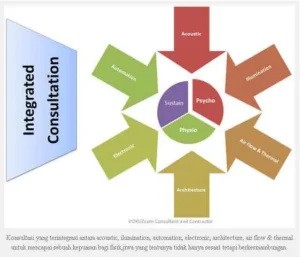
Five things distinguish the consultant route where complexity is real. Diagnosis : established framework and calibrated instruments identify the actual problem, where simpler observation with infrequently calibrated equipment can produce the wrong prognosis. Predictive analysis : modelling and simulation preview performance before committing, which a design-builder pricing a fixed proposal on a deadline is less inclined to invest in.
Cost control through accuracy : poorly planned designs produce outcomes that cost more to correct than the consultation would have cost, and design-bid-build preserves a genuine bidding process so you select the construction price after the design is settled. Broader parameters : ergonomics, environmental impact and aesthetics weighed alongside the technical brief. Brand independence : no manufacturer partnerships steering specification, plus an independent reviewer during construction to catch substitutions and defects.
When a Design-Builder Is the Better Choice
Three advantages are real and worth stating without qualification.
A single point of contact. On a smaller project (blocking noise from a neighbouring house, say), one contact and one communication line reduces the scope for miscommunication. That is a genuine risk on a small job.
A shorter timeline. Without a separate tender, the design-builder manages purchasing and construction directly. Smaller projects skip an extensive design phase entirely. Larger ones start from a conceptual design in the technical proposal, with detailed design running in parallel with procurement after signing.
Cost certainty. You see technical and commercial proposals before committing, and the price holds so long as work stays within the agreed scope. Note what this does and does not mean: design-builders price their financial risk in, and do not always run the depth of value engineering a consultant would, so certainty is not the same as cheapness. For less complex projects it is often both the lower-cost and lower-hassle route.
How to Decide
If the project is genuinely complex, appoint a consultant from the start, and if you are unsure how complex it is, ask both and compare what each proposes to do, or seek a third opinion from a building professional with no stake in the answer. If full budget control matters most, a design-builder may suit better, though not necessarily at a lower total.
If design quality and aesthetics are the priority, a consultant usually fits. If you cannot commit the time to oversee a longer design-and-tender process, design-and-build is a reasonable answer.
ALTA Integra works as an independent consultant across acoustics, noise control, lighting and passive design, the disciplines where complexity most often runs ahead of scale, through its engineering design practice. That includes saying when a project does not need one.
FAQ
What is the difference between design-bid-build and design-and-build?
In design-bid-build you appoint a consultant to complete the design, then bid construction separately. That keeps the two as distinct line items. In design-and-build one party handles both under a single quote, with the financial risk of carrying both roles priced in.
Is a consultant always more expensive?
Not necessarily. The consultation fee is typically a small share of total project cost, and design-bid-build preserves a genuine bidding process for construction. Design-builders price financial risk upfront, so a single quoted figure is not the same as a lower total.
When should I hire a design-builder instead?
For simpler, lower-complexity projects where a single point of contact, a shorter timeline and cost certainty matter more than an extensively engineered design. On a small job, having one communication line is a real and practical advantage.
Can a design-builder handle a complex acoustic or lighting project?
Generally not advisable. Highly specific problems such as concert venue acoustics require detailed modelling and analysis. But complexity does not track size. A modest music studio can need comprehensive design while a larger simple building may not.
Does hiring a consultant limit which products can be used?
The opposite, generally. Consultants aim to stay independent of manufacturer partnerships and can specify whatever meets the performance requirement, whereas design-builders may lean toward products tied to existing supplier relationships.