Listening Room Design: How a BAD Ceiling Combines Acoustics and RGB Lighting
One ceiling, two jobs. How a binary amplitude diffuser and programmable RGB lighting were designed as one element in a Jakarta listening room.
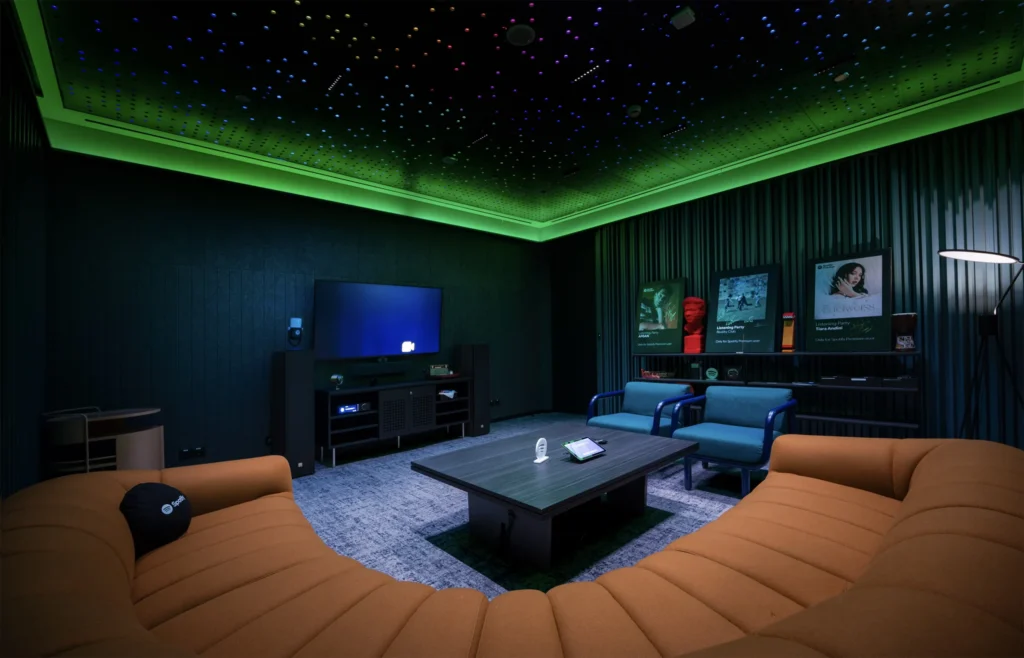
Listening room design for critical playback has to keep background noise low, hold stereo imaging steady, balance reverberation and control the bass. In a Jakarta office for a global audio streaming platform, ALTA Integra handled part of that brief through the ceiling. A custom Binary Amplitude Diffuser (BAD) ceiling absorbs and scatters sound, and the same surface carries programmable RGB lighting.
The room belongs to the Global Digital Entertainment Head Office in Jakarta, delivered in 2026, where ALTA Integra covered acoustic engineering and lighting design. This article explains what a critical listening room has to control, what a BAD ceiling does, and how lighting was designed into the same element.
What Listening Room Design Has to Control
A critical listening room is judged on four things: low background noise, accurate stereo imaging, balanced reverberation and controlled bass. Casual listening tolerates a weak score on any of them. Evaluating audio quality does not.
ALTA Integra designs listening rooms to two numbers. Background noise must stay at or below 25 dBA, and the reverberation time (RT60) must be 0.5 seconds or less.
| Design Target | Listening Room Value | What It Protects |
|---|---|---|
| Maximum background noise | 25 dBA | Quiet passages and low-level detail |
| Reverberation time (RT60) | 0.5 s or less | Clear transients and stable stereo imaging |
The two acoustic targets ALTA Integra works to in a listening room for critical listening.
What a Binary Amplitude Diffuser Ceiling Does
A Binary Amplitude Diffuser is a flat panel that absorbs part of the sound reaching it and scatters the rest. Its face is a pattern of reflective and absorptive patches laid out by a binary number sequence.
Peter D'Antonio patented the planar version for RPG Diffusor Systems in 1998. The patent describes a panel offering "both absorption and modest diffusion".
That combination suits listening room design in small rooms. Pure absorption on a large ceiling can make a room sound dead. A hard ceiling sends a strong early reflection straight back to the listening position, and that reflection blurs the stereo image.
A BAD surface sits between the two. The reflective patches break up the high-frequency reflection into many weaker ones, and the absorptive layer behind the openings takes energy out of the lower frequencies. Because the panel is flat, it does this without the depth a stepped diffuser needs, which matters in an office fit-out with a fixed ceiling height.
How Programmable RGB Lighting Shares the Same Ceiling
In this room, the BAD ceiling also carries the lighting. Point lights spread across the ceiling field and a continuous cove around the perimeter are both programmable RGB, so the room can shift colour and mood without any change to its acoustic surface.
Putting light into an acoustic surface raises coordination questions that a separate lighting layout never meets. Every light point takes up area that would otherwise be a reflective or absorptive patch. Drivers and dimming electronics can hum, and in a room held to 25 dBA that hum is audible.
Designing both at once is what avoids those conflicts.
Here the BAD ceiling was specially designed and integrated with the RGB lighting as one element. It contributes to acoustic control and it is also the main part of the room's visual character. ALTA Integra's acoustic consultant and lighting designer teams worked on the same element.
Why the Acoustic Treatment Became Part of the Architecture
Across the office, acoustic elements were treated as design elements and left in view. The question was simple. What if the parts that control sound could also be the parts people notice and remember?
The listening room is the clearest result of that approach to listening room design. Its ceiling is the most technical surface in the room and also the most visible one.
The project's wider brief followed the same line. Listening rooms and focus pods across the office were tuned so critical listening is available beyond one specialist room.
How Sound and Light Shape One Experience
Acoustic neutrality was essential, yet the room also had to feel cool, creative and contemporary. Dynamic lighting brings that atmosphere without touching the acoustic performance underneath it.
People do not experience a space one discipline at a time. They take in sound clarity, visual character, comfort and ambience together.
When acoustics and lighting share one surface, the room reads as a single designed space.
FAQ
What is a Binary Amplitude Diffuser?
A Binary Amplitude Diffuser is a flat acoustic panel that both absorbs and scatters sound. Its face carries reflective and absorptive patches arranged by a binary number sequence. The reflective patches spread high-frequency sound in many directions, and the absorptive backing reduces lower-frequency energy. Peter D'Antonio patented the planar version for RPG Diffusor Systems in 1998.
What reverberation time should a listening room have?
A listening room should have a reverberation time (RT60) of 0.5 seconds or less. That keeps reflections short enough for clear transients and a stable stereo image, so a listener can judge recordings accurately. ALTA Integra uses this as its reverberation target for listening rooms, and a BAD ceiling helps reach it without making the room sound dead.
How quiet should a listening room be?
Background noise in a listening room should stay at or below 25 dBA. The limit covers every steady source in the room, including air conditioning, equipment fans and lighting drivers. It is one reason lighting electronics need checking when lights are built into an acoustic ceiling.
Can lighting be built into an acoustic ceiling without hurting its performance?
Yes, if both are designed together from the start. Light points take up surface area that the acoustic pattern would otherwise use, and drivers or dimmers can add audible noise. Coordinating the acoustic layout, the light positions and the electronics in one ceiling design keeps the acoustic function intact while the lighting changes the mood of the room.
Who provides listening room design with integrated acoustics and lighting in Indonesia?
ALTA Integra provides acoustic engineering and lighting design for listening rooms, studios and workplaces across Indonesia. The listening room at the Global Digital Entertainment Head Office in Jakarta is one example. Its custom Binary Amplitude Diffuser ceiling carries programmable RGB lighting, so acoustics and light work as one design.
Sources
- ALTA Integra, Global Digital Entertainment Head Office project summary, Jakarta, 2026.
- ALTA Integra, "Sound. Light. One Experience.", Instagram project post, 17 September 2026.
- P. D'Antonio, "Planar binary amplitude diffusor", US Patent 5,817,992, RPG Diffusor Systems, granted 6 October 1998.