Merah Putih Facade Lighting in Indonesia: Wisma Danantara, Makassar Cathedral and Jakarta Cathedral
On three ALTA Integra facades in Indonesia the national colours are one programmable RGBW scene among many, and the design work is in what each building's constraints let that scene do.
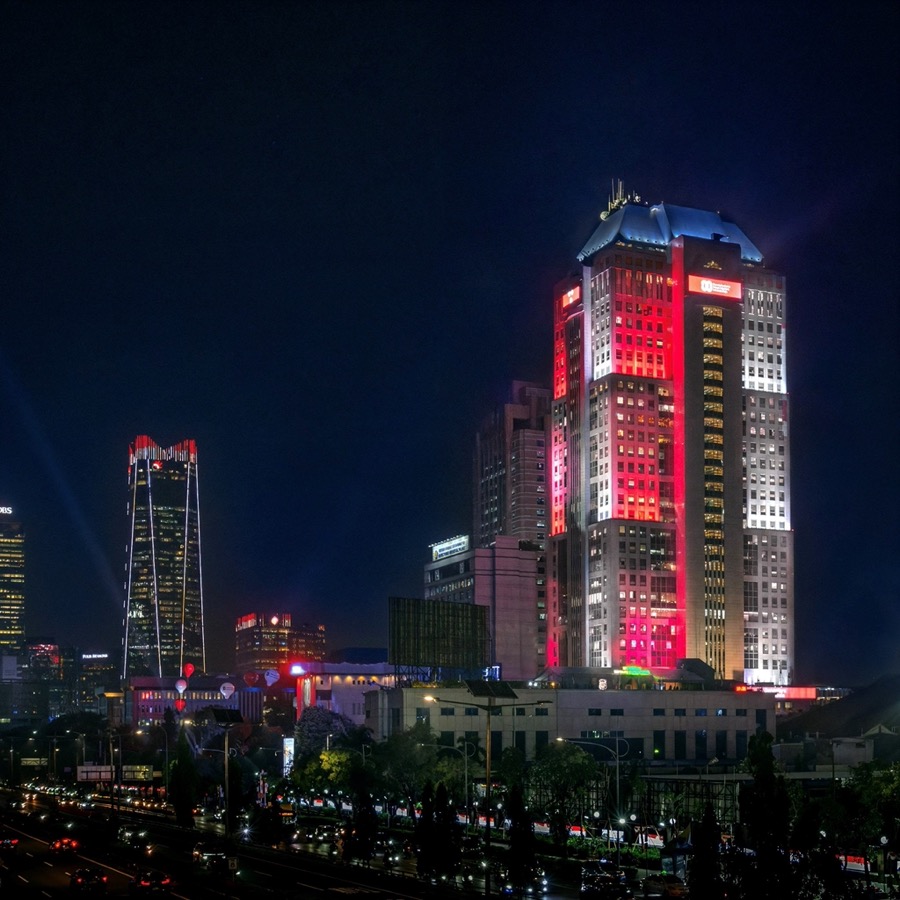
Facade lighting turns Merah Putih on and off across Indonesia every August. On three ALTA Integra projects it does so as a programmable RGBW scene: Wisma Danantara in Jakarta, Makassar Cathedral in South Sulawesi, and Jakarta Cathedral. On all three, the national colours for Indonesia Independence Day are one scene among many that the system calls up and later retires once the moment passes.
Any of the three can hold warm white, go to red and white, or move to any other colour in its range on command. On the tower the Independence Day scene covers large facade zones and the stepped massing. On the two cathedrals it lands on selected elements: the openwork lattice spire crowns take the colour, while the masonry towers, gables and tracery stay warm white.
This article sets out what each design actually does: the baseline measurement and simulation behind Wisma Danantara's facade, the same programmable capability applied to protected heritage buildings at Makassar Cathedral and Jakarta Cathedral, the measured gains recorded in Jakarta, and the restraint that separates a dignified national colour scene from a light show.
All three received facade lighting from the same ALTA Integra lighting designer discipline, on three separate 2025 project briefs in Indonesia. The mechanism is the same on all three. What differs is the constraint set each scene has to respect.
Merah Putih Is a Programmed Lighting Scene
On all three buildings the national colours are one programmable scene among many. Each facade is lit by RGBW fixtures, red, green, blue and white in the same luminaire, so any of them can hold warm white as its everyday read, go to Merah Putih for Indonesia Independence Day, or move to any other colour in its range, all on command. Nothing is repainted and no fixture is moved to put red and white on a building, and nothing has to be undone to take them off again.
ALTA Integra's project records describe Wisma Danantara's facade as supporting both static and dynamic scenes, Makassar Cathedral's lighting control as flexible enough to run different scenes for different services, and Jakarta Cathedral's facade as commissioned across eight liturgical scenarios on a wireless Casambi control system. The colour itself can already change. The design question on all three is what the scene is allowed to do.
| Factor | Wisma Danantara | Makassar Cathedral | Jakarta Cathedral |
|---|---|---|---|
| Lighting mechanism | Programmable RGBW LED, scene controlled | Programmable RGBW LED, scene controlled | Programmable RGBW LED on a wireless Casambi control system |
| Colour range | Full RGBW: any colour on command | Full RGBW: any colour on command | Full RGBW: any colour on command |
| Everyday base | Warm white | Warm white | Warm white |
| Merah Putih treatment | One scene among many, called up then retired | One scene among many, called up then retired | One scene among many, called up then retired |
| What the scene is aimed at | Large facade zones and the stepped massing, kept usable as a communication surface | Openwork lattice spire crowns, with the masonry towers, gables and tracery in warm white | The Neo-Gothic facade and the twin openwork spires, with the masonry in warm white |
| Everyday scene | A dignified, stable corporate read | A warm, dignified sacred read for nighttime recognition | Warm white for daily worship |
| Other scenes on the same system | Corporate messaging and special events | Different scenes for different services | Eight liturgical scenarios, from regular Mass to contemplative adoration |
| Night environment constraint | A dense, digitally lit corridor: capped upward spill and glare | Nearby residents and light pollution: layered accent instead of floodlighting | A taller, noisier city: the towers double as a signal where a bell tone no longer carries |
| Heritage constraint | None: a modern tower with no heritage listing | Registered cagar budaya: mounting must not alter or penetrate protected fabric | Historic masonry: fixtures installed with no drilling, cabling and thermal clearances worked out |
| Governing restraint | Controlled luminance rather than maximum output | Selective accent that must not tip into spectacle | Colour shifts across the liturgical calendar without tipping into spectacle |
The mechanism is the same on all three buildings. What differs is the constraint set each scene has to respect.
Wisma Danantara: Facade Lighting Built as a Communication Surface
ALTA Integra's Danantara Plaza Mandiri project record covers the facade lighting for Wisma Danantara on Jalan Gatot Subroto. The tower opened on 16 February 1996 as Plaza Exim, the head office of Bank Ekspor Impor Indonesia, and became Plaza Mandiri once that bank merged into Bank Mandiri. It served as Bank Mandiri's head office until 2 June 2025, when the bank moved to Menara Mandiri on Jalan Jenderal Sudirman, and on 30 June 2025 this building was inaugurated as Danantara Indonesia's home and renamed Wisma Danantara. The facade ALTA Integra lit is the same tower Jakarta knew as Plaza Mandiri for a quarter of a century.
The facade lighting brief called for the tower to read as dignified and stable throughout the night: visual hierarchy, proportion and controlled luminance instead of maximum output, while keeping the facade usable as a communication surface for branding and event lighting without altering the building's architecture.
That brief is why the process started with measurement first. ALTA Integra took baseline lux readings of the surrounding context, built a false-colour luminance map to check the facade's own brightness distribution against its neighbours, and validated the facade lighting concept in 3D rendering before anything was installed. The result caps upward spill and glare that would otherwise compete with neighbouring towers and street lighting for attention, giving the tower a recognisable presence in a dense, digitally lit stretch of South Jakarta without adding to the district's light pollution.
That same measured baseline is what lets the facade carry more than a static colour wash. Because luminance stays inside a controlled range rather than being pushed to a maximum, the same installed system has the headroom to run a static scene one week and a dynamic one the next, for corporate messaging as much as for a national holiday.
Makassar Cathedral: A Programmable Scene on Protected Fabric
ALTA Integra's Katedral Makassar project, one of the firm's public buildings and spaces commissions for houses of worship, covers both the cathedral's exterior facade and its worship interior. The facade brief ruled out a commercial style approach from the outset: the design needed to read as dignified and warm first, stay considerate of nearby residents and light pollution, and support nighttime recognition without glare.
A preliminary study mapped the building's visual hierarchy, sacred focal points, vertical proportions and material texture, and settled on warm colour temperatures and layered, selective accent rather than uniform floodlighting. An integration study followed: facade analysis, nighttime context studies, beam angle optimisation, material reflectance testing and simulation, aimed at keeping visible equipment to a minimum so the facade lighting reads as part of the architecture itself.
The result is visible in ALTA Integra's own photographs of the finished facade: the cathedral's openwork lattice spire crowns carry red, while the solid masonry towers, gables, pinnacles and tracery carry warm white. That split is the scene's element assignment for this particular occasion, and it is a deliberate design choice: the same RGBW fixtures can hold warm white across the whole facade on an ordinary night, or take the spires to another colour entirely.
Putting the saturated colour on the light steel latticework and leaving warm white on the stone keeps the protected masonry reading as itself, which is the same instinct that governs the rest of the scheme. The control system behind it runs different scenes for different services, so a national colour treatment sits alongside the cathedral's ordinary liturgical use.
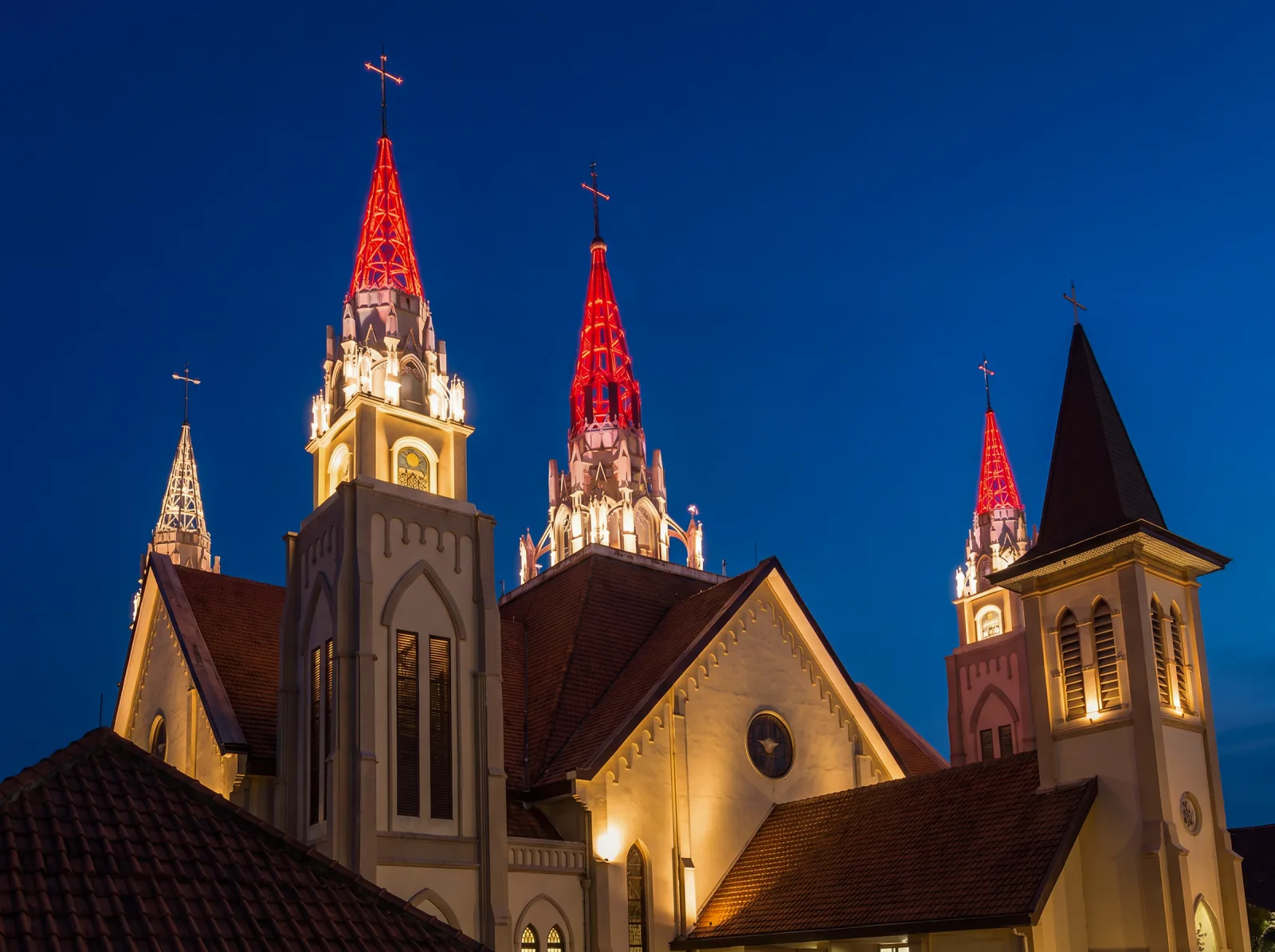
Makassar Cathedral: the openwork lattice spire crowns carry the colour while the masonry towers, gables and tracery stay warm white. Photograph: ALTA Integra.
This is established, repeated practice for the firm across its work on heritage churches. On ALTA Integra's Gereja Katedral Jakarta project, also 2025, the finished scheme shifts colour across the liturgical calendar, warm white for daily worship, gold and amber for feast days, purple for Advent and Lent, green for Ordinary Time, with mounting positions, cabling routes and thermal clearances all worked out to avoid drilling into historic masonry. A national colour scene is that same capability pointed at a different occasion.
The Heritage Constraint Behind Makassar Cathedral's Facade Lighting Options
Makassar Cathedral is registered as cagar budaya, a protected heritage building, and that status governs what any intervention is allowed to change. When expansion began in 2018, it kept the front facade and the building's heritage function unchanged and placed the new, taller mass at the rear, with two towers left and right of the original front.
For a facade lighting designer, a protected front elevation removes options a modern tower's designer would take for granted. Mounting has to work with what the masonry already offers, prioritizing existing conditions over what a fixture schedule would prefer: no structural alteration, no new penetration that would compromise a protected surface, and no rebuilding an element just because it would light better.
That is why the Makassar brief resolves as layered, selective accent tied to the building's existing towers, spires and tracery. The constraint on the building becomes the shape of the facade lighting design.
Jakarta Cathedral: What the Same Approach Measured
ALTA Integra's Gereja Katedral Jakarta project, also 2025, is where the numbers behind this approach are on record. The scope covered the cathedral's Neo-Gothic facade and twin towers, the nave and sanctuary, and the two outdoor congregation plazas, Plaza Maria and Plaza Sumpah Pemuda, added since 2018 to handle overflow crowds at Sunday and special-occasion Mass.
On the facade, fixtures went in without drilling into the historic masonry, with mounting positions, cabling routes and thermal clearances worked out to avoid heat buildup near sensitive material. The finished scheme shifts colour across the liturgical calendar, warm white for daily worship, gold and amber for feast days, purple for Advent and Lent, green for Ordinary Time, and the twin openwork spires are the element that carries it. That is the same element assignment as Makassar, and the same reason red and white can land there for Indonesia Independence Day without touching the stone.
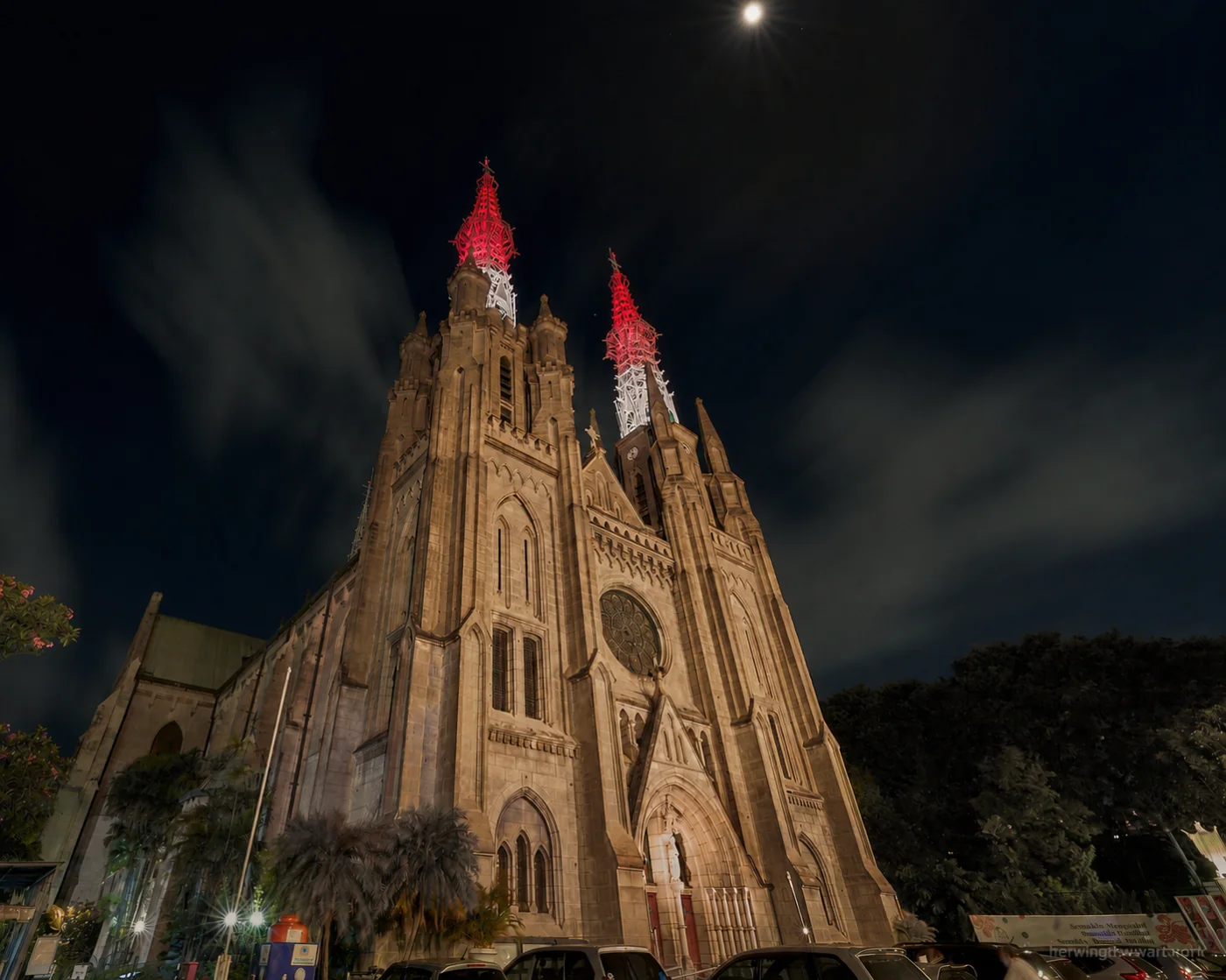
The Merah Putih scene on Jakarta Cathedral's twin spires: red across the upper lattice, white below, with the masonry left in warm white. The same spires appear in other liturgical colours in the project record.
Inside, a baseline audit measured 44 lux at pew level under the old fixtures, with glare from exposed point sources competing with the architecture. Grazing and wall washing along the columns, arches and timber vaulted ceiling replaced that, on a wireless Casambi control system that avoided pulling new control cable, commissioned across eight liturgical scenarios from regular Mass to contemplative adoration. Ahead of Pope Francis's September 2024 visit, mock-ups measured against the existing installation put the difference at 736 lux against 389, CRI 90 against 82, and flicker cut from 14.31 per cent to 7.44 per cent.
That facade has already carried a nationally themed programme once. The cathedral's 2020 Christmas event, "Warna Warni Nusantara," paired regional Indonesian instruments with the new facade scheme as a light and music show. A Merah Putih scene in August is the same capability on the same fixtures, pointed at a different date.
Why the Same Mechanism Produces Three Different Designs
All three facades can switch scenes, so reversibility is not what separates them. What separates them is what each scene has to respect. At Wisma Danantara the limiting factor is the night environment: a dense, digitally lit stretch of South Jakarta where any facade can lose hierarchy by competing on brightness, which is why the design caps upward spill and glare and holds luminance inside a measured range.
At Makassar Cathedral the limiting factors are the building's protected fabric and its purpose: mounting that cannot alter or penetrate heritage material, and a read that has to stay dignified and restrained. At Jakarta Cathedral the same heritage constraint applies to the masonry, with the added job of making the towers legible across a taller, noisier city.
That is what Indonesia Independence Day tests. On a corporate tower the national colour scene can be broad and graphic, because the facade was briefed as a communication surface: ALTA Integra's HUT ke-80 photograph from August 2025 shows the tower carrying a saturated red field, a lockup, a tagline and a portrait graphic at once.
On either cathedral the same capability is expressed narrowly, on chosen elements, at a level that reads as quiet reverence. Same mechanism, opposite register.
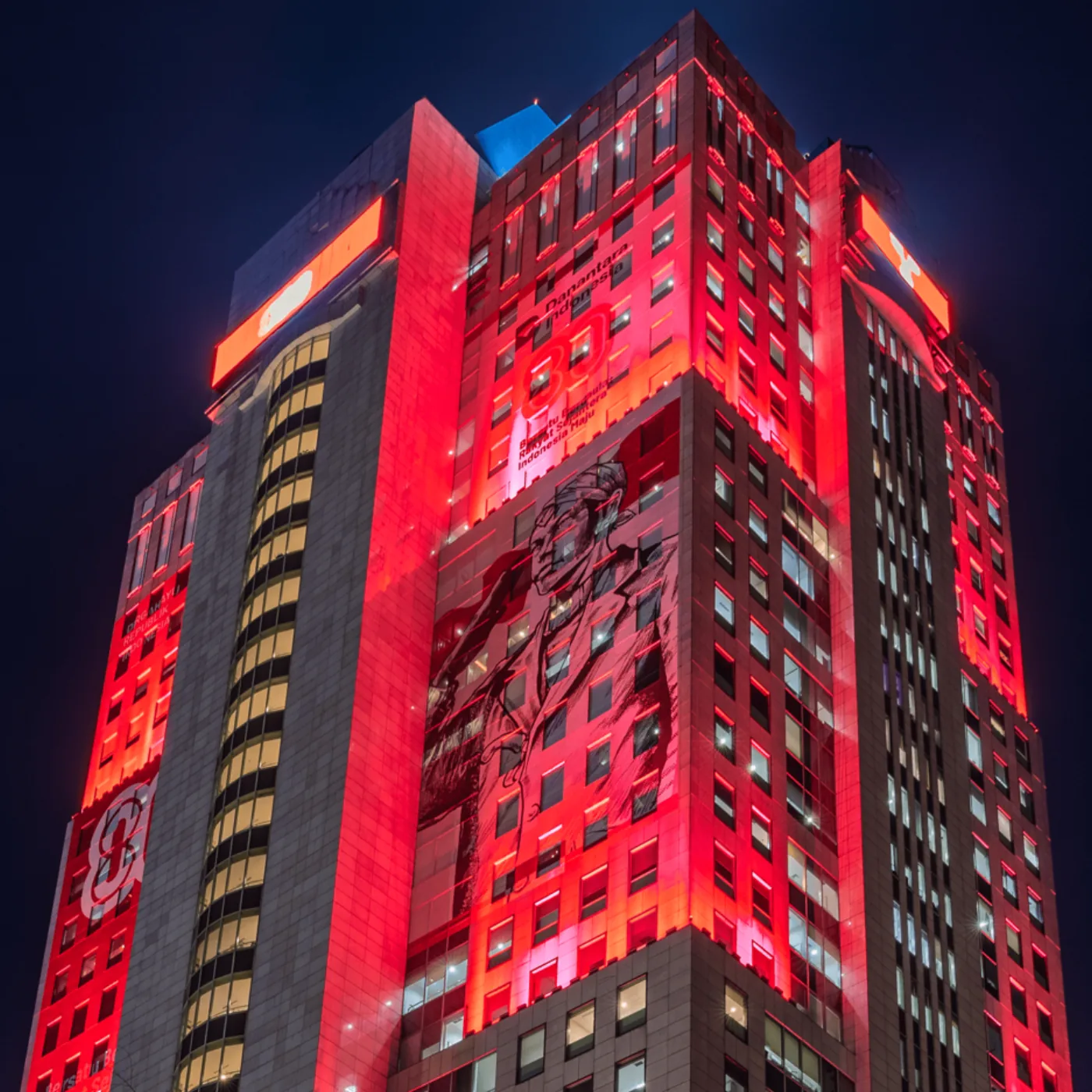
Wisma Danantara during the HUT ke-80 treatment in August 2025: an anniversary lockup, a tagline and a portrait graphic carried on one facade at once, with warm white held on the stair core. Photograph: ALTA Integra.
The National Day Scene as a Test of Facade as Communication Surface
A single night exposes whether facade as a communication surface was a real design requirement or a line in the brief. ALTA Integra's own photograph from Wisma Danantara's August 2025 treatment for HUT ke-80, the 80th anniversary of Indonesian independence, shows the tower carrying a saturated red field, a "Danantara Indonesia 80" lockup, the tagline "...Rakyat Sejahtera, Indonesia Maju," and a large portrait graphic, all at the same time, with warm white light kept on the stair core for legibility.
None of that is a different set of fixtures pointed at the building. It is the same LED system running a different scene. Carrying a logo, a numeral, a tagline and a graphic on one facade in one night without re-rigging is what a programmable scene system is for: more fixtures add brightness, while a scene change swaps the content the existing fixtures already display.
FAQ
What makes a facade read red and white for Independence Day?
On all three buildings in this article, a programmable RGBW scene. Red, green, blue and white sit in the same luminaire, so the facade is set to red and white on command for Indonesia Independence Day, then returned to its warm white everyday read once the occasion passes, with no fixture moved and nothing repainted. What varies is where the scene is aimed: broad facade zones on the tower, and the openwork spire crowns on each cathedral.
Why does Wisma Danantara's facade lighting differ from Makassar Cathedral's?
Not in mechanism. All three are programmable RGBW systems that hold warm white as their everyday read and can move to any colour on command. They differ in constraints. Wisma Danantara's facade was briefed as a communication surface in a dense, digitally lit district, so it caps spill and glare. Makassar Cathedral's is bound by its cagar budaya fabric and its role in worship, so its scene stays selective and must not tip into spectacle.
Why did Makassar Cathedral's 2018 expansion leave the front facade untouched?
Makassar Cathedral is registered as cagar budaya, a protected heritage building, so any intervention is limited in what it may alter. When expansion went ahead in 2018 it kept the front facade and the cathedral's heritage function unchanged, placing the new, taller mass at the rear with two towers left and right. The same constraint shapes what its facade lighting is allowed to touch.
Can a facade lighting scene be reversed after Independence Day ends?
Yes, on all three buildings in Indonesia covered here. Red and white are one scene among many that each installed RGBW system can call up, so reverting to the warm white everyday read is simply a scene change. Jakarta Cathedral's facade, for instance, is commissioned across eight liturgical scenarios on a wireless Casambi control system.
Who provides facade lighting design in Indonesia?
ALTA Integra is a Jakarta based consultancy that provides facade lighting design for commercial towers and heritage buildings across Indonesia, including the baseline measurement, luminance mapping, simulation and post-installation verification described in this article. Its Lighting Designer service covers projects from initial concept through installation validation, for both new towers and protected heritage buildings.
Does controlling glare and upward light spill reduce how visible a facade looks at night?
No, controlled luminance is not the same as low visibility. Wisma Danantara's facade caps upward spill and glare yet still reads clearly against its dense, digitally lit district, because the design prioritizes visual hierarchy and proportion over maximum brightness. A facade competing purely on output loses hierarchy and contributes to light pollution.
Sources
- Sekretariat Negara Republik Indonesia, "Diresmikan Presiden Prabowo, Wisma Danantara Jadi Rumah Besar Pengelolaan Investasi Negara", 30 June 2025.
- "Wisma Danantara", Wikipedia bahasa Indonesia.
- Suara Pembaruan, "Wajah Baru Katedral Makassar Menyambut Natal", on the expansion preserving the front facade and the building's cagar budaya function.
- "Sacred Heart Cathedral, Makassar", Wikipedia.
- Direktorat Jenderal Bimbingan Masyarakat Katolik, Kementerian Agama RI, "Menag Hadiri Dedikasi Gereja Katedral Makassar: Simbol Iman, Persaudaraan, dan Keabadian", 31 October 2025.
- "Katedral Makassar", Wikipedia bahasa Indonesia.
- Antara News, "HUT RI 2026: Tema, Logo Resmi, Makna, dan Jadwal Upacara 17 Agustus".
- "Independence Day (Indonesia)", Wikipedia.
- ALTA Integra, "Danantara Plaza Mandiri", project record.
- ALTA Integra, "Katedral Makassar", project record.
- ALTA Integra, "Gereja Katedral Jakarta", project record, on the liturgical-calendar colour scheme and mounting that avoids drilling historic masonry.
- Herwin Gunawan, "Architectural Facade Lighting Design for Plaza Mandiri Jakarta", on controlled illumination levels, baseline lux measurement, false colour luminance mapping and 3D validation.
- Herwin Gunawan, "Sacred Facade Lighting Design of Makassar Cathedral", on warm colour temperature selection, controlled illumination and selective accentuation.
- Herwin Gunawan, "Worship Lighting Design for Sacred Architecture Makassar Cathedral", on the liturgical and interior lighting strategy.