How to Use the RT60 Calculator: A Step by Step Guide
A field by field walkthrough of the RT60 calculator: what to prepare beforehand, how to fill in dimensions, materials and target use, and how to read the Sabine and Eyring results once generated.
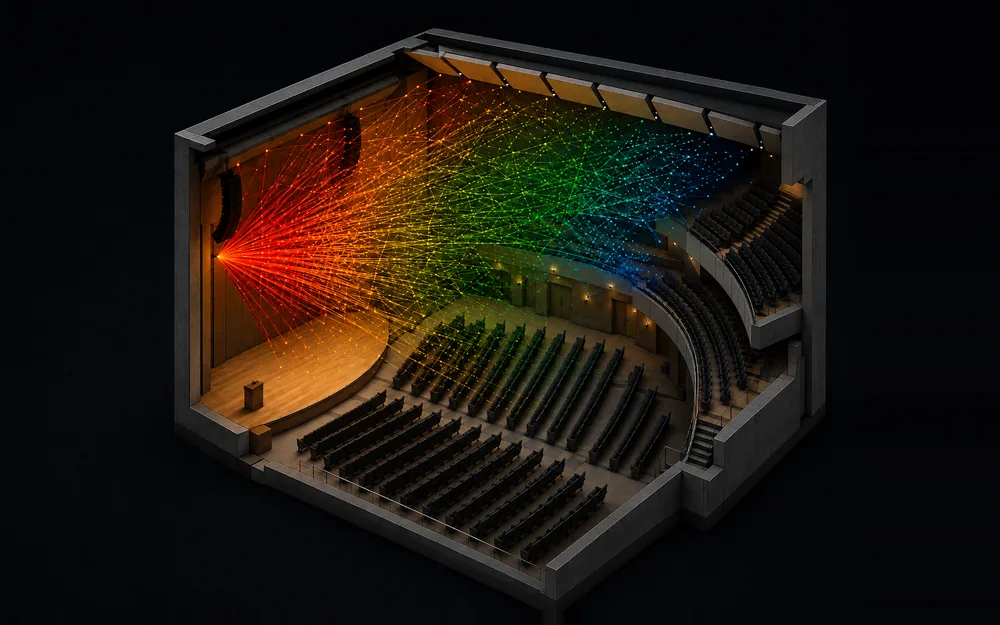
Table of Contents
The RT60 calculator computes a room's reverberation time from its dimensions and surface finishes, checked band by band against a target range using the Sabine or Eyring formula. It answers one practical question: will this room sound clear, or does the finish schedule need work before construction starts.
This guide lists every field the RT60 calculator asks for, what to enter, and what each output number means, in the order the interface presents them. Open the RT60 calculator in a second tab and follow along as you read.
The formula
The RT60 calculator runs one of two classical reverberation equations over every octave band, from the room's volume and the absorption its surfaces add up to.
Sabine on the first line, Eyring on the second. Both are written in metres; with the unit toggle on feet the constant becomes 0.049.
- V - room volume, in cubic metres.
- S - total surface area of the room, in square metres.
- Sᵢ, αᵢ - the area of one surface and its absorption coefficient at the band being solved.
- A - total absorption, every Sᵢ × αᵢ added up, in metric sabins.
- ᾱ - mean absorption, A / S. Past roughly 0.30 the Sabine line runs long and the Eyring line is the one to read.
Before you start
- Room length, width and height, in metres or feet, from a dimensioned floor plan or an as-built survey.
- A finish for all six surfaces, ceiling, floor and four walls, matched carefully from the finish schedule or the specification section for that room.
- Substitute finishes for any specified product the RT60 calculator's own library does not carry by name, noted somewhere for later reference.
- Door and window sizes and counts, including how many identical units repeat on each wall, from the door and window schedule.
- The room's real function, taken from the room brief rather than the label printed on the drawing title block. The four built-in target bands sit close to published room-acoustics guidance such as DIN 18041.
- A working unit, metres or feet, matching whichever your project drawings already use.
- A rough sense of how absorbent the finished room will end up being, to anticipate ahead of time whether Sabine or Eyring is the formula you will end up needing.
- A second scenario in mind, if you plan to compare a treated finish package against the untreated shell, side by side.
- Manufacturer datasheets for any critical material, ready to substitute once a design sits close to its target line.
Input fields
Every control the RT60 calculator asks for, grouped below by the interface panel it sits in, and listed in the order you meet it on screen as you work through a room.
Getting started
Load example - Fills the current scenario with an 8 × 6 × 3.2 m room: gypsum board ceiling, concrete floor, gypsum board walls, two 1.6 × 1.4 m south-wall windows. Sets Target use to Meeting room by default.
Room dimensions
Length, Width, Height - The room's internal dimensions, entered in the unit set by the m / ft toggle. Any positive number works in each field. Volume and Surface area appear as read-only figures once all three are filled.
m / ft toggle - Sets the working unit for every dimension and opening size on screen. Switching between metric and imperial afterward converts every existing value automatically, with no manual re-entry and no maths to redo.
Surfaces
Ceiling, Floor, Wall North, Wall South, Wall East, Wall West - Click a surface or its 3D face to open its material picker. Ceiling offers 5 finishes, Floor 7, walls 9 plus 3 treatment panels, listing absorption at 500 Hz.
Flip view / Reset view - Flip view looks at the room from above the ceiling instead of below it, useful for checking a ceiling finish. Reset view returns the camera to its starting angle without changing any material choice.
Target and formula
These two fields, together, decide how the RT60 calculator judges your result.
Target use - Recording studio, Meeting room, Open office or Auditorium / theatre, each with its own target band listed in the table below. Match it to the room's real function rather than what the drawing calls it.
Formula - Sabine or Eyring, applied to whichever scenario is active. Sabine is the default and suits most rooms at first pass. Switch to Eyring once heavily treated, a threshold covered under Reading your result below.
Doors and windows
This group is optional, and only needed if the room actually has glazing or doors cut into its walls.
+ Add - Adds one new, blank opening entry under Doors & windows, ready for its wall, finish, size and quantity to be filled in.
On wall, glazing or door finish, W, H, Qty - Each opening needs its wall, a glazing or door finish, its width and height, and a quantity for identical repeats. That area is deducted from its host wall.
Generate and compare
Generate result - Tells the RT60 calculator to compute and display the result. Stays greyed out and disabled until dimensions, all six materials and a target use are all set. Doors and windows remain optional throughout.
Scenario A / B - Two fully independent rooms, each with its own dimensions, materials, openings and generated result, useful for comparing a treated setup against an untreated one without losing either along the way.
Reset - Clears the current scenario back to empty, dimensions, materials and openings included, leaving the other scenario completely untouched.
| Control | Unit / format | Options or range |
|---|---|---|
| Length, Width, Height | m or ft | Any positive number |
| Ceiling material | category list | 5 finishes, exposed concrete to high-NRC tile |
| Floor material | category list | 7 finishes, bare concrete to carpet on foam underlay |
| Wall N / S / E / W material | category list | 9 wall finishes plus 3 treatment panels |
| Target use | preset band | Recording studio 0.20–0.40 s, Meeting room 0.40–0.60 s, Open office 0.40–0.70 s, Auditorium / theatre 0.90–1.20 s |
| Formula | toggle | Sabine or Eyring |
| Opening W, H, Qty | m or ft, count | Any positive number, whole number for Qty |
Every field the RT60 calculator asks for, in the order you meet it on screen.
Reading your result
RT60 mid (500–1k) - The decision number: reverberation time averaged across the 500 Hz and 1 kHz bands. A badge below it reads Within target, Too live or Over-damped, checked against the range and formula stated underneath.
Octave band response - A chart plotting RT60 at all six octave bands, 125 Hz to 4 kHz, against a shaded target region. A room can pass the mid-frequency average and still miss badly at 125 Hz.
ᾱ, mean absorption - A live figure under the 3D view, updating before you click Generate. Past roughly 0.30 with Formula on Sabine, the result starts running long: switch to Eyring and re-generate.
Loading the example into Scenario B pushes ᾱ past that line entirely on its own, since its high-NRC ceiling tile, heavy carpet and mineral wool panel add up to a heavily absorbent room. Whatever the RT60 calculator reports stays a statistical estimate, and a measurement on the finished room following the ISO 3382-1 method is the only way to confirm it actually hit the number predicted.
Common mistakes
The RT60 calculator produces a plausible but wrong number when one of these six inputs is off.
- A surface left unassigned - Generate result stays disabled until Ceiling, Floor and all four walls carry a material. Check the setup checklist above Load example rather than re-entering correct dimensions.
- A material changed after generating - The RT60 badge and chart do not refresh automatically, only the 3D view and the ᾱ readout update live. Click Generate result again after every change.
- An opening assigned to the wrong wall - On wall decides which wall loses that area in the calculation. Match it to the wall the opening is physically cut into, or the wrong wall gets penalised instead.
- W widened instead of Qty increased - W and H describe the size of one window or door only. Use Qty for the real count of identical repeats, or the total opening area comes out wrong by that same multiple.
- Sabine trusted past ᾱ 0.30 - A result that looks fine at first glance can still be wrong once mean absorption passes that line. Switch Formula to Eyring and re-generate with the same room.
- Target use picked from the room's label - A hall used mainly for lectures behaves acoustically like a meeting room even when the drawings label it a hall. Match Target use to how the space is really used day to day.
When the RT60 calculator is not enough
The RT60 calculator models a single rectangular box: one ceiling, one floor and four flat walls, each carrying exactly one material across its whole area. A raked ceiling, an alcove, part-treated walls or a plan that is not a rectangle all have to be approximated, and the more irregular the real room, the less that approximation is worth trusting for a final design decision. A stepped auditorium ceiling or a fan-shaped hall can carry meaningfully more surface area, and a different reflection pattern, than a rectangular box built from the same floor area and volume.
Every coefficient in the library is a published industry figure, capped at 1.00, standing in for whatever product is actually installed on site. A 50 mm mineral wool panel from one manufacturer against another can differ enough at a given band to move the result outside the target, so swap in the manufacturer's tested data once a design sits close to the target line. Published absorption figures come from controlled laboratory testing, a methodology documented by research bodies such as the Acoustical Society of America, and a panel fixed flush against a wall on site will not perform exactly like the same panel measured with an air gap behind it in the lab.
Doors and windows are the only openings the RT60 calculator understands, with no field for a suspended cloud, a ceiling void treated separately from the visible tile, or occupancy, all of which move a real room's decay time in ways this box model cannot see. Furniture and a full audience also add absorption a bare-room model like this one cannot register. Once a design sits close to target and the finish schedule is being locked in, ALTA Integra takes it from there with measured verification and full acoustic consulting.
FAQ
Should I enter room dimensions in metres or feet in the RT60 calculator?
Use whichever the m / ft toggle in the header is set to. The RT60 calculator supports both units directly, and switching the toggle after you have entered values converts Length, Width, Height and every opening size automatically, so you do not need to redo the conversion yourself.
Why does Generate result stay greyed out in the RT60 calculator?
The RT60 calculator needs three things filled in first: Length, Width and Height, a material on all six surfaces, and a Target use selected. The setup checklist above the Load example button marks each requirement as you complete it, so check which one is still missing.
When should I use Eyring instead of Sabine in the RT60 calculator?
Switch Formula to Eyring once the ᾱ readout under the 3D view passes roughly 0.30. Below that line, the RT60 calculator returns close to the same number under either formula, and Sabine is the simpler default. Above it, Sabine reports a longer decay than the room actually has.
Can I compare two different material combinations in the RT60 calculator?
Yes, using Scenario A and Scenario B in the header. Build one material palette under A, switch to B, and build a second independent version with its own dimensions and openings. The RT60 calculator keeps a separate generated result for each, so flip between the two tabs to compare them.
Why does the RT60 calculator still show my old result after I change a material?
The RT60 mid figure and the octave band chart only update when you click Generate result. Editing a material changes the 3D view and the live ᾱ readout right away, but the results panel still shows whatever was true at the last generate.
What does the ᾱ figure mean in the RT60 calculator?
It is the room's average absorption coefficient at 500 Hz, shown live beneath the 3D view of the RT60 calculator as you assign materials. A low reading means a mostly reflective room. Once it passes roughly 0.30, the Sabine formula stops being a safe read and Eyring should be used instead.