Measuring Room Acoustics for Sound Reproduction
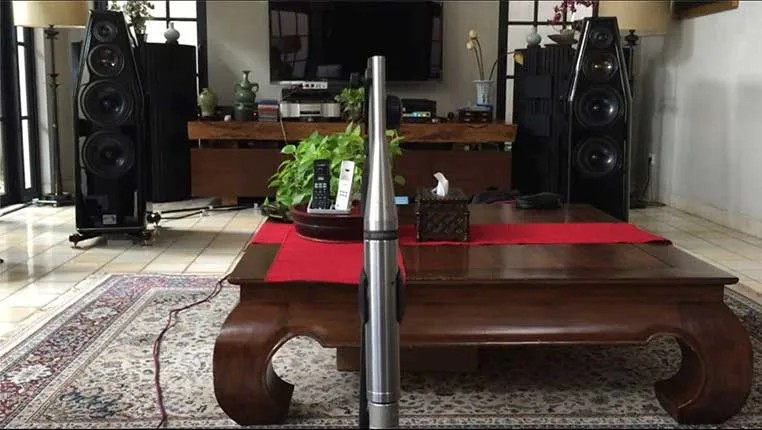
Sound reproduction acoustic measurement, carried out by ALTA Integra as acoustic consultant, is the testing of a playback room's acoustic behavior to confirm it reproduces a recording accurately, without adding its own character to the sound. A sound reproduction room is any space used to play back a recording rather than create it — an audiophile listening space, a control room in a recording studio, a home theatre, and similar rooms all fall into this category.
What "Accurate" Means for a Reproduction Room
The acoustic goal for a sound reproduction room is a natural acoustic characteristic: what plays back in the room should sound as close as possible to the master recording, meaning the room itself should not add extra "spice" — its own coloration — to the sound. A room with excellent acoustic characteristics produces accurate tonal balance and a clear, holographic sound image, rather than smearing or skewing what was actually recorded. Measurement exists to determine, objectively, whether a room built to a design actually achieves that.
Core Parameters: Room Response and Reverberation Time
Two acoustic parameters are central to evaluating a sound reproduction space:
### Room Response
Room response is a frequency-response measurement taken at a specific listening point. The characteristics measured at that point reflect both the direct sound from the source and the room's own acoustic behavior — shaped by room modes, speaker-boundary interference response, reflections, and reverberation. Engineers typically examine this through several complementary views of the same measurement: the impulse response over time, the impulse response smoothed at different resolutions across frequency, and a waterfall plot that shows frequency, level, and time together, making it easier to see how energy decays across the frequency range rather than at a single instant.
### Reverberation Time
Every room absorbs sound energy at a different rate across the frequency range (roughly 20 Hz–20,000 Hz), which is why every room has a distinct reverberation character. A room with long reverberation at high frequencies but short reverberation at low frequencies, for example, tends to sound "thin" or "harsh." Reverberation time is most commonly analyzed using the Sabine formula, which assumes reflections are distributed evenly throughout the room from all directions — a reasonable assumption for many spaces, though not a perfect model of every real room.
Reverberation time results are typically presented as a graph plotting time (in seconds) against frequency (in Hz), which makes it straightforward to see where a room's reverberation deviates from what is expected for its size and use.
Why Small Rooms Need Special Care
Room modes create particular difficulty when measuring the reverberation characteristics of small rooms. If reverberation time measurements are taken in a small room at frequencies below roughly 300 Hz, what is actually being measured is often the decay of individual room modes rather than a genuine, statistically averaged reverberation. Using reverberation-time data or calculations from below 300 Hz in a small-room acoustic design can therefore lead to analytical errors — a detail that matters for anyone measuring or designing home-theatre or small control-room spaces.
From Measurement to Analysis
After acoustic measurements of a sound reproduction space are taken, the results feed into a two-phase analysis of the room's acoustic characteristics. Alta Integra's measurement process identifies whether the room already performs at an excellent, good, or insufficient level, and — just as importantly — which specific design factors could improve the acoustic quality of the room going forward, rather than leaving the owner with a vague "it doesn't sound right" diagnosis.
This same measurement and analysis approach applies whether the room in question is a critical-listening space, a studio control room, or a home theatre, since all three share the same underlying goal of accurate, uncolored sound reproduction.
Frequently Asked Questions
What is sound reproduction acoustic measurement?
It is the on-site testing of a playback room — such as a listening room, control room, or home theatre — to check room response and reverberation time against what is expected for accurate, uncolored sound reproduction.
What is the difference between sound production and sound reproduction rooms?
Sound production rooms are used to create and capture sound (recording, mixing, dubbing), while sound reproduction rooms are used to play back a finished recording as accurately as possible.
Why does room response matter if the recording itself is already good?
Even a well-mixed recording will sound different — sometimes significantly — depending on the room it is played back in, because room modes, reflections, and reverberation all shape what the listener actually hears.
Why are small rooms harder to measure accurately?
Below roughly 300 Hz, a small room's measured "reverberation" is often dominated by individual room modes rather than genuine statistical reverberation, which can distort the reading if not accounted for.
Can a poorly performing reproduction room be improved after construction?
Yes — once measurement identifies which frequencies and parameters are underperforming, targeted acoustic treatment (absorption, diffusion, or bass trapping, depending on the finding) can correct much of the problem without rebuilding the room.
References
This overview follows established room-acoustics measurement principles as documented in Everest, F. Alton and Ken C. Pohlmann's *Handbook of Acoustics* (1981) and Trevor Cox's *Acoustics Absorbers and Diffusers* (2009).
Related reading: Room Acoustic Measurement for Sound Production · Acoustic Design Consultation Services · Audiovisual Media Technology Design