Sound Pressure Level (SPL): Our Way to Quantify the Strength of Noise
Part of ALTA Integra's Acoustics 101 lesson series.
Sound pressure level (SPL) is the standard, objective way engineers and acousticians quantify how strong a sound is, expressed in decibels (dB). It exists because everyday words like "loud" or "quiet" are relative and meaningless without a reference — if a friend says their washing machine makes a "loud" squeak, you still have no idea how loud, because there's no fixed baseline behind that word.
SPL is what a sound level meter actually displays, and it measures the physical strength of sound pressure — not the same thing as perceived loudness, which is how our ears and brain interpret that pressure. The two are strongly correlated but distinct, as this lesson will show.
From Pressure to a Usable Number
Pressure, by definition, is force applied divided by the area over which it's distributed. In the International System of Units (SI), force is measured in newtons (N) and area in square meters (m²), giving pressure the unit N/m², called the pascal (Pa) after French physicist Blaise Pascal.
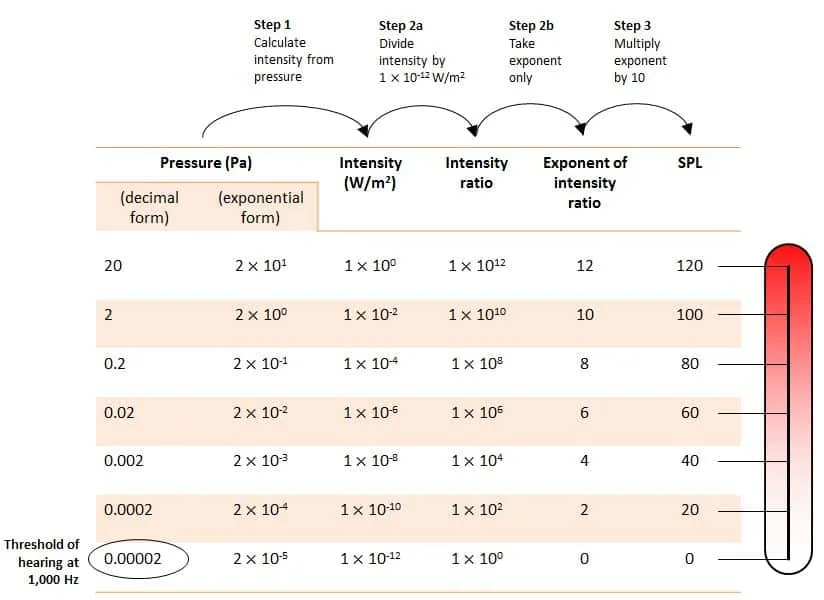
The threshold of human hearing at 1,000 Hz corresponds to a sound pressure of just 0.00002 Pa — a figure established through extensive research across age, gender, and racial groups. At the other extreme, the highest sound pressure before human ears feel pain is 20 Pa. That's a range of six orders of magnitude, far too unwieldy for everyday use, so a more practical scale was needed.
How the Decibel Scale Was Built
Getting from raw pressure in pascals to the decibel scale took three conceptual steps:
1. Convert sound pressure (Pa) to sound intensity (W/m²). Since sound intensity is proportional to the square of sound pressure, the intensity values at 20 Pa and 0.00002 Pa work out to exponents of 0 and -12 respectively.
2. Divide by a reference intensity to get rid of the negative exponent. Using the intensity at the threshold of hearing as the reference, the resulting intensity ratios span exponents from 0 to 12 — simpler, but still too narrow a range to map well onto human loudness perception.
3. Multiply each exponent by 10 ("deci" in Latin) to widen the range to 0–120 — a scale where an increase of about 3 becomes noticeable to human listeners. This final quantity became the sound pressure level, and its unit, the decibel (dB), was named after Alexander Graham Bell, inventor of the first practical telephone.
SPL vs. Loudness: Related but Not the Same
SPL and loudness are distinct quantities, but strongly correlated — SPL is the physical measurement; loudness is how our ears perceive it, and perception isn't flat across frequencies. If a sound were equally loud at every frequency for a given SPL, its loudness would trace a straight line. In reality, human hearing is more sensitive at some frequencies than others, producing the curved equal-loudness contours defined in ISO 226 (a more refined, modern version of the earlier Fletcher–Munson curves).
For example, on one such contour, 60 dB of sound at 1,000 Hz is perceived as equally loud as roughly 78 dB at 100 Hz and 55 dB at 3,000 Hz — the same physical SPL, three very different perceived loudness levels depending on frequency.
Why This Matters for Acoustic Design
Understanding SPL is the foundation for everything that follows in room and building acoustics: measuring background noise, rating it against Noise Criteria (NC) curves, and designing insulation and treatment strategies that target the frequencies where a space's noise problem actually lives — rather than just chasing a single overall number. This is the same foundation ALTA Integra's acoustic engineers build every measurement and design recommendation on.
Frequently Asked Questions
What is sound pressure level (SPL)?
SPL is the standard, decibel-based measurement of the physical strength of sound pressure, used to objectively quantify how strong a sound or noise is.
Is SPL the same as loudness?
No. SPL is a physical measurement of sound pressure; loudness is the human ear's perception of that pressure, which varies by frequency even at the same SPL.
Why is sound pressure level measured in decibels instead of pascals?
Pascals span too wide a range (0.00002 Pa to 20 Pa) to be practical. The decibel scale compresses that range into a more manageable 0–120, better matched to how humans perceive changes in loudness.
What are equal-loudness contours?
Equal-loudness contours, defined in ISO 226, map out which combinations of SPL and frequency are perceived as equally loud by the human ear — a refinement of the earlier Fletcher–Munson curves.
Who is the decibel named after?
The bel (and its more commonly used subunit, the decibel) is named after Alexander Graham Bell, inventor of the first practical telephone.
Suggested internal links: Background Noise: Why Is It a Serious Problem?, Noise Criteria: A Background Noise Rating Standard, Noise Control Performance Indices & Ratings.