How Sound Behaves in Rooms: Reflection, Absorption, Diffusion, Diffraction & Resonance
When a sound wave inside a room strikes a surface, it can reflect, be absorbed, scatter through diffusion, bend around obstacles through diffraction, or build up into resonance — and controlling these five behaviors, a question ALTA Integra's acoustic consultants answer on nearly every project, is what separates a room with excellent acoustics for music or speech from one that fights against its occupants.
Sound Reflection and the Angle of Incidence
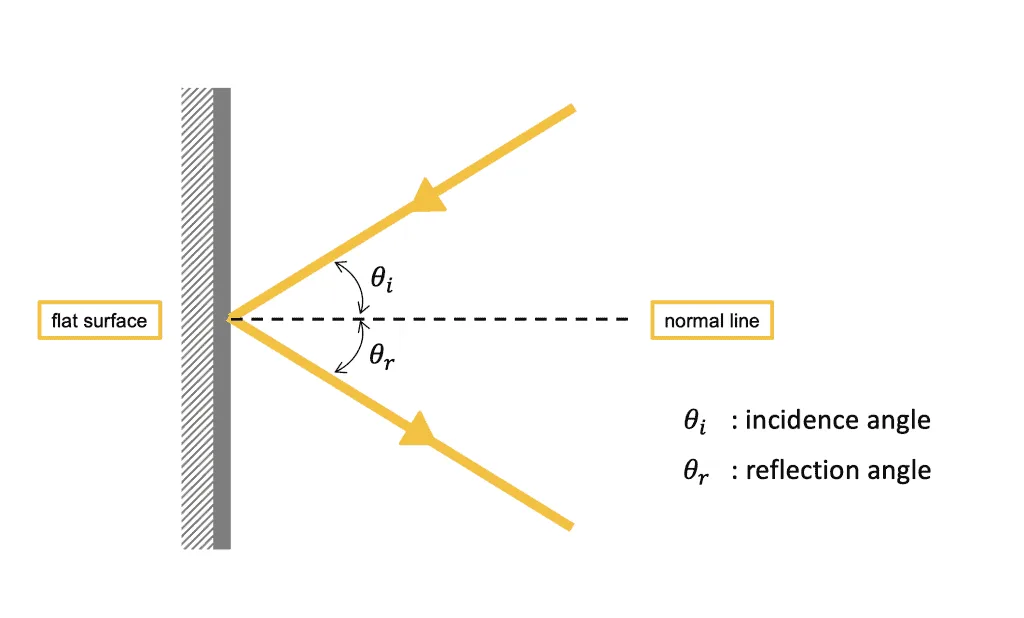
When a sound wave strikes a surface, some of its energy bounces back in a different direction. As with light, the reflected sound leaves at the same angle as the incident sound, measured from an imaginary line perpendicular to the surface (the normal line). For reflection off a flat surface, the reflection angle always equals the incidence angle.
Diffusion: When Reflection Scatters in Every Direction
Real surfaces are rarely perfectly flat. When a sound wave strikes a rough or irregular surface, it still obeys the same law of reflection — but because the surface is made up of many small facets, each with its own normal line, the reflected sound scatters across many angles at once. This phenomenon is called acoustic diffusion (sometimes called diffuse reflection, as opposed to specular reflection for smooth-surface reflection).
The degree of scattering a material produces is quantified by its scattering coefficient, defined in ISO 17497-1:2004 as one minus the ratio of specular reflected acoustic energy to total reflected acoustic energy. The value ranges from 0 (a fully specular, mirror-like reflecting surface) to 1 (a fully scattering surface), and it describes how much a surface's roughness or irregularity scatters sound away from the specular direction.
Absorption and the Sound Absorption Coefficient
Not all of the energy that strikes a surface reflects — some of it is absorbed by the material. The sound absorption coefficient (α) is the ratio of absorbed sound energy to incident sound energy, ranging from 0 (fully reflective) to 1 (fully absorptive), and it varies with frequency. It is typically measured using the room method described in the American standard ASTM C 423 or the international standard ISO 354.
Because α varies with frequency, it isn't a simple number for non-specialists to interpret, so the industry commonly uses a single-number rating called NRC (Noise Reduction Coefficient) instead. NRC also ranges from 0 to 1 and represents the average sound absorption coefficient measured at 125 Hz, 500 Hz, 1000 Hz, and 2000 Hz, rounded to the nearest multiple of 0.05. Two materials that share the same NRC rating will not necessarily perform identically, since NRC is only an average across four frequencies.
Diffraction: How Sound Bends Around Obstacles and Openings
Diffraction is the ability of a sound wave to spread out after passing through a small opening, or to bend around an obstacle — which is why you can still hear music from a stage even while standing behind a large post, or hear a conversation through a small gap even when you aren't directly in front of it.
Diffraction depends on wavelength: the longer the wavelength, the more a sound wave bends or spreads out. Since wavelength and frequency are inversely related, diffraction is more dominant at lower frequencies, which have longer wavelengths — low-frequency sound spreads out and bends around obstacles noticeably more than high-frequency sound does.
Resonance and Room Modes
Small rooms, such as listening rooms and recording studios, often show an uneven distribution of low-frequency loudness across the space — a symptom of acoustic resonance. Resonance occurs when a sound wave's frequency matches one of a room's natural frequencies. When that happens, the sound energy forms standing waves at that frequency: the wave doesn't travel outward as usual, and the resulting pattern of nodes (zero pressure) and antinodes (maximum pressure) causes sound to be much louder at some points in the room than at others, even though the source hasn't moved.
A group of resonances generated by a source such as a loudspeaker or an acoustic instrument is collectively known as room modes. Room modes affect the low- to mid-frequency response of live music and music reproduction in rooms, and if left untreated, overlapping resonances can noticeably degrade sound quality.
Why These Five Behaviors Matter for Acoustic Design
Reflection, diffusion, absorption, diffraction, and resonance aren't independent curiosities — they interact in every enclosed space, and a room's perceived sound quality is the net result of all five. Acoustic engineering design for music venues, speech spaces, and critical listening rooms works by deliberately managing this balance: enough absorption to control reverberation, enough diffusion to avoid harsh flutter echoes, and enough attention to a room's natural frequencies to avoid audible resonance problems.
FAQ
What is the difference between sound reflection and diffusion?
Reflection is when sound bounces off a surface at the same angle it arrived — like light off a mirror. Diffusion is what happens when that same law of reflection acts across a rough or irregular surface: the sound scatters across many angles rather than in one direction.
What does the sound absorption coefficient measure?
It is the ratio of sound energy absorbed by a material to the energy that struck it, ranging from 0 (fully reflective) to 1 (fully absorptive), and it changes with frequency.
What is NRC and why is it used?
NRC (Noise Reduction Coefficient) is a single-number average of a material's sound absorption coefficient at 125, 500, 1000, and 2000 Hz. It simplifies frequency-dependent absorption data into one easy-to-compare figure, though two materials with the same NRC can still perform differently in detail.
Why does low-frequency sound diffract more than high-frequency sound?
Diffraction depends on wavelength, and lower frequencies have longer wavelengths. The longer the wavelength relative to an opening or obstacle, the more the sound bends or spreads out.
What causes room modes, and why do they matter?
Room modes are groups of resonances that occur when a sound source's frequency matches a room's natural frequencies, creating standing waves with uneven loudness across the space. Left untreated, they degrade the accuracy of music reproduction and live sound in small rooms.
Suggested internal links: Structure-Borne Noise vs Airborne Noise in Buildings · Acoustic Engineering Design · History & Comparison of Building Noise Rating Standards