Upper-Room UVGI: How Germicidal UV Disinfects Air in Occupied Rooms
The technology is eighty years old, the evidence is unusually good, and the standard governing it was published in 2023.
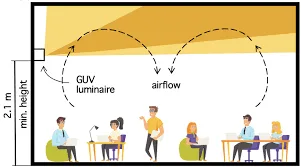
Upper-room UVGI installs germicidal UV-C fixtures near the ceiling to inactivate airborne pathogens as room air mixes up into a treated upper zone, while occupants below stay shielded. It delivers the equivalent of roughly 6–12 air changes per hour in an occupied room, against 1–2 for a typical portable unit. Unlike a portable cleaner, it works while the room is in use, which is the whole point in a waiting room or a classroom that is never empty.
Upper-room UVGI's technology is not new. What is new is the governance around it: ASHRAE Standard 241-2023, Control of Infectious Aerosols now addresses upper-room UVGI directly and requires systems to be installed and operated in accordance with ANSI/IES RP-44-21. Any specification written before 2023 predates both.
Upper-Room UVGI Compared With the Alternatives
| Approach | Equivalent ACH | Works in occupied rooms? | Governing reference |
|---|---|---|---|
| Portable UVGI air cleaner | 1–2 | Effective mainly when unoccupied | ASHRAE 241-2023, in-room air cleaner provisions |
| Upper-room UVGI (254 nm) | ~6–12 | Yes: fixtures mounted above the occupied zone | ASHRAE 241-2023, ANSI/IES RP-44-21 |
| Whole-room far-UVC (222 nm) | Under active research | Yes, designed for direct occupant exposure | Emerging, still without equivalent standard coverage |
The third row is the development to watch. Far-UVC treats the whole room rather than an upper layer, which removes the air-mixing dependency that limits upper-room performance.
What UV-C Actually Is
Not every UV wavelength inactivates pathogens. UV-C occupies roughly 100–280 nm, and conventional germicidal UV (commonly called GUV) uses low-pressure mercury lamps peaking at 254 nm.
The 254 nm figure describes a specific source, the mercury lamp line, sitting inside the wider UV-C band. The distinction matters now that far-UVC at 200–235 nm is a separate design option with different safety properties.
UV-C cannot be sourced from sunlight: the ozone layer absorbs almost all of it before it reaches the ground. Its germicidal potential has been studied since the nineteenth century (Niels Finsen received the 1903 Nobel Prize in Medicine for phototherapy work using UV against lupus and tuberculosis), and healthcare facilities have used GUV for room air disinfection for roughly seventy years, with kill rates exceeding 99.9% for airborne organisms including measles and tuberculosis.
Why Upper-Room UVGI Outperforms Portable Units
Portable UVGI cleaners and robots are how most people encounter this technology, and they are a comparatively weak tool against airborne transmission. Most deliver only 1–2 equivalent air changes per hour.
They do kill effectively in a patient room, but principally when it is unoccupied. Regularly emptying a 24-hour airport lounge, a waiting room, a shop or a restaurant is not practical.
Upper-room installations reach roughly 6–12 equivalent ACH in an occupied space. Because fixtures sit above the occupied zone (a minimum of 2.1 metres from floor to the bottom of the fixture), occupant exposure stays low.
In one documented installation, healthcare workers and patients received no more than a third of the applicable UV-C daily safety limit. Accidental exposure at these wavelengths tends to produce only a mild, temporary sunburn-like effect, because UV-C's short wavelength is absorbed by the outer layer of dead skin cells rather than penetrating to living tissue as UV-A and UV-B do.
The Evidence Base Is Unusually Old and Unusually Good
Upper-room UVGI has a longer track record than most building health interventions. In 1941, William F. Wells studied its effect on measles transmission in Philadelphia day schools: 53.6% of susceptible students in schools without upper-room UVGI became infected, against 13.3% in schools with it. During the 1957–58 influenza pandemic, McLean measured a 1.9% infection rate in an irradiated ward at a Veterans Hospital tuberculosis unit against 18.9% in a non-irradiated ward.
The US Centers for Disease Control and Prevention published design-parameter guidance for upper-room UVGI in healthcare settings in 2009, building on a 1997 University of Colorado study on tuberculosis containment. ASHRAE 241-2023 is the more recent and more directly applicable reference for building designers.
Why COVID Renewed Interest, With a Caveat
Indoor environments concentrate aerosols (the pathogen-laden droplets released by coughing, sneezing and speaking), which makes them prone to outbreaks and put air disinfection under intense scrutiny from 2020. Fears et al. reported SARS-CoV-2 remaining infectious in suspended aerosol for up to 16 hours, and swab tests from exhaust outlets in a Singapore patient room returned positive results, suggesting airflow can carry virus-laden droplets well beyond an infected person's vicinity.
Read the 16-hour figure carefully. It was obtained under Goldberg drum laboratory conditions designed to keep aerosols suspended, which is not how a real room behaves. It demonstrates that the virus can survive in aerosol under laboratory conditions, a narrower finding than routine sixteen-hour survival in an occupied building. Citing it without that qualification overstates the case for an intervention that does not need overstating.
What Determines Whether an Installation Works
Ventilation design governs upper-room UVGI performance more than the fixtures do. The system only treats air that reaches the upper zone, so air circulation has to achieve the target change rate and promote enough vertical mixing to carry contaminated air upward, while still maintaining thermal comfort below, a real tension in a tropical climate where the instinct is to avoid vertical air movement.
The other governing variable in upper-room UVGI performance is dose: irradiance multiplied by exposure time. Because air moves continuously rather than sitting still like a surface, irradiance has to be high enough to deliver an adequate dose during a short transit. Room configuration, fixture placement and the effectiveness of airflow in carrying air into the treated zone complete the parameter set.
That is why the UVGI specification and the ventilation strategy have to be coordinated as one design problem. ALTA Integra advises on this as part of its healthy building advisory and certification practice, alongside the wider indoor air quality strategy it sits within.
FAQ
What is upper-room UVGI?
An air disinfection method installing germicidal UV-C fixtures near the ceiling, so airborne pathogens are inactivated as room air mixes into the treated upper zone while occupants below remain shielded from direct exposure. It works in occupied rooms, which is its principal advantage.
Is upper-room UVGI safe in occupied rooms?
Yes, when installed at the recommended height of at least 2.1 m from floor to fixture and in accordance with ANSI/IES RP-44-21, as required by ASHRAE Standard 241-2023. Documented installations have kept occupant exposure to no more than a third of the applicable daily UV-C limit.
How does it compare to portable air cleaners?
Portable units typically deliver 1–2 equivalent air changes per hour and are effective mainly in unoccupied rooms. Upper-room UVGI delivers roughly 6–12 continuously while the room is in use, which matters in spaces that are never empty.
What is far-UVC and how is it different?
Far-UVC uses wavelengths of roughly 200–235 nm, typically 222 nm, and is designed to treat the whole room including the occupied zone rather than only an upper layer. Research including a 2024 occupied-room study indicates it inactivates airborne pathogens with limited skin and eye effects, though standards coverage is less mature than for conventional upper-room systems.
What determines whether an installation performs?
Ventilation rate and vertical mixing, UVGI dose (irradiance × exposure time), fixture placement and room configuration. The system only treats air that reaches the upper zone, so the ventilation strategy matters more than the fixture specification.
Upper-room UVGI of this kind is most often specified on ALTA Integra’s hospital complex projects, where air disinfection has to run continuously without displacing occupied space.
Sources
1. ANSI/ASHRAE Standard 241-2023, Control of Infectious Aerosols.
2. ANSI/IES RP-44-21, Recommended Practice for Ultraviolet Germicidal Irradiation.
3. M. Buonanno et al., "222 nm far-UVC light markedly reduces the level of infectious airborne virus in an occupied room," Scientific Reports, 2024.
4. CDC/NIOSH, upper-room ultraviolet germicidal irradiation guidelines for healthcare settings, 2009.