Room Acoustics Explained: Reflection, Absorption, Diffusion, Diffraction and Room Modes
Five things sound does when it hits a surface, and why the NRC number on a product datasheet is no longer the rating its own test standard defines.
Room acoustics reduces to five behaviours: a sound wave striking a surface can reflect, be absorbed, scatter through diffusion, bend around obstacles through diffraction, or build into resonance. A room's perceived sound quality is the net result of all five interacting, which is why treating only one of them (the usual instinct being to add absorption) so often produces a room that is quieter but no better. This article covers each behaviour, the number that quantifies it, and one measurement standard change most product datasheets have not caught up with.
Room Acoustics Ratings Compared: α, NRC, SAA and Scattering Coefficient
| Rating | What it measures | Frequencies used | Rounded to | Status |
|---|---|---|---|---|
| α (absorption coefficient) | Absorbed energy ÷ incident energy, 0 to 1 | Reported per frequency band | 0.01 | The underlying measurement (ASTM C423 / ISO 354) |
| NRC | Single-number average absorption | 250, 500, 1,000 and 2,000 Hz | 0.05 | Defined in earlier editions of ASTM C423, but still universal on datasheets |
| SAA | Single-number average absorption | Twelve ⅓-octave bands, 200–2,500 Hz | 0.01 | The single-number rating in the current ASTM C423 |
| αw | Weighted single-number absorption | Curve-fitted across bands | 0.05 | The ISO-side counterpart, reported from ISO 354 data |
| Scattering coefficient (s) | Diffusion, a distinct rating: 0 = mirror-like, 1 = fully scattering | Random incidence | - | ISO 17497-1:2004 (amended 2014) |
Within room acoustics absorption ratings, NRC and SAA are not interchangeable: SAA uses twelve bands instead of four and is rounded to 0.01 instead of 0.05, so it discriminates between products that share an identical NRC.
Sound Reflection and the Angle of Incidence
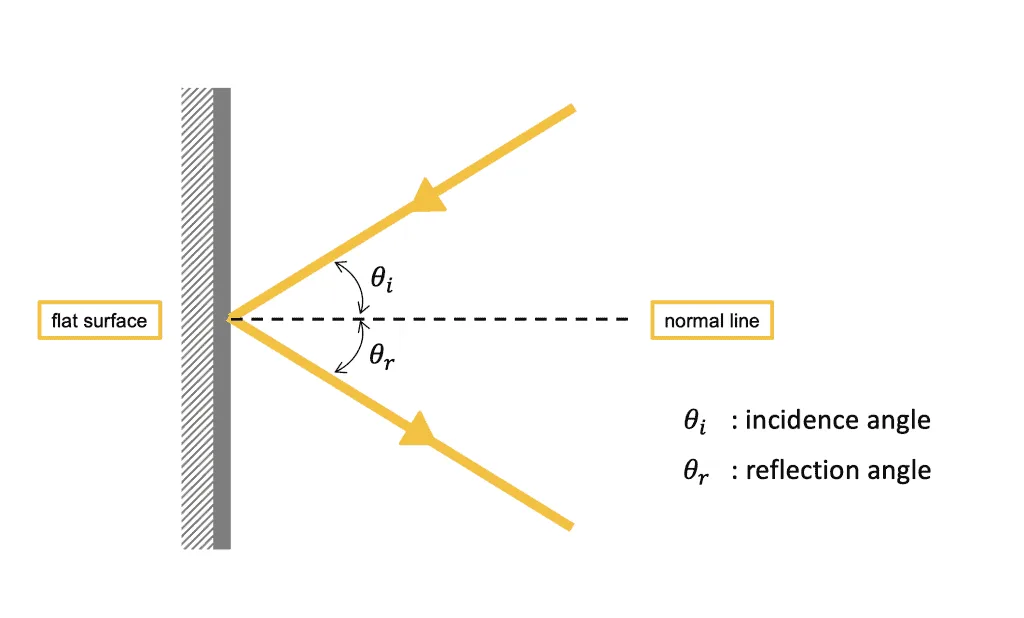
Sound reflection is the first of the five room acoustics behaviours covered here. When a sound wave strikes a surface, part of its energy bounces back in a new direction. As with light, the reflected wave leaves at the same angle it arrived, measured from an imaginary line perpendicular to the surface, the normal.
Off a flat surface, reflection angle always equals incidence angle. This is the behaviour that lets a reflector panel above a stage be aimed at a specific seating block, and equally the behaviour that puts a slap echo between two parallel walls nobody thought about.
Diffusion: What the Scattering Coefficient Actually Rates
Diffusion, the second room acoustics behaviour, comes from the fact that real surfaces are rarely perfectly flat. When a wave strikes a rough or irregular surface it still obeys the same law of reflection, but the surface is effectively many small facets each with its own normal, so the reflected energy scatters across many angles at once. This is acoustic diffusion, or diffuse reflection, as opposed to specular reflection off a smooth surface.
The degree of scattering is quantified by the scattering coefficient, defined in ISO 17497-1:2004 (amended 2014) as one minus the ratio of specularly reflected acoustic energy to total reflected energy. It runs from 0 for a fully specular, mirror-like surface to 1 for a fully scattering one, and it describes how much a surface's roughness deflects sound away from the specular direction.
Note what it does not describe: the standard explicitly excludes the spatial uniformity of the scattering. A surface can scatter strongly and still scatter unevenly.
Absorption: Why the NRC on a Datasheet Is Not the Current Rating
Absorption, the third room acoustics behaviour, accounts for the energy reflection does not. Not all energy reaching a surface reflects. Some is absorbed.
The sound absorption coefficient (α) is the ratio of absorbed to incident energy, running from 0 for fully reflective to 1 for fully absorptive, and it varies with frequency. It is measured by the reverberation room method described in ASTM C423 or its international counterpart ISO 354.
Because a frequency-dependent curve is awkward for non-specialists, the industry condensed it into a single number: NRC, the noise reduction coefficient. Two corrections are due here. First, NRC is the average of the absorption coefficients at 250, 500, 1,000 and 2,000 Hz (not 125 Hz, a substitution that appears in a great deal of secondary material.)
Second, and more consequential: the current edition of ASTM C423 refers to NRC as the rating defined "in previous versions" of the test method. The single-number rating the standard now defines is SAA, the sound absorption average, the arithmetic average of twelve one-third octave band coefficients from 200 to 2,500 Hz, rounded to the nearest 0.01 rather than 0.05.
NRC has not vanished. Nearly every manufacturer datasheet still leads with it, and most now print SAA alongside.
But the practical consequence of the difference is worth carrying into a specification: two materials sharing an identical NRC can behave measurably differently, because NRC averages four bands and rounds coarsely. SAA resolves what NRC flattens.
Diffraction: How Sound Bends Around Obstacles and Openings
Diffraction, the fourth room acoustics behaviour, is a wave's ability to spread out after passing through a small opening, or bend around an obstacle. It is why you still hear the stage from behind a structural column, and why a conversation carries through a gap you are not standing in front of.
Diffraction depends on wavelength: the longer the wavelength, the more the wave bends or spreads. Since wavelength and frequency are inversely related, diffraction dominates at low frequencies. This is the physics that makes noise barriers awkward: a barrier that shields a receiver from high-frequency tyre noise will let low-frequency engine noise bend straight over the top of it, and no amount of added surface mass changes that.
Resonance and Room Modes in Small Rooms
Resonance, the fifth room acoustics behaviour, shows up differently: small rooms (listening rooms, recording studios, home cinemas) commonly show uneven low-frequency loudness from one position to another. That is acoustic resonance. It occurs when a sound's frequency matches one of the room's natural frequencies.
At that point, the energy forms standing waves. The wave settles into a fixed pattern of nodes (zero pressure) and antinodes (maximum pressure). This makes the sound dramatically louder at some points in the room than others, even though the source itself has not moved.
This resonance behaviour is one of the least understood parts of room acoustics: a group of such resonances excited by a loudspeaker or an instrument is collectively called room modes. They govern the low- to mid-frequency response of both live music and reproduction, and where overlapping resonances are left untreated they degrade sound quality in a way that no amount of broadband absorption on the walls will fix. Porous absorbers thin enough to fit a room are ineffective at the wavelengths involved.
Why All Five Room Acoustics Behaviours Have to Be Designed Together
Reflection, diffusion, absorption, diffraction and resonance are not independent curiosities. They interact in every enclosed space, and a room's perceived quality is the net result.
Acoustic design for music venues, speech spaces and critical listening rooms works by deliberately managing that balance: enough absorption to control reverberation, enough diffusion to avoid harsh flutter echoes, and enough attention to the room's natural frequencies to keep resonance inaudible. Getting one of the five right while ignoring the others is the most common way a well-intentioned treatment budget produces a disappointing room, which is why ALTA Integra's acoustic engineering and design team models all five together as one interacting system.
In summary, room acoustics comes down to how a surface handles an incoming sound wave: through reflection, absorption, diffusion, or diffraction. Treating room acoustics as a single "add more absorption" problem misses the cases where diffusion or a room-mode fix is what the space actually needs. ALTA Integra diagnoses room acoustics behaviour by behaviour, applying a specific treatment to each one.
FAQ
What is the difference between sound reflection and diffusion?
Reflection is sound bouncing off a surface at the same angle it arrived, like light off a mirror. Diffusion is that same law of reflection acting across a rough or irregular surface. Because the surface presents many small facets with different normals, the energy scatters across many angles at once.
Which frequencies are used to calculate NRC?
NRC is the average of a material's sound absorption coefficients at 250, 500, 1,000 and 2,000 Hz, rounded to the nearest 0.05. The 125 Hz band is not included, despite appearing in a great deal of secondary material. Because it averages only four bands and rounds coarsely, two materials with the same NRC can perform noticeably differently.
What is SAA and how does it differ from NRC?
SAA, the sound absorption average, is the single-number rating defined in the current edition of ASTM C423, which now describes NRC as belonging to previous versions. SAA averages twelve one-third octave band coefficients from 200 to 2,500 Hz and rounds to 0.01, so it resolves differences between products that share an identical NRC.
Why does low-frequency sound diffract more than high-frequency sound?
Diffraction depends on wavelength, and lower frequencies have longer wavelengths. The longer the wavelength relative to an opening or obstacle, the more the wave bends or spreads around it. This is why noise barriers control high-frequency tyre noise well but allow low-frequency engine noise to bend over the top.
What causes room modes, and why do they matter?
Room modes are groups of resonances that occur when a source frequency matches one of a room's natural frequencies. They create standing waves with nodes and antinodes, and loudness varies sharply by position as a result. Left untreated they degrade low-frequency accuracy in small rooms, and thin porous absorbers are largely ineffective at those wavelengths.
Who provides room acoustics design in Jakarta?
ALTA Integra provides room acoustics design for studios, auditoriums, offices, education and worship spaces across Indonesia and Southeast Asia, covering absorption and diffusion specification, low-frequency and room mode treatment, and verification measurement against the design target.
Sources
The standards below define the room acoustics ratings covered in this article.
1. ASTM C423, Test Method for Sound Absorption and Sound Absorption Coefficients by the Reverberation Room Method (current edition, with NRC described as defined in previous versions and SAA defined at 200–2,500 Hz).
2. ISO 354:2003, Acoustics: Measurement of sound absorption in a reverberation room.
3. ISO 17497-1:2004 (Amd 1:2014), Sound-scattering properties of surfaces: random-incidence scattering coefficient.