Reverberation Time (RT60): The Sabine Equation, DIN 18041 Targets and Echo Control
Why absorption fixes an echo in an auditorium but ruins a concert hall, and the 17-metre rule that tells you which problem you have.
Reverberation time is defined in ISO 3382-1:2009 as the time required for sound in an enclosure to decay by 60 decibels after the source stops, written RT60. A 110 dB source that takes five seconds to fall to 50 dB gives that room an RT60 of five seconds.
Echo is a different phenomenon from the same cause: where reverberation is many overlapping reflections merging into a decay, an echo is one reflection arriving late enough and loud enough to be heard as a separate repeat. The distinction matters because the two problems have opposite treatments, and applying the reverberation fix to an echo problem is how concert halls get ruined.
This article covers what RT60 measures, what the Sabine equation says controls it, the current design-target standard, and the geometric threshold at which a room needs echo mitigation rather than general absorption.
When a Room Needs Targeted Echo Control, Beyond General Absorption
| Quantity | Value | Where it comes from |
|---|---|---|
| Delay at which the ear separates a reflection from the direct sound | ≈ 0.1 s | Human hearing threshold |
| Speed of sound in air at room temperature | ≈ 343 m/s | Physical constant at ~20 °C |
| Reflection path length at that delay | ≈ 34 m | 343 × 0.1 |
| Spacing of parallel reflective surfaces that produces it | ≈ 17 m | 34 ÷ 2 (out and back) |
A room with parallel hard surfaces 17 metres or more apart may call for a dedicated echo mitigation strategy alongside the reverberation target. Below that spacing, general absorption usually covers it.
What Reverberation Time Actually Measures
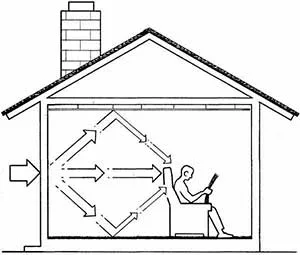
When sound is generated in an enclosed space with reflective surfaces, it bounces repeatedly before its energy dissipates, and that string of overlapping reflections is what we hear as reverb. A 60 dB decay after the source stops is the formal definition: it comes from ISO 3382-1:2009, which specifies both the interrupted-noise and integrated-impulse-response measurement methods.
Two currency notes are worth carrying into any specification. ISO 3382-1:2009 remains current, but it is under revision: the draft successor is retitled Spaces for music, speech and communication, broadening its stated scope beyond performance spaces. And for ordinary rooms: offices, classrooms, meeting rooms, the bulk of commercial work, the applicable part is ISO 3382-2:2008, which was reviewed and confirmed as current in 2022, rather than Part 1. Citing Part 1 for a meeting room is a common and avoidable mismatch.
What the Sabine Equation Says Controls Reverberation Time
Reverberation time can be calculated with the Sabine equation, derived by Wallace C. Sabine, and it depends on three variables: the room's volume (V), the total absorption coefficient of its surfaces (α_tot), and its total surface area (S_tot). Larger rooms tend toward longer reverberation, all else equal, which is intuitive: more volume means more distance travelled between reflections.
Surface material matters as much as size. If every surface is highly absorptive, energy is removed at each reflection and the sound dies quickly.
Because real rooms combine materials, the equation's total absorption coefficient weights each material's individual absorption coefficient by its share of the room's total surface area. This is also why the equation is a design starting point rather than a design answer: it assumes a diffuse field and even absorption distribution, neither of which holds in a room with a hard rear wall and a carpeted floor.
Live Rooms and Dead Rooms: What RT60 Values Mean in Practice
| Room character | Typical RT60 | Suits | How it is achieved |
|---|---|---|---|
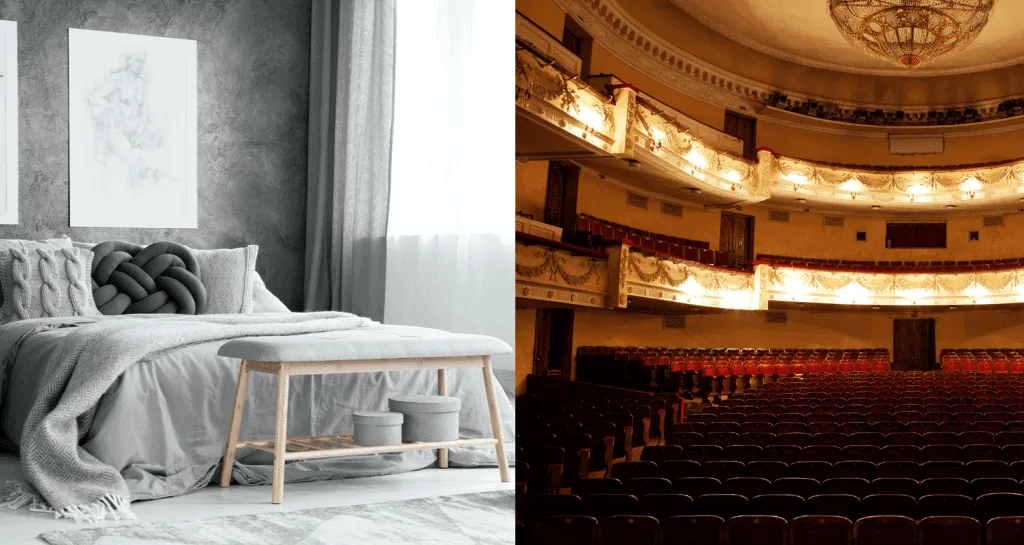
| Live | ≈ 2.0 s | Unamplified music performance | Hard, reflective surfaces: absorption used sparingly |
| Dead | ≈ 0.6 s | Recording studios, critical listening | Deliberate absorptive treatment across most surfaces |
The same room volume can sit at either end of this range depending entirely on surface treatment, which confirms that RT60 comes from a deliberate design decision made during fit-out.
For target values by room type and volume, the reference most acousticians work from is DIN 18041. Note the edition: DIN 18041:2016-03 replaced DIN 18041:2004-05, and the revision is not cosmetic: it responded to the widespread adoption of electroacoustic and media systems, added requirements for rooms with voice alarm systems, and explicitly removed the RT measurement and calculation guidance that the 2004 version contained. It divides rooms into two groups: Group A, where acoustic quality must carry over medium and long distances via reverberation control and sound deflection, and Group B, where absorption is used primarily to reduce noise over shorter distances. Any specification still citing the 2004 edition is citing a superseded document.
In practice, hitting a specific target in a real room usually requires computer simulation rather than hand calculation, because too many variables interact. That is the point at which room acoustics work moves from the acoustic design spreadsheet into a model.
The Longest Reverberation Time Ever Measured
Several historic buildings are known for unusually long reverberation, among them the Taj Mahal and Gol Gumbaz in India, Hamilton Mausoleum in Scotland, and Tomba Emmanuelle in Oslo, and any sufficiently large cathedral offers a taste of the effect first-hand.
The extreme documented case is Inchindown, a WWII-era naval oil storage tank cut into rock near Invergordon in Scotland, built to hold 25.5 million litres of furnace fuel with walls 45 cm thick. Acoustic engineer Trevor Cox, with Allan Kilpatrick firing a blank pistol as the impulse source, measured a reverberation time of 112 seconds at 125 Hz, 30 seconds at mid frequencies, and 75 seconds broadband.
It is the 75-second broadband figure that Guinness World Records certified: filed, as Cox himself notes, under "longest echo", which is the wrong term for the phenomenon actually measured. The measurements were published in the Journal of the Acoustical Society of America in 2015.
How to Fix an Echo Without Killing a Room's Reverberation
Applying highly absorptive material reliably prevents echo, and in a space that already wants a short reverberation time, such as an auditorium or a lecture theatre, that is the correct and cheapest answer. It stops being the correct answer the moment the room is supposed to be reverberant.
In a concert hall, absorption removes the echo and the reverb together, which defeats the purpose of the room. The tool for that case is a diffuser: an acoustic panel shaped to scatter incident sound into many directions across its working frequency range, breaking one strong late reflection into a wash of smaller ones that merge into the reverberant field instead of registering as a distinct repeat. Balancing enough absorption to control decay against enough diffusion to prevent discrete reflections is the core of room acoustics design for concert halls, auditoriums and performance venues, and it is work ALTA Integra carries out from concept through commissioning.
In summary, reverberation time is the defining acoustic property of any enclosed space, and arriving at the right reverberation time is a design decision rather than an accidental byproduct of a room shape. Whether the target reverberation time comes from DIN 18041, ISO 3382-1, or a client brief, modelling reverberation time early avoids costly retrofits once a room is built.
FAQ
What is reverberation time (RT60)?
RT60 is the time required for sound in an enclosed space to decay by 60 decibels after the source stops, as defined in ISO 3382-1:2009. If a 110 dB source takes five seconds to fall to 50 dB, the room's reverberation time is five seconds. It is measured either by the interrupted-noise method or from an integrated impulse response.
What determines a room's reverberation time?
The Sabine equation gives three variables: room volume, total surface area, and the total absorption coefficient of the surfaces. Larger rooms with harder surfaces tend toward longer reverberation. Because real rooms mix materials, the total absorption coefficient weights each material by its share of the room's surface area.
Which ISO standard applies to reverberation measurement in an ordinary room?
ISO 3382-2:2008, confirmed as current in 2022, covers reverberation time in ordinary rooms such as offices, classrooms and meeting rooms. ISO 3382-1:2009 covers performance spaces and is currently under revision, with the draft successor retitled to cover spaces for music, speech and communication.
How is an echo different from reverberation?
Reverberation is the general decay of sound through many overlapping reflections. An echo is a single reflection distinct enough for the ear to hear as a separate repeat, which requires roughly 0.1 seconds of delay or more. At 343 m/s that corresponds to a 34-metre reflection path, produced by parallel hard surfaces about 17 metres apart.
How do you fix an echo without ruining a room's intended reverberation?
Absorptive material removes the echo but shortens reverberation too, which is acceptable in short-RT spaces such as auditoriums. Where a long reverberation time is wanted, use diffusers instead: they scatter the single strong reflection into many smaller ones that blend into the reverberant field rather than removing the energy.
Who designs room acoustics for performance venues in Indonesia?
ALTA Integra provides room acoustics design for concert halls, auditoriums, houses of worship and performance venues across Indonesia and Southeast Asia, including reverberation modelling, absorption and diffusion specification, and commissioning measurement against the design target.
Sources
1. ISO 3382-1:2009, Acoustics: Measurement of room acoustic parameters; Part 1: Performance spaces.
2. ISO 3382-2:2008, Part 2: Reverberation time in ordinary rooms (confirmed 2022).
3. DIN 18041:2016-03, Acoustic quality in rooms (replaces DIN 18041:2004-05).
4. T. J. Cox and A. Kilpatrick, "A record 'longest echo' within the Inchindown oil despository," J. Acoust. Soc. Am., vol. 137, no. 3, pp. 1602–1604, 2015.
5. T. J. Cox, The Sound Book: The Science of the Sonic Wonders of the World, W. W. Norton, 2014.