Noise Control Ratings Explained: STC, ASTC, OITC, IIC and Damping Loss Factor
Match the index to the path: which rating actually applies to a partition, a facade, a floor slab or a vibrating material, and which ASTM editions are current.
Every noise control rating measures exactly one transmission path, and specifying the wrong one is the most common and most expensive error in building acoustics. The five noise control ratings covered here (STC, ASTC, OITC, IIC, and damping loss factor) each answer a different question, and no single one substitutes for the others. STC rates airborne noise through an interior partition in a laboratory.
ASTC rates the same partition once it is built, flanking paths included. OITC rates a facade against low-frequency traffic and aircraft noise. IIC rates impact noise through a floor-ceiling assembly.
Damping loss factor rates a material's ability to dissipate vibration. This article maps each index to the path it belongs to. It also flags three ASTM standards that have changed name or edition since most Indonesian specification templates were written.
Noise Control Ratings Compared: Which Index Applies to Which Path
These noise control ratings are not interchangeable, and Indonesian specifications frequently misapply them. A facade schedule may quote STC instead of OITC, or a floor slab may be evaluated only against airborne noise control ratings when the real complaint is footfall impact. Getting the mapping right the first time avoids a re-test, a change order, or a client dispute after handover.
| Rating | Test method | Rated per | Frequency range | Applies to |
|---|---|---|---|---|
| Transmission loss (TL) | ASTM E90 (laboratory) | - | 125–4,000 Hz, ⅓ octave | Raw per-band value for a partition |
| STC | ASTM E90 (laboratory) | ASTM E413-22 | 125–4,000 Hz, 16 ⅓-octave bands | Interior partitions, lab-rated |
| ASTC | ASTM E336 (field) | ASTM E413-22 | 125–4,000 Hz | Interior partitions as built, flanking included |
| OITC | ASTM E90 | ASTM E1332-22 | 80–4,000 Hz, ⅓ octave | Facades, windows, exterior doors |
| IIC | ASTM E492 (laboratory) | ASTM E989-21 | 100–3,150 Hz, 16 ⅓-octave bands | Floor-ceiling assemblies, impact noise |
| AIIC | ASTM E1007 (field) | ASTM E989-21 | 100–3,150 Hz | Floor-ceiling assemblies as built |
| ΔIIC | ASTM E2179 | ASTM E989-21 | - | Improvement contributed by a floor covering |
| Damping loss factor | Material test | - | Frequency-dependent | Vibration dissipation within a solid material |
The single most useful thing about these noise control ratings: STC and IIC are laboratory ratings, ASTC and AIIC are their field equivalents, and the field number is almost always lower.
Airborne Noise Between Rooms: Transmission Loss and STC
STC and its field counterpart ASTC are the two noise control ratings most often specified for ordinary interior partitions, so getting this pair right covers the majority of a typical building's wall schedule.
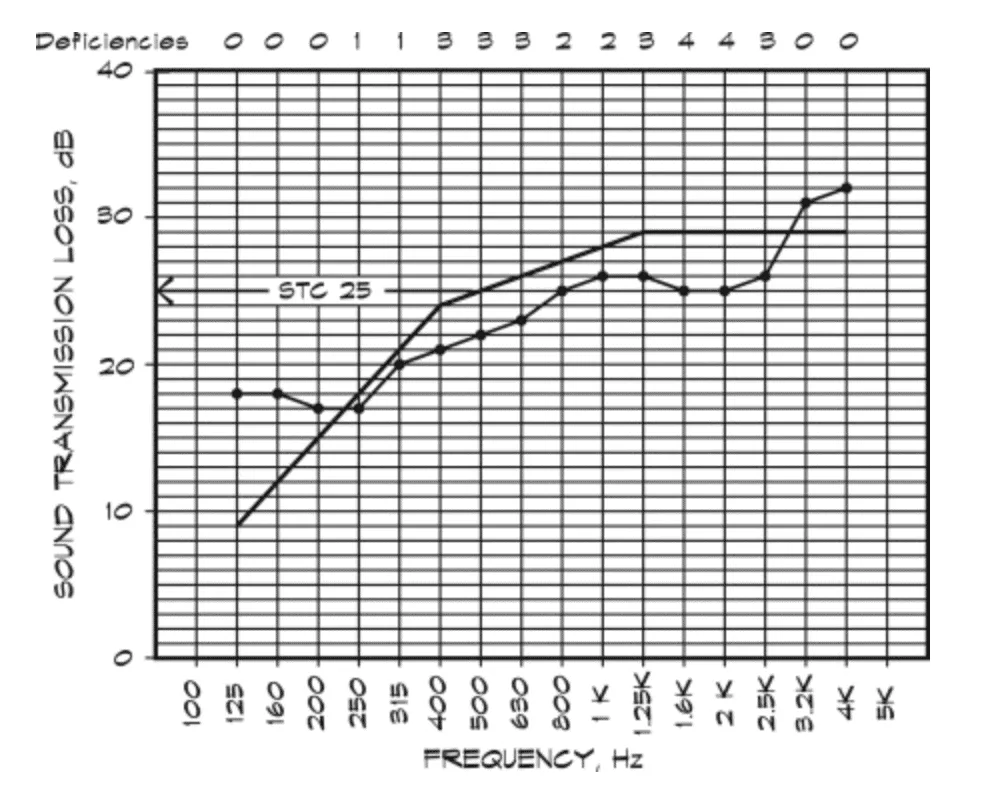
The airborne insulation performance of a partition between two rooms is the difference in sound pressure level between the source room and the receiver room: sound transmission loss, or TL. It is measured in a laboratory per ASTM E90 and reported as 16 separate values across one-third octave bands from 125 Hz to 4,000 Hz.
Among the noise control ratings in this article, STC is the one most Indonesian tender documents already ask for, so a worked illustration helps: generate 100 dB at 250 Hz in a source room and measure 65 dB of that same sound next door, and the partition's transmission loss at 250 Hz is 100 − 65 = 35 dB. Because comparing 16 band values is impractical for tendering, ASTM E413 condenses them into a single number by fitting the measured curve against a reference contour: the sound transmission class, or STC.
STC's limitation is built into its frequency range. It covers only the speech range, 125 Hz to 4,000 Hz, so it says nothing useful about how a partition handles low-frequency energy below that. A wall specified at STC 55 can still transmit a subwoofer through it without contradicting its own rating.
Why Field Results Now Use the Term ASTC, Replacing FSTC
ASTC is one of the two noise control ratings (alongside STC) that most interior-partition specifications reference, and confusing it with its retired predecessor is a common, avoidable error.
Once a partition is installed, performance is measured again on site under ASTM E336. Older specifications call the resulting number FSTC: field sound transmission class. In current ASTM practice that is no longer the default term.
The normal field rating is ASTC, apparent sound transmission class, which ascribes all measured transmission to the partition, flanking paths included. FSTC still exists in the standard, but may only be reported where the stringent flanking-suppression requirements of Annex A1 have actually been met, a condition rarely satisfied on an ordinary construction site.
The practical difference is not academic. ASTC is lower than the laboratory STC of the same assembly, and deliberately so: construction imperfections and flanking paths through floors, ceilings and junctions are exactly what the occupant hears.
A specification that demands "FSTC 50" on a normal site is asking for a measurement that mostly cannot be legitimately reported. Write ASTC.
Facades and Exterior Noise: When to Specify OITC Instead of STC
Among the noise control ratings covered here, OITC is the one most often skipped on a facade schedule, simply because STC is the more familiar default.
For exterior walls, windows and doors, the relevant rating is outdoor-indoor transmission class (OITC), classified under ASTM E1332, current edition E1332-22, not the E1332-90 that circulates in older templates. OITC exists because exterior noise sources skew far lower in frequency than interior speech: its reference spectrum is an average of aircraft takeoff, road traffic and diesel locomotive passby, and it is calculated across one-third octave bands from 80 Hz to 4,000 Hz.
STC remains the more commonly quoted number for general soundproofing comparison. But when the dominant problem is low-frequency (a facade onto a busy arterial road, a site under a flight path, a neighbour with a bass-heavy sound system), OITC is the rating that describes what the occupant will actually experience, and an assembly's OITC is usually several points below its STC.
Impact and Structure-Borne Noise: IIC, AIIC and What Changed in 2021
Of the noise control ratings in this article, IIC and AIIC are the two that most often get confused with an airborne rating, because the symptom (a thump heard in the room below) sounds identical to airborne noise until the transmission path is actually traced.
Not everything that sounds airborne is airborne in origin. Footsteps heard in the room below start as a physical impact on a floor, travel as vibration through the structure, and only become audible sound when the ceiling below radiates them. Treating that as an airborne problem (adding mass to the ceiling) addresses the last few centimetres of a path that began several metres earlier.
The governing index is impact insulation class (IIC), derived from measurements at 16 one-third octave bands from 100 Hz to 3,150 Hz using the standard tapping machine. A higher number means better performance. Worth knowing: ASTM E989 was substantially reworked in its 2021 edition and is now titled Standard Classification for Determination of Single-Number Metrics for Impact Noise.
It no longer covers IIC alone. It now assigns the laboratory rating IIC via Test Method E492, the field ratings AIIC (apparent impact insulation class), ISR and NISR via E1007, and ΔIIC (the improvement a floor covering contributes) via E2179. If a specification references "ASTM E989" expecting only IIC, it is referencing a broader standard than its author assumed.
One further limit: IIC does not address sounds below 100 Hz, which is precisely where lightweight joist floors generate their footfall energy, nor the squeaking and rattling that loose construction elements produce. A compliant IIC number on a timber floor is not the same thing as a quiet timber floor.
Vibration in Materials: What Damping Loss Factor Tells You
Damping loss factor sits apart from the other noise control ratings in this article. It describes a property of the material itself, independent of any transmission path between two spaces.
For structure-borne noise and vibration within solid materials, the key measurement is damping loss factor, the ratio between the energy a material dissipates per radian of vibration and the total energy in that vibration. A higher loss factor means more vibration energy converted to heat rather than passed along, and better damping performance. Of the noise control ratings covered in this article, damping loss factor is the only one that addresses vibration inside a solid material rather than sound travelling through air.
The caveat that gets lost when loss factor appears as a single figure on a datasheet: it is not a material constant. It varies with both vibration frequency and temperature. A damping product characterised at 20 °C behaves differently in an unconditioned Jakarta plant room, and a figure quoted without its test frequency is not comparable to one quoted at a different frequency.
Choosing the Right Noise Control Ratings for the Job
The discipline is simple to state and easy to skip: match noise control ratings to the noise path, then match the edition to the calendar. TL and STC for airborne noise between interior spaces, ASTC for the same partition once built, OITC for facades facing low-frequency exterior noise, IIC and AIIC for impact noise through floor-ceiling assemblies, and damping loss factor for a material's vibration behaviour. ALTA Integra applies this same noise control ratings mapping (treating each one as a diagnostic tool rather than a single pass/fail number) when specifying insulation on client projects through its acoustic engineering and design service.
In summary, noise control ratings exist because no single number can describe how a partition, a floor slab, or a vibrating piece of equipment behaves under sound. Matching the correct noise control ratings to an airborne, impact, or structure-borne path is what keeps a project's measured acoustic performance aligned with its design intent.
A default pick, whichever noise control ratings a spec sheet lists first, breaks that alignment. ALTA Integra treats these noise control ratings as five separate diagnostic questions, each pointing to a distinct transmission path.
FAQ
What is the difference between TL and STC?
Transmission loss (TL) is the raw laboratory-measured value at each of 16 one-third octave bands from 125 Hz to 4,000 Hz, tested per ASTM E90. STC condenses those 16 values into a single rating by fitting them against a reference contour per ASTM E413. TL tells you where a partition performs. STC tells you roughly how well overall.
Has FSTC been replaced by ASTC?
In normal practice, yes. Under current ASTM E336 and E413, the standard field rating is ASTC, apparent sound transmission class, which includes flanking transmission. FSTC still exists but may only be reported where the stringent flanking-suppression requirements of Annex A1 are met, which is uncommon on an ordinary construction site.
Why isn't STC enough for facades?
STC only covers 125 Hz to 4,000 Hz, the speech range, while exterior sources such as road traffic, aircraft and rail skew considerably lower. OITC was created for this case: it uses a reference spectrum averaged from aircraft takeoff, road traffic and diesel locomotive noise, calculated across one-third octave bands from 80 Hz to 4,000 Hz.
What does ASTM E989 cover in its current edition?
Since the 2021 edition, ASTM E989 is titled Standard Classification for Determination of Single-Number Metrics for Impact Noise. It assigns IIC via laboratory Test Method E492, the field metrics AIIC, ISR and NISR via E1007, and ΔIIC, the improvement from a floor covering, via E2179. Earlier editions covered IIC alone.
What does a material's damping loss factor tell you?
It indicates how effectively a material dissipates vibration energy as heat instead of transmitting it onward. A higher loss factor means better damping. It is not a fixed material property: the value changes with both vibration frequency and temperature, so a figure quoted without its test conditions cannot be compared directly against another product's.
Who specifies sound insulation ratings for projects in Indonesia?
ALTA Integra's acoustic consultants specify STC, ASTC, OITC and IIC targets for architecture, hospitality, education and industrial projects across Indonesia and Southeast Asia, matching each rating to the diagnosed transmission path rather than applying a single default number across an entire building.
Sources
The standards below define every one of the noise control ratings covered in this article.
1. ASTM E413-22, Classification for Rating Sound Insulation.
2. ASTM E1332-22, Classification for Rating Outdoor-Indoor Sound Attenuation.
3. ASTM E989-21, Classification for Determination of Single-Number Metrics for Impact Noise.
4. ASTM E90, Laboratory Measurement of Airborne Sound Transmission Loss of Building Partitions and Elements.
5. ASTM E336, Measurement of Airborne Sound Attenuation between Rooms in Buildings.