Structure-Borne vs Airborne Noise: How to Diagnose the Transmission Path in a Building
Footsteps sound airborne but are not. Diagnosing which path a noise takes is what separates an effective mitigation budget from an expensive guess.
Structure-borne noise and airborne noise are the two paths sound takes to reach a listener inside a building, and they call for opposite treatments. Airborne noise travels through the air and enters a room either through an opening or by vibrating a solid surface from the air side.
Structure-borne noise is generated inside a solid element (a wall, floor or slab) and only becomes audible when the receiving room's surface radiates that vibration as sound. Footsteps from the floor above are the classic trap: what the occupant below hears is airborne, but what caused it is structure-borne, and treating the symptom rather than the path is the most reliable way to spend a mitigation budget without fixing anything.
This article covers how each path works, the diagnostic signals that distinguish them, and why the wrong diagnosis costs money, programme time and, for building owners, reputation.
How to Diagnose a Noise Complaint by Transmission Path
| Path | Typical complaint | Rating that applies | Correct first move | Common wrong fix |
|---|---|---|---|---|
| Airborne, direct | Speech audible through a door gap, keyhole or service penetration | None: it is a leakage problem | Seal the opening | Adding mass to the partition |
| Airborne, indirect | Conversation or music through a fully closed wall | STC (lab) / ASTC (field) | Add mass, decouple layers, seal junctions | Absorptive panels inside the receiving room |
| Structure-borne, impact | Footsteps, dropped objects, chair scrapes from above | IIC (lab) / AIIC (field) | Treat at the source: floor covering, floating floor, resilient ceiling hangers | Mass or absorption on the ceiling below |
| Structure-borne, low-frequency excitation | Windows, glazing or furniture rattling from nearby bass | Damping loss factor, vibration isolation | Damp or isolate the resonating element | Increasing partition mass |
Two of the four rows have the same symptom family ("noise from next door") and opposite correct answers. That is the whole case for diagnosing before specifying.
Why Misdiagnosing Structure-Borne Noise Is the Expensive Mistake
Structure-borne noise is routinely misdiagnosed as an airborne problem, and that single mistake drives most of the wasted mitigation budget on real projects. Inside a building, occupants encounter both wanted and unwanted sound, and every one of them arrives through a medium (air, or a solid object) that carries the wave from source to ear. The recurring and costly failure in building acoustics is applying a mitigation strategy without ever establishing which medium is doing the carrying.
Controlling noise effectively requires two answers: what excites the sound, and how it is transmitted to the receiving space. Fixing the wrong one wastes money and programme time, and for a building owner facing tenant complaints it costs reputation as well. It also tends to be irreversible in the sense that matters: once a resilient layer should have gone into a floor build-up and did not, the remedy shifts from a specification decision to a demolition one.
What Is Structure-Borne Noise?
Structure-borne noise results from either an impact on a solid surface or a low-frequency sound vibrating a solid surface. In both cases the vibration travels through the building's structural elements from where it originates, and radiates from a solid surface of the receiving room as audible sound.
Impact on a solid surface
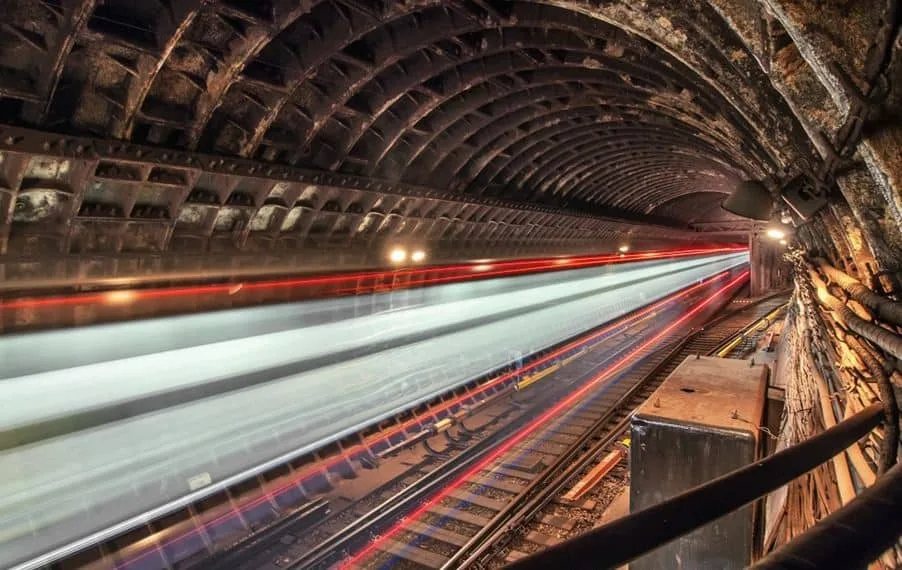
The vibration felt underfoot when a subway train passes below is structure-borne noise in its clearest form: the wheel-rail interaction generates a powerful vibration that oscillates the particles of the surrounding structure. Calling vibration "noise" seems odd until you recall that in physics sound is the mechanical vibration of particles.
Conversation and music are simply the audible end of the same phenomenon. In high-rise buildings, the dominant impact source is footsteps on the floor above.
Low-frequency vibration of a solid surface
A neighbour's Friday-night party is the second case. The wall may attenuate the music enough that the sound itself is tolerable, yet the vibrating windows and furniture are very noticeable.
That happens because when a sound's frequency matches the natural frequency of an object such as a glass pane, the object oscillates far more strongly than it would at any other frequency. Subwoofers are a common trigger, because they are designed to produce exactly the very low frequencies that many building elements happen to resonate at.
The diagnostic tell here is useful: if the complaint is about rattling rather than about hearing the music clearly, mass added to the partition will not help. The element that is resonating needs damping or isolation, and the relevant material property is damping loss factor rather than any sound transmission rating.
What Is Airborne Noise?
Airborne noise occurs when energy compresses the surrounding air. The resulting high-pressure region is followed by rarefaction, a low-pressure region, and that compression-rarefaction pattern travels away from the source at the speed of sound.
It reaches a room by two routes. Directly, through any opening connecting two spaces: a door undercut, a window, a service penetration, a keyhole. Indirectly, by striking a solid surface such as a wall, vibrating that wall's particles and, if the energy is sufficient, travelling through the wall to re-radiate as sound on the far side, with every opening sealed.
This second route is why sealing alone has a ceiling. Seal every gap in a lightweight partition and speech will still come through it. The partition itself is now the transmission path, and the applicable rating becomes STC in the laboratory or ASTC once built, since the field measurement necessarily includes flanking transmission through floors, ceilings and junctions.
Why the Diagnosis Has to Come Before the Specification
Because airborne and structure-borne noise travel by fundamentally different mechanisms, acousticians evaluate airborne insulation and impact or structure-borne insulation as separate exercises, using separate test methods and separate ratings. Modelling how a specific path will behave in a real building also means accounting for how the speed of sound varies with the transmission medium and with temperature: a solid slab and the air above it are not the same channel.
Getting that diagnosis right before specifying a solution (confirming structure-borne noise rather than assuming an airborne path) is what separates an effective noise control design from an expensive guess. It is the first step in the acoustic engineering and design work ALTA Integra carries out for architects and building owners, and it is deliberately done before any product is named.
In summary, structure-borne noise and airborne noise demand opposite fixes, and treating structure-borne noise as if it were an airborne problem is one of the most common and most expensive misdiagnoses in building acoustics. Confirming the transmission path before specifying a fix is what separates a mitigation budget that actually resolves structure-borne noise from one that is spent twice.
FAQ
What is the difference between airborne noise and structure-borne noise?
Airborne noise travels through the air and enters a room through an opening or by vibrating a surface from the air side. Structure-borne noise originates as vibration inside a solid building element such as a floor or wall and radiates as sound only once that vibration reaches the receiving room's surface. They need different mitigation strategies.
Are footsteps airborne or structure-borne noise?
Both, in sequence. What the occupant below hears is airborne sound radiated by the ceiling, but its cause is a structure-borne impact on the floor above. Because the path begins in the structure, effective treatment works at the source: floor coverings, floating floors, resilient ceiling hangers, rather than by adding mass to the ceiling below.
Can airborne noise pass through a closed door or window?
Yes. Even with every opening sealed, airborne noise can vibrate a solid surface such as a wall or glazing. If the sound energy is high enough, that vibration travels through the element and radiates as audible sound on the other side. Sealing removes the leakage path but not the partition's own transmission.
Why do windows vibrate when bass-heavy music plays nearby?
Because when a sound's frequency matches the natural frequency of an object such as a glass pane, that object oscillates far more strongly than at other frequencies. That is a resonance effect, distinct from the music passing through the glass. Subwoofers commonly trigger it because many building elements resonate at very low frequencies.
Why does correctly diagnosing the noise path matter?
Airborne and structure-borne noise travel by different physical mechanisms and are rated by different standards, so a treatment that works for one is usually ineffective for the other. Misdiagnosis leads to costly fixes that do not solve the complaint, and in the case of floor build-ups the remedy afterwards is demolition rather than specification.
Who diagnoses building noise problems in Jakarta?
ALTA Integra's acoustic consultants carry out noise path diagnosis and noise control design for architecture, hospitality, education, industrial and infrastructure projects across Indonesia and Southeast Asia, establishing the transmission path through measurement before any mitigation product is specified.
Sources
1. ASTM E90 and ASTM E336: laboratory and field measurement of airborne sound transmission.
2. ASTM E492 and ASTM E1007, covering laboratory and field measurement of impact sound transmission.
3. ASTM E989-21, Classification for Determination of Single-Number Metrics for Impact Noise.
4. Hyperphysics, Georgia State University (speed of sound by medium and temperature).