Sound Pressure Level (SPL) Explained: From Pascals to the Decibel Scale
Why a sound level meter reads decibels instead of pascals, and why the same SPL is not the same loudness at every frequency.
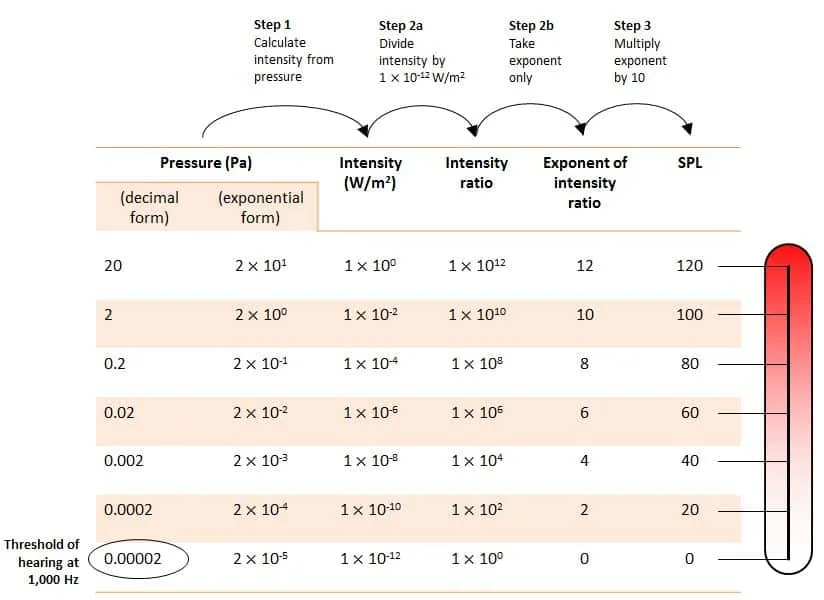
Sound pressure level (SPL) is the decibel-based measurement that turns a physical pressure range of 0.00002 Pa to 20 Pa (six orders of magnitude) into a workable 0 to 120 scale. It is the number a sound level meter displays, and it is the foundation every other building acoustics metric is built on: background noise ratings, sound insulation ratings, and reverberation measurements all resolve back to a sound pressure level. This article covers how pascals become decibels, why SPL and perceived loudness are not the same quantity, and how ALTA Integra's acoustic engineering and design team uses SPL as a design input that shapes decisions throughout a project.
The reason a fixed scale is needed at all is that everyday language has no baseline. If a colleague says the air handling unit makes a "loud" hum, that word carries no information: 55 dB and 85 dB are both "loud" to someone. Sound pressure level replaces the adjective with a number referenced to a fixed threshold.
Sound Pressure Level Reference Points: What 0 dB and 120 dB Actually Mean
| Sound pressure (Pa) | SPL (dB re 20 µPa) | Reference point |
|---|---|---|
| 0.00002 | 0 | Threshold of human hearing at 1,000 Hz |
| 0.0002 | 20 | - |
| 0.002 | 40 | - |
| 0.02 | 60 | - |
| 0.2 | 80 | - |
| 2 | 100 | - |
| 20 | 120 | Threshold of pain |
Every tenfold increase in sound pressure adds 20 dB. The audible range spans six orders of magnitude in pascals but only 0–120 on the decibel scale, which is precisely why the decibel exists.
How Sound Pressure in Pascals Becomes a Decibel Value
Pressure is force divided by the area it acts on. In SI units that is newtons per square metre (N/m²), named the pascal (Pa) after Blaise Pascal.
The threshold of human hearing at 1,000 Hz corresponds to a sound pressure of 0.00002 Pa, established through hearing research across age, sex and population groups. The highest pressure before the ear registers pain is 20 Pa.
Getting from that raw pressure range to the decibel scale takes three steps. First, sound pressure is converted to sound intensity, which is proportional to the square of pressure, putting the two extremes at exponents of 0 and −12. Second, each value is divided by the intensity at the threshold of hearing, which removes the negative exponent and leaves a ratio spanning exponents 0 to 12. Third, each exponent is multiplied by ten ("deci"), widening the range to 0–120, a scale on which a change of roughly 3 becomes noticeable to a listener. The resulting unit, the decibel, takes its name from Alexander Graham Bell.
Why Sound Pressure Level Is Not the Same as Loudness
SPL is a physical measurement, while loudness is the ear's interpretation of it. The two diverge because human hearing is not equally sensitive at every frequency.
If it were, a constant loudness would trace a flat line across the spectrum. Instead it traces the equal-loudness contours specified in ISO 226, a modern refinement of the Fletcher–Munson curves of the 1930s.
| Frequency | SPL required for equal perceived loudness | Difference vs 1,000 Hz |
|---|---|---|
| 100 Hz | ~78 dB | +18 dB |
| 1,000 Hz | 60 dB | reference |
| 3,000 Hz | ~55 dB | −5 dB |
Three very different sound pressure levels that a listener hears as equally loud. This is the reason A-weighting exists and the reason a single overall dB figure can mislead.
A currency note worth stating plainly: most acoustics references still cite ISO 226:2003. That edition has been withdrawn. It was replaced in March 2023 by ISO 226:2023, the third edition, which aligns the 0-phon data with ISO 389-7 and corrects systematic errors. The practical impact is small (the contours shift by no more than 0.6 dB), but a specification that cites a withdrawn standard is still a specification that cites a withdrawn standard.
How Acoustic Engineers Use Sound Pressure Level in Building Design
In project work, SPL is rarely the deliverable on its own. It is the raw material. Time-averaged sound pressure level at each octave band (the equivalent level, Leq) is what gets plotted against Noise Criteria curves to produce a background noise rating.
The difference in sound pressure level between a source room and a receiver room defines sound transmission loss, the basis for STC. The rate at which sound pressure level decays after a source stops is what defines reverberation time.
That is why a design conversation that starts and ends with one overall dB number usually misses the actual problem. A room can meet an overall target and still be unusable because all of its energy sits in one band. Working at the octave-band level (locating the frequencies where a space's noise problem actually lives) is the difference between a treatment that works and one that only looks compliant on paper.
In summary, sound pressure level is the single physical quantity every other acoustic metric in this article traces back to. Whether the conversation is about background noise ratings, sound insulation, or reverberation, it starts from a sound pressure level reading, and understanding why sound pressure level and perceived loudness diverge is what keeps a design decision grounded in what people actually hear.
FAQ
What is sound pressure level (SPL)?
Sound pressure level is the decibel-based measurement of the physical strength of sound pressure, referenced to 20 µPa (0.00002 Pa), the threshold of human hearing at 1,000 Hz. It is what a sound level meter displays, and it gives an objective figure in place of relative words like "loud" or "quiet" that carry no fixed baseline.
Is SPL the same as loudness?
No. SPL is a physical measurement of pressure, whereas loudness is how the ear and brain interpret it. The two are strongly correlated but not identical, because hearing sensitivity varies with frequency. At equal perceived loudness, a 100 Hz tone needs roughly 18 dB more SPL than a 1,000 Hz tone.
Why is sound measured in decibels instead of pascals?
Because the audible pressure range runs from 0.00002 Pa to 20 Pa (six orders of magnitude), which is impractical to work with directly. Converting pressure to an intensity ratio, referencing it to the hearing threshold and multiplying the exponent by ten compresses that range into a 0–120 scale that also tracks perceived changes in loudness reasonably well.
Which edition of ISO 226 is current?
ISO 226:2023, published in March 2023 as the third edition. It cancels and replaces ISO 226:2003, which is withdrawn. The revision aligns the 0-phon data with ISO 389-7 and corrects systematic errors, with the resulting contours differing from the 2003 edition by no more than 0.6 dB.
Who provides acoustic measurement and design consulting in Jakarta?
ALTA Integra provides acoustic, noise and vibration engineering consulting from its Jakarta office, covering octave-band SPL measurement, background noise assessment against NC and dBA targets, sound insulation specification and room acoustics design for projects across Indonesia and Southeast Asia.
Sources
1. ISO 226:2023, Acoustics: Normal equal-loudness-level contours, 3rd edition, March 2023.
2. ISO 226:2003 (withdrawn), superseded by ISO 226:2023.
3. ANSI/ASA S12.2-2019 (R2023), Criteria for Evaluating Room Noise.