Noise Criteria (NC) Ratings: How to Read an NC Curve and Convert It to dBA
The tangency rule, the octave-band range NC actually covers, and how to turn eight band measurements into a single LAeq value in dBA.
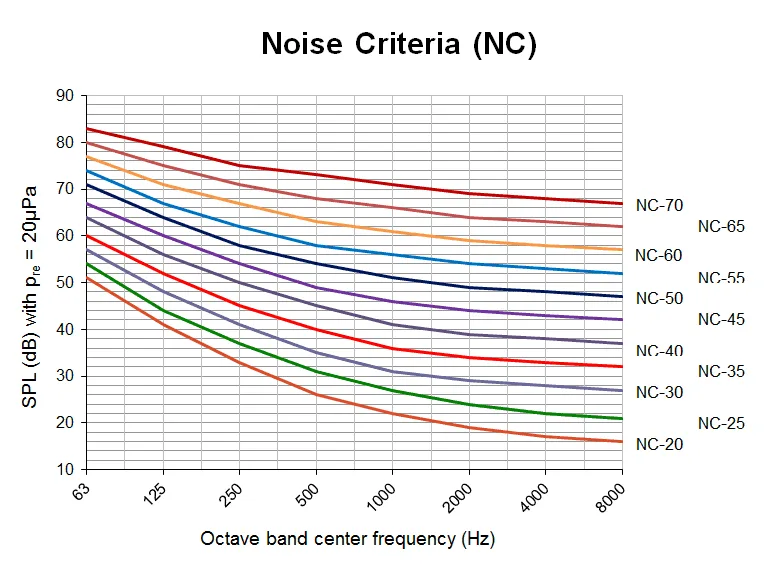
Noise criteria (NC) condenses a room's background noise (measured across the eight octave bands from 63 Hz to 8,000 Hz) into a single number, so that a design target can be written into a mechanical specification instead of eight separate band limits. The rating is read by the tangency method: plot the measured octave-band levels, and the NC rating is the value of the lowest NC curve that no band exceeds. This article covers how to read that rating correctly, how NC differs from the dBA figure used interchangeably with it in many project documents, and where the NC system runs out of usefulness.
The reason noise criteria exists as a single-number rating at all is practical. Sound pressure level varies with frequency, and no project team is going to compare rooms, tender packages or equipment options across eight band values at once. NC gives one figure to design against: the trade-off is that a single figure necessarily discards information.
Noise Criteria (NC), dBA and RC Compared: Which Background Noise Rating to Use
| Rating | Frequency range | How it is derived | What it cannot tell you |
|---|---|---|---|
| NC | 63 Hz – 8 kHz, octave bands | Tangency to a family of curves, then report the tangent band, e.g. NC-45 (125 Hz) | Spectral character, anything below 63 Hz |
| NC-(SIL) | 500, 1k, 2k, 4k Hz | Arithmetic average of four bands (speech interference level) | All low- and high-frequency content |
| RC | 16 Hz – 4 kHz | Arithmetic mean of 500, 1k and 2k Hz, plus a spectral quality descriptor (N/R/H/RV) | Not a tangency rating, and less common outside ASHRAE practice |
| RNC | Includes 16, 31.5 and 63 Hz | Tangency, with a correction for surging and turbulent HVAC noise | Requires low-frequency measurement capability |
| LAeq, overall (dBA) | Typically 63 Hz – 8 kHz, flexible | Logarithmic sum of A-weighted band levels | Every piece of spectral information |
Noise criteria (NC) and dBA are the two ratings most Indonesian project specifications use interchangeably. Only NC preserves any information about which frequency band is causing the problem.
How to Read a Noise Criteria Rating From an Octave-Band Measurement
Start with time-averaged sound pressure level at each octave band: the equivalent level, or Leq. Plot those eight values onto an NC graph and connect them. The NC rating is the value of the lowest NC curve that the measured line does not cross, which is the same thing as the highest curve the line touches.
Two details are routinely dropped and shouldn't be. First, the octave band where tangency occurs is part of the result and should be reported with it: written as NC-45 (125 Hz), not just NC-45. That band is the diagnostic information.
It tells the mechanical engineer where to look. Second, if the measurement line peaks above the NC 40 curve but stays under NC 45, the reported result is NC 45. A full graph with intermediate resolution may allow a more precise reading such as NC 41, but rounding up to the next curve is the conservative default.
Who Developed NC Curves, and Which Standard Governs Noise Criteria Now
NC curves are frequently described as an ANSI committee product. They are not, originally. They were developed by Leo Beranek and published in 1957, in response to the HVAC noise problems appearing in post-war office buildings, and the designating number was set to correspond approximately to the speech interference level, a measure of how effectively background noise masks conversation.
The curves were standardised later. The governing document today is ANSI/ASA S12.2-2019, Criteria for Evaluating Room Noise, which revises and replaces the withdrawn 2008 edition, was reaffirmed in 2023, and changed the recommended NC and dBA values for some space types. It sets out three primary methods: the A-weighted survey method, the engineering method using expanded NC curves, and the RNC method for low-frequency fluctuating noise. If a specification on your desk still cites S12.2-2008, the room-type target values in it may no longer match the current standard, so it is worth checking before it becomes a contractual number.
How to Convert Octave-Band Leq to LAeq, Overall in dBA
Many standards state maximum background noise in dB(A) rather than as a noise criteria number. That value (the overall A-weighted equivalent sound pressure level, LAeq, overall) sums A-weighted levels across broadly the same 63 Hz to 8,000 Hz range NC uses, but with more flexibility about which bands are included. A-weighting is applied because it approximates the ear's relative sensitivity across frequencies.
The calculation is three steps: convert each band's Leq into an A-weighted intensity ratio using that band's weighting value, sum the ratios, then convert the sum back from a logarithmic intensity ratio into decibels. Worked example: eight octave-band measurements converted and summed give a total intensity ratio of 36,384. The base-10 logarithm of 36,384 is 4.56. Multiplied by ten, that gives LAeq, overall = 45.6 dBA for that measurement set.
Where Noise Criteria Falls Short: Low Frequency and Spectral Quality
Noise criteria has two structural blind spots that matter on real projects. It reports only the worst-case band, so a room dominated by low-frequency rumble and a room dominated by high-frequency hiss can carry the same NC rating while producing entirely different complaint patterns. And the curves do not extend below 63 Hz, so mechanical noise capable of causing audible rattling or perceptible vibration in lightweight building elements is invisible to the rating.
Where either of those risks is live (large air handling plant, rooftop equipment above occupied space, lightweight partitions), the RC or RNC methods in the same standard are the better instrument, because both reach down into the 16 Hz and 31.5 Hz bands.
Why Noise Criteria Targets Belong in the HVAC Specification, Ahead of the Snag List
On real projects, noise criteria functions as a design target far more often than as a post-construction verification. HVAC is usually the single largest contributor to a room's background noise, because mechanical, electrical and plumbing equipment generates continuous low- to mid-frequency noise that will dominate a space if nothing constrains it.
Setting the NC target before equipment selection and duct routing gives the whole team one benchmark to design against. Setting it afterwards means retrofitting attenuation into a system that is already installed and already too loud, which is expensive, disruptive, and usually only partially successful.
Recommended maximum levels also vary by country and project type, so the applicable local regulation needs checking rather than assuming an American or European table applies. ALTA Integra sets noise criteria targets as a standard part of HVAC design review within its acoustic engineering and design scope.
In summary, noise criteria exists to turn eight separate octave-band measurements into one number a mechanical specification can actually use. Reading a noise criteria curve correctly, via the tangency method, and knowing when a project brief should cite noise criteria and when it should cite dBA instead, is what keeps a design target enforceable on site.
FAQ
What is Noise Criteria (NC)?
NC is a single-number rating of a room's background noise level, derived by comparing octave-band sound pressure levels from 63 Hz to 8,000 Hz against a family of reference curves. It was developed by Leo Beranek in 1957 and is standardised today in ANSI/ASA S12.2-2019, where its designating number corresponds approximately to the speech interference level.
How do you read an NC rating from a graph?
Plot the time-averaged sound pressure level at each octave band, connect the points, and identify the lowest NC curve that the resulting line does not cross. That curve's number is the NC rating. Report the octave band where tangency occurs alongside it, written as NC-45 (125 Hz), because that band identifies which part of the spectrum is driving the result.
What is the difference between NC and dBA?
NC compares octave-band levels against a curve and reports the tangent curve plus the band where it occurs, preserving some spectral information. LAeq, overall in dBA is a single decibel value obtained by logarithmically summing A-weighted band levels, which discards spectral detail entirely. Many specifications use the two interchangeably despite that difference.
Which standard currently governs NC ratings?
ANSI/ASA S12.2-2019, Criteria for Evaluating Room Noise, reaffirmed in 2023. It revises and replaces the withdrawn 2008 edition and changed the recommended NC and dBA values for some space types. It also defines the RNC method for low-frequency fluctuating noise and retains RC Mark II in an informative annex.
Do all countries use the same maximum NC or dBA limits?
No. Recommended maximum background noise levels vary by country and by project type, and national regulations do not necessarily track the ANSI values. The applicable local regulation should be checked for each project rather than assuming an American or European table applies by default.
Who sets NC targets for building projects in Jakarta?
ALTA Integra's acoustic engineers set NC and dBA background noise targets as part of HVAC design review for projects in Jakarta and across Indonesia, working from the applicable local regulation and the room-type criteria in ANSI/ASA S12.2-2019.
Sources
1. ANSI/ASA S12.2-2019 (R2023), Criteria for Evaluating Room Noise.
2. L. L. Beranek, "Revised criteria for noise in buildings," Noise Control, vol. 3, pp. 19–27, 1957.
3. ISO 226:2023, Acoustics: Normal equal-loudness-level contours.