Controlling Reverberation and Echo: Measuring RT60 in Each Frequency Band
A room can hit a textbook average RT60 and still sound wrong, because the average hides what each frequency is doing.
The Sabine formula is the standard calculation for reverberation time, but a room can hit a textbook average result from it and still sound wrong. That is the single most useful thing to know about controlling reverberation: the average hides what individual frequencies are doing, and unevenness across frequency bands is what listeners actually hear as boomy, thin or harsh. The marker of a well-treated room, and the real target of every Sabine formula calculation, is a flatter RT60 across the spectrum.
This article covers how RT60 is measured and calculated using the Sabine formula, what an appropriate value is for a given room volume, and why material choice matters more than material quantity. For the underlying standards and the echo-versus-reverberation distinction, see our article on reverberation time and echo control.
Ideal RT60 by Room Volume
| Room volume | Ideal RT60 |
|---|---|
| ~10 m³ (~350 ft³) | ≈ 0.9 s |
| ~500 m³ (~17,700 ft³) | ≈ 1.4 s |
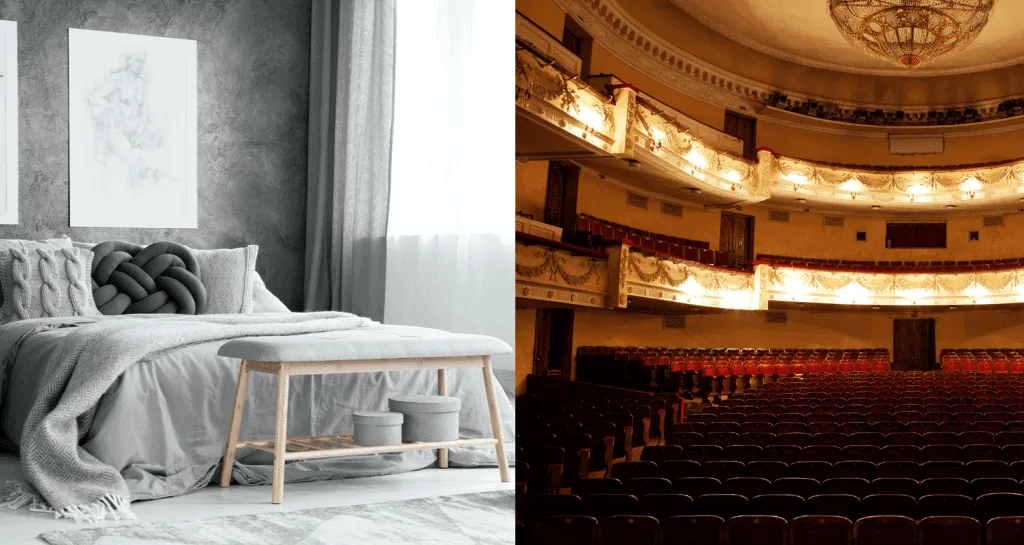
Larger rooms sustain longer reverberation before it reads as excessive. These are listening-room benchmarks: for halls and function spaces the targets differ substantially by use.
Using the Benchmark as a Diagnostic
The Sabine formula's RT60 benchmark works in both directions, which is the part most often missed. A measured RT60 well above the ideal for the room's volume means the space needs more absorptive material. A measured RT60 well below the ideal means it already has too much, and over-absorbed rooms are a real and common failure.
A room damped to 0.7 seconds where 1.15 was appropriate does not sound "very well treated." It sounds dead, and the fix is removing absorption or replacing it with harder, more reflective surfaces.
Why Frequency Matters More Than the Average
Materials absorb and reflect unevenly across frequency, which is why an average RT60 from the Sabine formula can be misleading. Cement reflects high frequencies strongly while doing little to control low ones. Carpet does close to the opposite: absorbing highs while letting lows continue largely unchecked.
This is the mechanism behind one of the most common mistakes in home studios and listening rooms: lining floor and walls entirely in carpet. The result is a boomy room with poor detail, because the highs have been removed while the bass was never addressed. The material choice produced that outcome.
Quantity was irrelevant. No amount of additional carpet corrects it.
Calculating RT60 With the Sabine Formula
The standard calculation for controlling reverberation is the Sabine formula. In metric units:
RT60 = 0.161 × V / A, where V is room volume in m³ and A is total absorption in square metre sabins: the sum, across every surface, of that surface's area multiplied by its absorption coefficient at the frequency being calculated. In imperial units the constant is 0.049 with volume in cubic feet.
The critical detail is in that last clause: absorption coefficients are frequency-dependent, so the calculation is run separately at each band, typically 125, 250, 500, 1,000, 2,000 and 4,000 Hz. Running it once with a single average coefficient produces a single average answer and hides exactly the unevenness the exercise exists to find.
Worked Method: Before and After Treatment
The Sabine formula procedure on a real room runs in four steps. Calculate volume from the dimensions. Calculate the surface area of each distinct material: floor, walls, ceiling, treated and untreated areas separately.
Apply each material's published absorption coefficient at each frequency band to its area. Solve the Sabine formula per band, then compare the resulting curve against the ideal for the room's volume.
Applied to a room finished entirely in concrete floor and cement walls and ceiling, the calculation shows reverberation considerably longer than ideal across most bands (consistent with cement reflecting rather than absorbing). Replacing those finishes with carpet on the floor and fibreglass-lined walls produces a curve that is flatter across frequency as well as shorter.
Editorial note: the source articles included specific before-and-after figures for a 76 m³ example room. Those numbers do not reconcile against the formula and are not reproduced here. Recalculate them from the original project data before publishing, or publish the method without them.
Why Flatness Is the Real Target
A wide spread between bands, say 0.4 seconds at one frequency and 2.5 at another, creates timing differences across the spectrum that degrade stereo imaging and make speech and music harder to follow. A room can have a technically correct average and still perform poorly for exactly this reason.
Applying the Sabine formula correctly means treatment aims at the right absorption at the right frequencies. Blanket absorption everywhere is not the method.
That means combining materials with complementary characteristics: a broadband absorber, a mid-frequency panel, and dedicated low-frequency treatment where the calculation shows it is needed. This is why ALTA Integra measures reverberation by frequency band rather than as a single number, as part of its acoustic engineering and design practice.
FAQ
What is RT60?
Reverberation Time, the time it takes for sound in a room to decay by 60 decibels after the source stops. It is the standard measure of how live or dead a room sounds, and it should be measured per frequency band rather than as a single average.
What is the ideal reverberation time for a room?
It scales with volume. For listening rooms, around 0.9 seconds suits a small room of roughly 10 m³, rising to about 1.4 seconds at 500 m³. Halls and function spaces have substantially different targets depending on use.
How do I know if a room needs more or less absorption?
Compare measured RT60 against the ideal for the room's volume. Well above means it needs more absorption. Well below means it already has too much: an over-absorbed room sounds dead, and the fix is removing absorption or adding reflective surface.
Why does a carpeted room sound boomy?
Carpet absorbs high frequencies effectively but does little at low frequencies. Lining floor and walls in carpet removes the highs while leaving bass uncontrolled. The result is a boomy, detail-poor room. The material choice caused it, so more carpet will not fix it.
What formula calculates reverberation time?
The Sabine formula: RT60 = 0.161 × V / A in metric, where V is volume in m³ and A is total absorption in square metre sabins (each surface's area times its absorption coefficient at the frequency being calculated). The imperial constant is 0.049.