Tracing Noise Leakage to a Roof: A Karaoke Venue Case Study
The loudest leak was not a wall or a door. It was the roof, and the energy was almost all low-frequency.
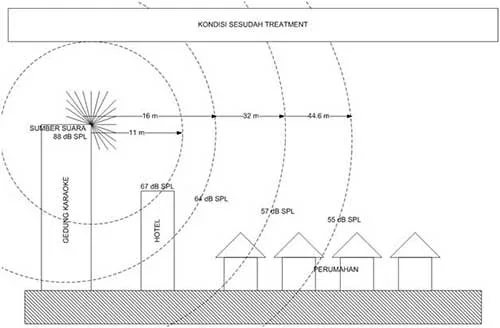
When a karaoke venue in Pamanukan was disturbing neighbouring housing and a nearby hotel, the obvious suspects were walls and doors. Measurement found otherwise: this was roof noise leakage, and the largest single path was the zincalum roof, radiating 99 dB at its surface, with the escaping energy concentrated at low frequencies: the range lightweight materials block least effectively. That single finding redirected the entire solution, and it is the reason the case is worth reading.
Measurements were taken on 26 January 2010 between 5 and 6 p.m. The target was to bring leakage within 55 dB, the applicable threshold under Indonesian noise regulation for a residential setting.
Measured Leakage, and Projected Performance After Treatment
| Measurement point | Measured (Jan 2010) | Projected after treatment |
|---|---|---|
| Speaker | 120 dB | 120 dB |
| Middle hall | 110–115 dB | 110–115 dB |
| Ceiling below zincalum roofing | 106 dB | 94 dB |
| Zincalum roofing surface | 99 dB | 89 dB |
| Concrete roofing | 88 dB | 75 dB |
| Rear hallway | 80–85 dB | 68 dB |
| Left hallway | 80 dB | 69 dB |
| Hotel parking | 78 dB | 66 dB |
| Front parking | 75 dB | 60 dB |
| Kitchen (door closed) | 70 dB | 58 dB |
The right-hand column is only projected. These are the estimated results of applying the recommended treatment, calculated at design stage. No post-implementation measurement is recorded in the source.
Reading the Measurements
Two things stand out in the measured column. The zincalum roof at 99 dB is the highest reading outside the hall itself, higher than any hallway, wall or door position. And the ceiling immediately below that roofing sits at 106 dB, confirming the energy is reaching the roof rather than escaping elsewhere and being picked up there.
Zincalum roofing is thin, lightweight profiled steel. Its mass per unit area is low, and transmission loss through a single-leaf element depends heavily on mass, which is why it performs poorly at exactly the low frequencies a karaoke system produces most of. The venue's loudest surface was, in effect, its lightest.
From 99 dB at the Zincalum Roof to a 158-Metre Disturbance Radius
From the measured levels and the low-frequency concentration, disturbance above the 55 dB threshold was estimated to remain audible up to roughly 158 metres from the venue (well beyond its own boundary), which accounts directly for complaints from both residents and hotel guests. Converting a surface measurement into a disturbance radius is what turns an acoustic reading into something a venue owner and a neighbour can both understand.
The Recommended Solution
Two interventions, both aimed at the identified path rather than distributed around the building. Replace the zincalum roof with a concrete deck, addressing the largest single leakage surface by substituting a high-mass element for a low-mass one. And add high-mass sound insulation material to block remaining low-frequency transmission through the rest of the structure.
Both work through the same mechanism: mass, because that is what the diagnosis called for. Low-frequency transmission through a lightweight element is a mass problem, and absorption, sealing or barrier treatment would not have addressed it. Projected results put the disturbance radius at roughly 45 metres, down from 158 (a reduction of more than two-thirds).
Why the Method Outlasts the Project
The transferable point is not the roof. It is that the leakage path was identified by measurement before anything was specified. A generic noise-reduction package for an entertainment venue would have addressed walls, doors and glazing (all of which measured lower than the roof) and would have improved the situation marginally at considerable cost.
Identifying which surface, which frequency range and which path is responsible, then applying a targeted structural and material fix, remains how ALTA Integra approaches entertainment-venue and mixed-use noise control through its acoustic engineering and design practice. It follows the same measurement-first logic set out in our article on acoustic noise measurement.
FAQ
What caused the noise leakage at this venue?
The zincalum roof, measuring 99 dB at its surface, is the highest reading outside the hall itself. Zincalum is thin, lightweight profiled steel with low mass per unit area, so it performs poorly against exactly the low-frequency energy a karaoke system produces most of.
What solution was recommended?
Replacing the zincalum roof with a concrete deck, and adding high-mass sound insulation material to block remaining low-frequency transmission. Both work through mass, because low-frequency transmission through a lightweight element is a mass problem that absorption or sealing would not address.
How much did the disturbance radius improve?
The estimated radius of disturbance above the 55 dB threshold was projected to fall from about 158 metres to about 45 metres. That is a reduction of more than two-thirds. These are design-stage projections rather than post-implementation measurements.
Why was 55 dB the target?
It was the applicable compliance threshold under Indonesian noise regulation for the venue's residential surroundings. Indonesian noise limits are set by area designation, so the applicable figure depends on the zoning around a given site.
Is this measurement-led approach still used?
Yes. Identifying the specific leakage path and frequency range through on-site measurement, then recommending a targeted structural fix rather than a generic package, remains the core method for entertainment-venue and karaoke noise control.
This 158-to-45-metre fix is drawn directly from ALTA Integra’s work on night entertainment venues, where roof construction is a frequent, underestimated leakage path.
For karaoke room design consultation, please contact us at:
ALTA Integra
Indonesia Stock Exchange Building, Tower 1, Level 3 Unit 304
SCBD Senayan, Kebayoran Baru, South Jakarta, DKI Jakarta 12190
Tel: +62 818 826 036
Email: customer@altaintegra.com