Measuring Room Acoustics for Sound Reproduction: Room Response, RT60 and the 300 Hz Problem
Below roughly 300 Hz in a small room, what you measure as reverberation is usually not reverberation at all. Designing from that number introduces error.
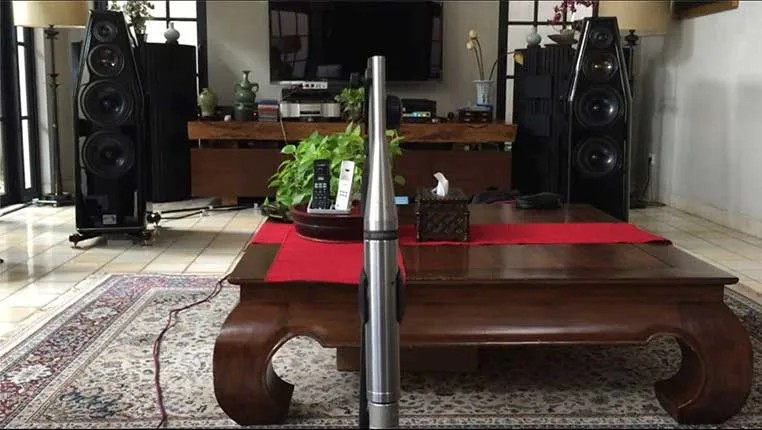
Room acoustic measurement for a sound reproduction space tests whether a playback room reproduces a recording accurately or adds character of its own. Two parameters carry most of the answer: room response, measured at the listening position, and reverberation time across frequency. A third factor governs how far either can be trusted: in a small room, reverberation measurements below roughly 300 Hz are usually reading the decay of individual room modes rather than genuine statistical reverberation, and designing from those numbers introduces analytical error.
A sound reproduction room is any space used to play back a recording rather than create one: an audiophile listening room, a studio control room, a home cinema. This article covers how room response and reverberation are each measured, how the results are read, and where small-room measurement goes wrong.
The Two Core Measurement Parameters
| Parameter | What it measures | How it is presented | What it reveals |
|---|---|---|---|
| Room response | Frequency response at a specific listening point | Impulse response over time, smoothed at varying resolution, waterfall plot | Room modes, speaker-boundary interference, reflections, reverberation combined |
| Reverberation time | Decay rate across roughly 20 Hz – 20 kHz | Time in seconds plotted against frequency in Hz | Where decay deviates from what the room's size and use would predict |
The waterfall plot is the one worth insisting on: it shows frequency, level and time together, so energy that decays slowly at one frequency is visible rather than averaged away.
What "Accurate" Means for a Reproduction Room
The acoustic goal for a reproduction room is a flat room response: playback should sound as close as possible to the master recording, with the room adding no coloration of its own. A room with excellent characteristics delivers accurate tonal balance and a clear, holographic stereo image, with no smearing or skewing of what was recorded.
A flat room response is a harder target than it sounds, because a room cannot be acoustically absent. It can only be neutral. Measurement exists to establish objectively whether a room built to a design actually achieves that neutrality, as distinct from sounding pleasant, which is a different and sometimes conflicting property.
Room Response: Reading the Same Measurement Three Ways
Room response is a frequency-response measurement taken at a specific listening point. What it captures at that point is both the direct sound from the source and the room's own behaviour, shaped by room modes, speaker-boundary interference response, reflections and reverberation, all superimposed.
Engineers typically examine three complementary views of the same measurement: the impulse response over time, the impulse response smoothed at different resolutions across frequency, and a waterfall plot showing frequency, level and time together. The third view matters most for diagnosis, because a room response curve alone cannot distinguish a peak caused by a resonance that rings for a long time from one caused by a reflection that arrives and leaves. Those two problems have different treatments.
Reverberation Time in a Playback Room
Every room absorbs energy at a different rate across the audible range, which is why each has a distinct reverberation character. A room with long reverberation at high frequencies and short reverberation at low frequencies tends to sound thin or harsh. The reverse tends to sound thick.
Reverberation time is most commonly analysed using the Sabine formula, which assumes reflections are distributed evenly throughout the room from all directions. That is a reasonable assumption for many spaces and a poor one for a small, asymmetrically treated listening room. It is worth remembering before treating a Sabine-derived number as ground truth.
Results are presented as a graph of time in seconds against frequency in Hz, which makes deviations from the expected profile immediately visible. Our article on reverberation time and echo control covers the underlying method in more depth.
Why Small Rooms Mislead Below 300 Hz
Room modes create a specific measurement trap in small rooms. Take a reverberation measurement in a small room at frequencies below roughly 300 Hz and what is actually being captured is, in most cases, the decay of individual room modes rather than a genuine statistically averaged reverberation. The statistical assumptions underlying reverberation time simply do not hold when only a handful of modes are active in a band.
Using reverberation-time data or calculations from below 300 Hz in a small-room design leads to analytical error. It is a consequential one, because low frequency is precisely where small rooms have their real problems. Anyone measuring or designing a home cinema or a compact control room needs to treat sub-300 Hz reverberation figures as modal data, and analyse them as such, rather than folding them into a whole-room average.
From Measurement to Analysis
Room response and reverberation measurements feed a two-phase analysis of the room's characteristics. The process identifies whether the room currently performs at an excellent, good or insufficient level, and, more importantly for an owner, which specific design factors would improve it. The deliverable is a targeted list of what to change, more specific than a verdict that the room "doesn't sound right."
The same room response approach applies whether the space is a critical-listening room, a studio control room or a home cinema, since all three share the goal of accurate, uncoloured reproduction. This measurement and analysis work forms part of ALTA Integra's acoustic engineering and design practice, alongside high-end audio room design where measurement informs the build right from the start.
FAQ
What is sound reproduction acoustic measurement?
It is on-site testing of a playback room (a listening room, control room or home cinema), measuring room response at the listening position and reverberation time across frequency, to establish objectively whether the room reproduces a recording accurately or adds coloration of its own.
What is the difference between sound production and sound reproduction rooms?
Sound production rooms are used to create and capture sound: recording, mixing, dubbing. Sound reproduction rooms are used to play back a finished recording as accurately as possible. The measurement goals differ accordingly: production rooms may want character, reproduction rooms want neutrality.
Why does room response matter if the recording is already good?
Because even a well-mixed recording sounds different depending on the room it is played in. Room modes, speaker-boundary interference, reflections and reverberation all shape what reaches the listener. A room cannot be acoustically absent. It can only be neutral or coloured.
Why are small rooms harder to measure accurately?
Below roughly 300 Hz, a small room's measured reverberation is usually dominated by the decay of individual room modes rather than genuine statistical reverberation. The statistical assumptions behind reverberation time do not hold when only a few modes are active, so those figures must be read as modal data rather than averaged.
Can a poorly performing playback room be improved after construction?
Often, yes. Once measurement identifies which frequencies and parameters are underperforming, targeted treatment, whether absorption, diffusion or bass trapping depending on the finding, can correct much of the problem without rebuilding. Measurement first is what makes the treatment targeted at the actual problem.
Who measures room acoustics for listening rooms in Indonesia?
ALTA Integra carries out room acoustic measurement and analysis for critical-listening rooms, studio control rooms and home cinemas across Indonesia and Southeast Asia. The result is a specific list of design factors to change.
References
1. F. A. Everest and K. C. Pohlmann, Master Handbook of Acoustics, 7th ed., McGraw-Hill.
2. T. J. Cox and P. D'Antonio, Acoustic Absorbers and Diffusers: Theory, Design and Application, 3rd ed., CRC Press, 2016.
3. ISO 3382-2:2008, Measurement of room acoustic parameters, Part 2: Reverberation time in ordinary rooms.