High-End Audio Room Acoustic Design: Room Modes, Reflection Points and Why Ratio Beats Treatment
Three things colour the sound at the listening position, and better speakers fix none of them. Two decisions made before construction fix most.
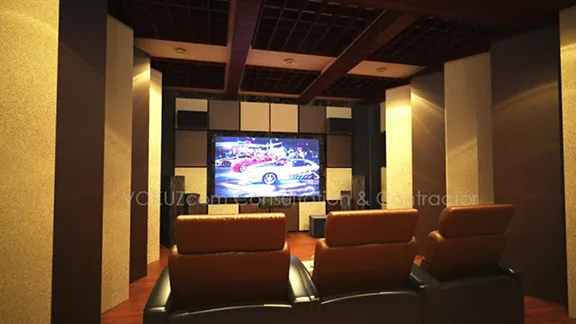
High-end audio room acoustic design has one measurable target: a room response at the listening position that stays close to flat across the frequency range. Three things stand between a system and that target: room modes, reflection, and reverberation.
None of them is improved by better speakers. This is the part owners most consistently underestimate, and the reason a substantial equipment upgrade in an untreated room so often produces a smaller improvement than expected.
Two decisions made before construction, room ratio and seating position, determine more of the outcome than any treatment applied afterwards. This article covers the three coloration mechanisms behind every high-end audio room, how each is analysed, and why the sequencing matters more than the budget.
Three Causes of Coloration and How Each Is Analysed
| Cause | What it does at the listening position | Analysis method | Best point to address it |
|---|---|---|---|
| Room modes | Bass peaks and nulls that change with listener position | Comparative modal analysis for the room geometry | Design stage: room ratio and dimensions |
| Reflection | Early arrivals that smear imaging and shift tonal balance | Ray tracing to first, second and third reflection points | Design stage, then targeted surface treatment |
| Reverberation | Overall decay that thickens or thins the presentation | RT60 across frequency | Treatment stage: absorption and diffusion balance |
Two of the three are best fixed before anything is built. That is the argument for involving an acoustician on a high-end audio room at layout stage rather than after the interior is finalised.
The Design Target: A Flat Room Response
High-end audio is the pursuit of reproducing a recording as closely as possible to the performance the engineer intended: the sensation of being able to place the music in the room. Achieving it in a high-end audio room depends on room acoustic design and speaker choice working together, and of the two, the room is the element most often underestimated.
For high-end audio, the target is stated as room response: the tonality heard at the listening position, held close to a flat line across the frequency range. Any of the three coloration mechanisms, left unaddressed, is sufficient to make an excellent recording played through an excellent speaker still sound wrong in the room where it is actually heard.
Room Modes: Where the Bass Problem Comes From
In a high-end audio room, room modes are resonances created when parallel surfaces reinforce particular frequencies (usually in the bass range) determined by the room's dimensions. A comparative analysis of modal behaviour for a given geometry shows exactly where those buildups occur, which is the starting point for either adjusting the room's proportions or treating specific frequencies directly.
The distinction between those two options is a cost distinction as much as an acoustic one. Adjusting proportions is free at drawing stage and impossible afterwards. Treating specific low frequencies in a finished room requires dedicated hardware, consumes volume, and is less effective.
Thin porous absorption does very little at long wavelengths. Our article on how sound behaves in a room covers the underlying mechanism.
Ray Tracing: Finding the Surfaces That Matter
In high-end audio work, ray tracing analysis maps how sound reflects off room surfaces before arriving at the listening position, typically studied as first, second and third reflection points. Each of those points is a specific location on a specific surface where treatment (absorption or diffusion) changes how much reflected energy reaches the listener, and when, relative to the direct sound from the speaker.
The value of this is that it makes treatment targeted rather than distributed. Panels placed at identified reflection points do work that the same panels placed decoratively around the room will not do, which is why an acoustically treated-looking room and an acoustically treated room are not the same thing.
Room Ratio and Seating Position: The Two Decisions That Matter Most
In any high-end audio room, two choices made early have an outsized effect on the result. Room proportions determine how modes distribute across the bass range.
A poorly chosen ratio stacks several modes at the same frequency and produces an exaggerated peak, while a well-chosen ratio spreads them more evenly. Seating position then interacts directly with those modes and with the reflection pattern, which is why moving a listening position by even a small distance can noticeably change how balanced a room sounds.
Getting both right at design stage, before construction and interior finishes are locked, is dramatically less costly than correcting them later. This is the same design-stage logic examined in ALTA Integra's RECAV 2017 research on room ratio and splayed walls, which compared five room-ratio methods using finite element analysis.
Why Acoustics, Interior, Lighting and Audio Have to Be Designed Together
In a high-end audio project, acoustic treatment competes with interior design, lighting and AV for the same wall and ceiling surfaces. Where the interior scheme is finalised first, the acoustician inherits whatever surfaces are left, which is rarely the set that modal and ray tracing analysis identified. Coordinating the four together avoids that:
For a high-end audio room, acoustics sets room ratio, seating position, and the specific materials and panels matched to the coloration problems identified in that room. Lighting provides ambience without competing for the surfaces treatment needs.
Interior design selects theme, colour and furniture that harmonise with the treatment. Audio design covers system matching and speaker positioning tuned to the room's measured behaviour rather than a generic setup guide.
Sequenced this way, the room performs and looks as intended from the start, without the rework that uncoordinated design produces. It is measurable rather than asserted, which is where room acoustic measurement comes in. This integrated approach is how ALTA Integra runs high-end audio room projects within its acoustic engineering and design practice: the same high-end audio discipline applied consistently from concept to commissioning.
FAQ
What makes a high-end audio room sound right?
A room response that stays close to flat across the frequency range at the listening position, so the room adds no coloration of its own to what the speakers and recording produce. Three mechanisms work against that: room modes, reflection and reverberation.
What are room modes and why do they matter?
Room modes are resonant buildups at particular frequencies caused by a room's dimensions and parallel surfaces, mostly in the bass range. They produce peaks and nulls that change with listener position, and they are one of the three main causes of tonal coloration in a listening room.
What is ray tracing used for in audio room design?
Ray tracing maps first, second and third reflection points: the specific locations on room surfaces where sound reflects toward the listening position, so treatment can be placed exactly where it changes the result. Panels at identified reflection points do work that decoratively placed panels do not.
Will better speakers fix a room that sounds wrong?
Generally no. Room modes, reflection and reverberation act on whatever signal the speakers produce, so an equipment upgrade in an untreated room typically delivers less improvement than expected. The room is the element owners most consistently underestimate relative to the speakers.
Can an existing listening room be corrected after it is built?
Often, once modal behaviour and reflection points are identified through analysis. But room ratio and seating position are far cheaper to get right at design stage: adjusting proportions is free on a drawing and impossible afterwards, and low-frequency treatment in a finished room consumes volume and works less well.
Who designs high-end listening rooms in Indonesia?
ALTA Integra designs high-end audio and critical listening rooms across Indonesia and Southeast Asia, coordinating acoustics with interior, lighting and audio system design from concept stage, and verifying the result by measurement rather than by assertion.
Sources
1. T. J. Cox and P. D'Antonio, Acoustic Absorbers and Diffusers: Theory, Design and Application, 3rd ed., CRC Press, 2016.
Please contact us for a consultation:
ALTA Integra
Indonesia Stock Exchange Building, Tower 1, Level 3 Unit 304
SCBD Senayan, Kebayoran Baru, South Jakarta, DKI Jakarta 12190
Tel: +62 818 826 036
Email: customer@altaintegra.com