Viscoelastic Layers and Transmission Loss: ALTA Integra's RECAV 2017 Panel Research
A measured doubling of low-frequency transmission loss from one added layer, and three periodic configurations tested to find out which arrangement does it.
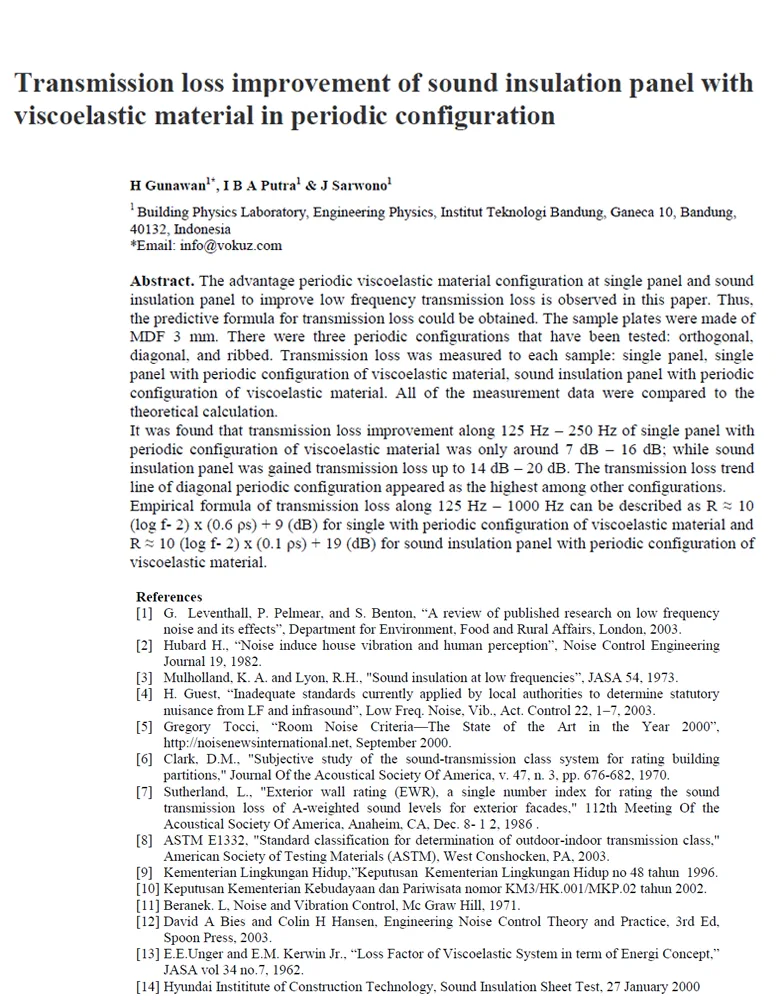
Adding a viscoelastic material layer in a periodic configuration raised a sound insulation panel's transmission loss from 7–16 dB to 14–20 dB across the 125–250 Hz range. That is roughly a doubling at the low frequencies where lightweight partitions are weakest.
That measurement is the core finding of the paper ALTA Integra presented at RECAV 2017, authored by Herwin Gunawan with I.B. Ardhana Putra and Joko Sarwono as co-authors. It matters in practice because 125–250 Hz is exactly where an STC rating starts to lose descriptive power, and where added mass alone gives poor value per kilogram.
Measured Transmission Loss by Sample Type
| Sample | Transmission loss, 125–250 Hz |
|---|---|
| Single panel | 7 dB – 16 dB |
| Single panel with viscoelastic material | Measured as an intermediate step, folded into the paper's calculation without a separate standalone figure |
| Sound insulation panel with viscoelastic material | 14 dB – 20 dB |
All three sample types were measured and then compared against theoretical calculation. That comparison validated a transmission loss prediction equation, the study's central contribution beyond the measured figures.
What a Viscoelastic Material Does in a Panel
A viscoelastic material combines the properties of an elastic solid and a viscous fluid. That combination lets it absorb and dissipate vibration energy as heat inside the panel: the same principle behind the damping loss factor used to characterise vibration control materials generally.
The variable this paper examined was arrangement. Three periodic configurations were tested (orthogonal, diagonal and striped) on the premise that how a damping layer is distributed across a panel changes its effect just as much as how much of it is present. That distinction is what makes the result useful to a specifier: it suggests performance can be bought through geometry as well as through material volume.
Method: Three Samples, Measured Against Theory
Transmission loss was measured across three sample types: a single panel, a single panel fitted with viscoelastic material, and a sound insulation panel incorporating viscoelastic material. Measured results for each were then compared against theoretical calculation to validate the transmission loss prediction equation: this is the part of the study with the longest useful life, since a validated prediction method outlasts any single measured value.
Why the 125–250 Hz Range Is the Interesting One
The improvement was measured in a frequency band that causes disproportionate trouble on real projects. Standard airborne insulation ratings such as STC cover 125 Hz to 4,000 Hz, and performance at the bottom of that range is where lightweight construction typically underperforms its single-number rating. A partition that measures well overall can still pass bass-heavy music, mechanical rumble or traffic noise, because the rating averages across a range in which the low end contributes least to the number and most to the complaint.
Raising low-frequency transmission loss without a proportional increase in mass is worth more than the same improvement higher up the spectrum, both acoustically and structurally, since added partition mass has to be carried by something.
Why This Research Still Informs Project Work
Presenting at RECAV 2017 reflects ALTA Integra's intent to ground its consulting practice in tested research findings. The transmission loss principles examined in this paper continue to inform how the firm specifies sound insulation panels for partitions in studios, performance spaces and other isolation-critical environments through its acoustic engineering and design practice. It was one of two papers ALTA Integra submitted to the conference that year, alongside a study on splaying walls and room mode distribution.
FAQ
What is transmission loss in acoustics?
Transmission loss is a measure, expressed in decibels, of how effectively a partition or panel blocks sound passing from one space to another. It is the difference in sound pressure level between the source side and the receiving side. A higher value means less sound gets through.
What is a viscoelastic material and why use it in a sound insulation panel?
A viscoelastic material combines the properties of an elastic solid and a viscous fluid. That combination lets it absorb and dissipate vibration energy as heat within the material itself. Arranged in the right configuration within a panel, that dissipation raises the panel's transmission loss.
How much did transmission loss improve in this study?
Across the 125–250 Hz range, a single panel measured 7 dB to 16 dB of transmission loss, while the sound insulation panel incorporating viscoelastic material measured 14 dB to 20 dB over the same range. That amounts to roughly a doubling at the low frequencies where lightweight partitions typically perform worst.
What material configurations were tested?
Three periodic configurations of the viscoelastic material within the panel: orthogonal, diagonal and striped. Testing arrangement was the point of the study. It examines whether performance can be improved through geometry as well as through material volume.
Who authored this paper?
Herwin Gunawan was first author, with I.B. Ardhana Putra and Joko Sarwono as co-authors. The paper, "Transmission Loss Improvement of Sound Insulation Panel with Viscoelastic Material in Periodic Configuration," was presented at RECAV 2017 in Denpasar, Bali.
Who specifies sound insulation panels for projects in Indonesia?
ALTA Integra specifies partition and panel systems for studios, performance venues and other isolation-critical spaces across Indonesia and Southeast Asia, matching transmission loss targets to the frequency range where each project's actual noise problem sits.
Sources
1. H. Gunawan, I. B. Ardhana Putra and J. Sarwono, "Transmission Loss Improvement of Sound Insulation Panel with Viscoelastic Material in Periodic Configuration," RECAV 2017, Denpasar, Bali.
2. ISO 10140-2:2021, Laboratory measurement of sound insulation of building elements; Part 2: Measurement of airborne sound insulation.