Splaying Walls and Room Mode Distribution: ALTA Integra's RECAV 2017 Research
Angling a wall away from parallel, tested against four established room-ratio methods, and analysed with FEM rather than assumed.
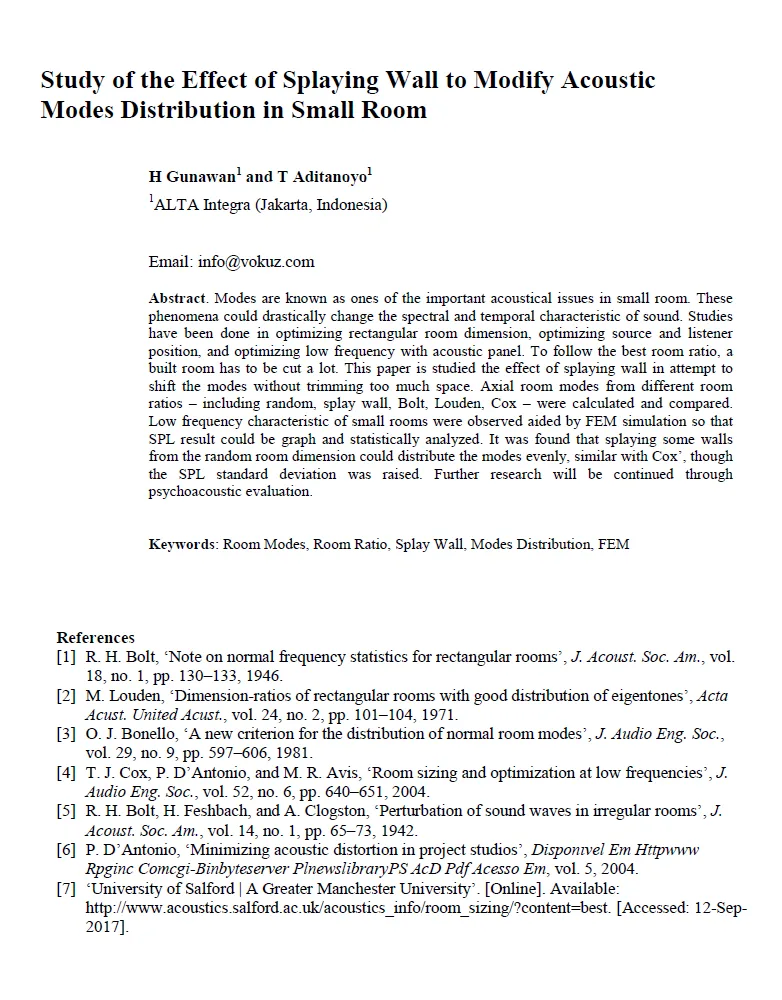
At RECAV 2017 in Denpasar, Bali, ALTA Integra acoustic consultant Herwin Gunawan, with co-author Teguh Aditanoyo, presented a paper testing whether splaying a wall (angling it away from parallel) can modify the distribution of low-frequency room modes in a small room. The study compared five room-ratio approaches using Finite Element Method analysis, and it was one of two papers ALTA Integra submitted to the conference that year. The practical question behind it is a familiar one on small-room projects: can mode distribution be improved through geometry alone, without surrendering floor area to treatment?
The Five Room-Ratio Methods Compared
| Approach | Basis |
|---|---|
| Random ratio | Control case, no deliberate proportioning |
| Splayed wall | Angling one wall away from parallel with the surface opposite |
| Bolt | Established room-ratio criterion for even modal spacing |
| Louden | Established room-ratio criterion for even modal spacing |
| Cox | Established room-ratio criterion for even modal spacing |
Each configuration's effect on room modes was modelled and its resulting sound pressure level distribution compared against the others, rather than the splayed wall being assessed in isolation.
What the Paper Set Out to Test
Room modes are resonant low-frequency standing waves that build between a room's parallel surfaces. They are the main reason small rooms sound uneven at bass frequencies, with some notes booming and others disappearing depending on where the listener sits. This is a problem covered in more depth in our article on how sound behaves in a room.
The paper tested whether splaying a wall could reduce that unevenness without requiring additional floor space, which is the constraint that rules out many conventional fixes in a small room. Low-frequency behaviour in each configuration was analysed using the Finite Element Method, a standard numerical technique for modelling how sound pressure distributes through a space, and the resulting sound pressure level data was compared across configurations to identify which room-ratio method performed best for controlling room modes in small rooms.
Why Room Modes Matter in Small-Room Acoustics
Room modes cannot be eliminated. What varies is how severe and how audible they are, and how evenly they are distributed across the low-frequency range: stacked modes at one frequency produce an exaggerated peak, while spread modes produce a more even response. In small rooms the resulting bass buildup and cancellation is more pronounced, simply because the room dimensions place the modal frequencies squarely in the musically important range.
This is why room ratio and wall splaying, both levers for controlling room modes, are studied as design-stage decisions rather than after-the-fact corrections. Once the room is built, its modal distribution is fixed, and the remaining options are treatment-based, space-consuming and less effective than getting the proportions right in the first place.
ALTA Integra's Research Practice
This paper was one of two ALTA Integra submitted to RECAV 2017. For the full conference detail and how the two papers relate, see ALTA Integra at RECAV 2017.
Presenting at RECAV reflects an ongoing intent at ALTA Integra to contribute to published acoustics research and to keep its acoustic, lighting and thermal consulting grounded in its own carefully tested method. Room-ratio and room modes analysis of the kind in this paper continues to inform how the firm approaches small-room and critical-listening projects.
FAQ
What is a room mode in acoustics?
A room mode is a resonant standing wave that forms between a room's parallel surfaces, most audible at low frequencies. It causes certain notes to sound louder or quieter depending on where the listener is positioned, which is why small rooms often have uneven bass response.
What is a splaying wall and how does it affect room acoustics?
A splaying wall is one angled away from parallel with the surface opposite it. Angling breaks the parallel-surface condition that standing waves depend on, and the technique was studied here as a way to modify and potentially even out low-frequency mode distribution in small rooms without consuming floor area.
Who authored this research?
The paper, titled "Study of the Effect of Splaying Wall to Modify Acoustic Modes Distribution in Small Room," was authored by Herwin Gunawan, ALTA Integra's acoustic consultant, with co-author Teguh Aditanoyo, and presented at RECAV 2017 in Denpasar, Bali.
What method was used to analyse the room modes?
The Finite Element Method was used to model low-frequency sound characteristics in each configuration, with the resulting sound pressure level data compared across five room-ratio approaches: a random ratio control, the splayed wall, and the Bolt, Louden and Cox methods.
What was RECAV 2017?
The Regional Conference on Acoustics and Vibration 2017, held 27–28 November in Denpasar, Bali. It was organised by the Indonesian Acoustics and Vibration Association with the Society of Acoustics (Singapore), in collaboration with the Acoustical Society of America, the International Commission on Acoustics, ITS and ITB.
Who provides small-room and critical listening acoustic design in Indonesia?
ALTA Integra provides room-ratio analysis, modal modelling and acoustic design for listening rooms, studios and small critical-listening spaces across Indonesia and Southeast Asia, applying the same design-stage approach examined in this research.
Sources
1. H. Gunawan and T. Aditanoyo, "Study of the Effect of Splaying Wall to Modify Acoustic Modes Distribution in Small Room," IOP Conference Series: Journal of Physics, RECAV 2017.