EASE Acoustic Modelling for a Multi-Use Function Hall: The Mandiri Club Case Study
Five parameters modelled before construction, so the acoustic answer fitted the interior design instead of requiring it to be reworked.
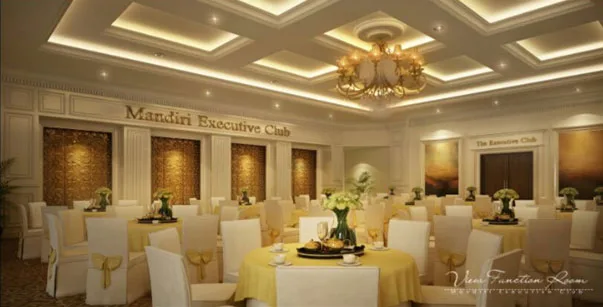
ALTA Integra was appointed acoustic consultant for the function hall renovation at Mandiri Club, Plaza Mandiri in South Jakarta, and used EASE simulation software to model five acoustic parameters before construction. EASE modelling is a repeatable method used across projects, this one included. Modelling first mattered here for a specific reason: the room already had an interior design, and the brief was to meet acoustic targets within that scheme rather than to send the interior back for rework.
Simulation is what makes that possible. It tests whether a target is reachable inside a given set of surfaces before anyone commits to demolition.
The Five Parameters Modelled in EASE
| Parameter | What it governs |
|---|---|
| Sound Pressure Level (SPL) | How loud sound is at listening positions across the room, and whether coverage is even or falls away at the back |
| Reverberation Time (RT60) | How long sound persists after the source stops, the main driver of both speech clarity and musical character |
| Clarity | The balance of early, useful reflections against later ones that blur detail |
| Speech Transmission Index (STI) | How intelligible the spoken word remains across the room |
| Bass Ratio | Low-frequency reverberation relative to mid-frequency, which drives perceived warmth or boominess |
Bass ratio is the parameter most often left out of a function hall brief, and the one most likely to produce the complaint that the room sounds "boomy" without anyone being able to say why.
The Brief: One Room, Four Event Types
Bank Mandiri planned to renovate the Mandiri Club at Plaza Mandiri, Jalan Mataram 1 No. 3, South Jakarta. The renovation included a second-floor function room intended for VIP partner events: seminars, gala dinners, multimedia presentations and live acoustic music. PT Studio-T Transintrasia, the project's architectural planner, appointed ALTA Integra as acoustic consultant for the hall.
Four event types in one volume is the recurring difficulty in corporate function space. A seminar wants short decay and high intelligibility. Live acoustic music wants enough reverberant energy to sound alive rather than flat.
A gala dinner wants speech to carry over the sound of two hundred people eating. These do not resolve to a single optimum, which is why the room needed five parameters evaluated together rather than a reverberation target alone.
Why Model Before Building
EASE (Enhanced Acoustic Simulator for Engineers) simulates how sound will behave in a room before it exists: pressure level distribution, reverberation, clarity and speech intelligibility. The value lies in the point in the programme at which it happens.
A design change made in a model costs a modelling run. The same change made after construction costs demolition, materials, programme time and, in a working corporate venue, lost bookings.
Evaluating all five EASE parameters together also allowed recommendations that met the acoustic targets while working within and complementing the existing interior design. That is a materially different outcome from an acoustic solution that requires the interior scheme to be reworked around it, and it is only reachable if the acoustic evaluation happens against the actual proposed surfaces rather than against a generic room.
The Project Team
Studio T acted as architect and primary planner, ALTA Integra as acoustics and noise control consultant, and VOKUZcom as audio-video system integrator. This is the same acoustics-plus-AV pairing ALTA Integra uses on hospitality and corporate function spaces generally, because room acoustics and sound reinforcement have to be resolved against each other rather than in sequence.
Applying the Same EASE Method Elsewhere
EASE-based modelling across SPL, reverberation time, clarity, STI and bass ratio remains ALTA Integra's working method for function halls, corporate auditoriums and multi-use event spaces across Indonesia, through its acoustic engineering and design practice. ALTA Integra also worked with Bank Mandiri on Mandiri University.
FAQ
What is EASE software used for in acoustic design?
EASE (Enhanced Acoustic Simulator for Engineers) simulates how sound will behave in a room before construction: sound pressure level, reverberation, clarity and speech intelligibility. The value lies in timing: a design change made in a model costs a modelling run rather than demolition.
Why does bass ratio matter in a function hall?
Bass ratio compares low-frequency reverberation to mid-frequency reverberation. An unbalanced ratio makes a room sound boomy or thin, affecting both speech clarity and music quality. It is the parameter most often left out of a brief and the one most likely to produce a complaint nobody can articulate.
Can one room work well for both seminars and live acoustic music?
Yes, with careful design. A seminar wants short decay and high intelligibility. Live acoustic music wants enough reverberant energy to sound alive. They do not share a single optimum, so the room has to be modelled and treated to balance STI against reverberation time rather than optimised for one.
Why coordinate acoustic design with the interior designer?
Acoustic treatment means absorptive and reflective surfaces. It is physically part of the interior. Evaluating acoustics against the actual proposed surfaces, rather than a generic room, is what allows recommendations to work within an existing scheme.
Does ALTA Integra work with corporate and banking clients?
Yes. ALTA Integra provides architectural acoustics consulting for banking, corporate and hospitality function spaces across Indonesia, including this Mandiri Club function hall and the Mandiri University campus for Bank Mandiri.
The same EASE-modelling workflow applies across ALTA Integra’s auditorium and multi-purpose hall projects, wherever a single room has to serve more than one acoustic brief.