High-End Audio Room Acoustics: The Physics Behind Tonal Balance, Decay and Phase
Play a track in A in a room whose mode sits near G#, and you hear both. That is not equipment, and it is not opinion.
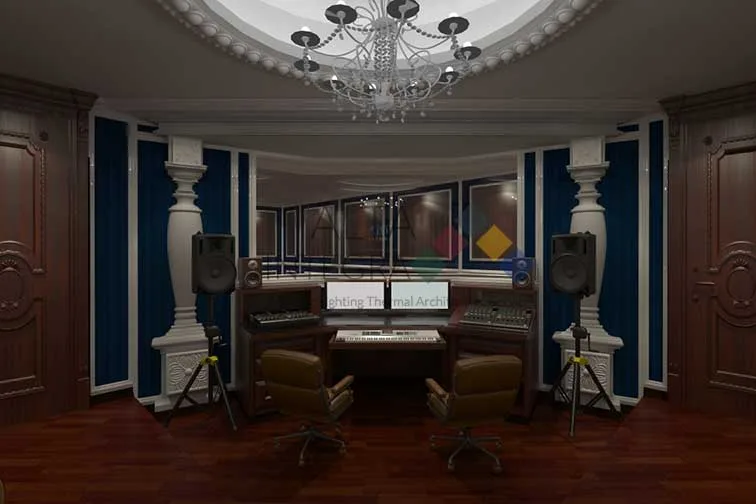
High-end audio room acoustics is the science of controlling how a room reshapes sound through three measurable parameters — tonal balance, reverberation and phase — not a matter of expensive equipment or audiophile folklore. The room is part of the audio system whether anyone designs for it or not, which is why a substantial investment in speakers, amplifiers and cabling can still sound wrong in a space that was never accounted for.
This article covers the physics — starting from the same room modes that govern any enclosed space. For how that physics turns into a design process coordinated with interior, lighting and AV, see our article on high-end audio room design.
The Three Parameters That Define the Problem
| Parameter | What it controls | How it fails |
|---|---|---|
| Tonal balance | Amplitude across frequency at the listening position | Some frequencies louder than others; no upstream quality recovers it |
| Reverberation | Attack and decay rate of each note | Too long, trailing energy masks the next note; too short, notes die before their sustain |
| Phase | Timing relationship between direct and reflected sound | Stereo image collapses inward; instruments blur together spatially |
A room can measure flat in tonal balance and still sound collapsed, because phase governs imaging rather than colour. All three have to be solved at the same listening position, simultaneously.
Every Room Colours Sound, and It Is Easy to Prove
Most listeners assume what changes from room to room is their hearing. A thirty-second test settles it: talk loudly in a bedroom, then a living room, then a garage. The tonality of your own voice changes audibly in each. Then do the same in the middle of an open field, where the voice sounds markedly flatter and more neutral than in any enclosed space.
Every room has an acoustic signature that colours whatever happens inside it. The signature is invisible but it is not subtle, and it acts on music exactly as it acts on a raised voice. Pairing a carefully engineered system with a room that was never designed to carry it is an expensive compromise made by default.
When a Room Mode Lands Between Two Notes
Rooms do not only colour sound generally — they can disagree with the specific notes being played. Music built around the note A puts energy at roughly 55, 110 and 220 Hz and their octaves. A room 3.2 metres wide has a mode near 106 Hz, which falls between G# at 103.83 Hz and A at 110 Hz — on neither.
Play a track anchored on a bass A in that room and two things sound at once: the note from the speakers, and a second tone excited by the room itself, sitting between G# and A. The result is an audible beating or smearing between the two. It is not a recording flaw and not an equipment flaw. It is the room asserting its own resonance on top of the music, and it is fully predictable from the room's dimensions — see our article on calculating room resonance.
Absorption or Diffusion? The Question Has No General Answer
The audiophile argument over absorption panels versus diffusers is long-running and mostly ungrounded. One camp holds that absorption kills a room and diffusion is always safer; the other holds that diffusers add noise to the reflection field. Both, stated as blanket rules, are opinions presented as expertise, and a good deal of audiophile media repeats them without checking.
The actual design target is narrower and harder: at the listening position, minimise coloration of tonal balance, mismatch in attack-and-decay timing, and phase-driven smearing of spatial imaging — all three at once. Whether that calls for absorption, diffusion or a calculated combination depends on the room's dimensions, surfaces and system. There is no rule of thumb because there is no typical room.
Tonal Balance, Reverberation and Phase in Detail
Tonal balance is the foundational requirement. If a room is not reasonably even across the audible range, no amount of upstream quality makes it sound right. In measurement or simulation it appears as amplitude in dB plotted against frequency; a level line means room and reproduction are both close to flat.
Reverberation is what the ear hears as the sum of direct sound and every reflection. In a hard-surfaced room the result is louder overall, and the rate at which sound peaks and fades defines the decay. Too long and trailing reverberation masks the next note; too short and notes vanish before their natural sustain, leaving the room feeling dead. A fast, clean attack is what gives the perceptual impression of live performance.
Phase is the timing relationship between direct sound and the reflection arriving slightly later. Where the two mix at the wrong phase relationship, the sound stage collapses inward and instruments blur into one another rather than holding distinct positions. This is the parameter that explains a room measuring flat and still sounding wrong.
What a Science-Based Process Requires
Because the problem is multi-parameter and interacting, solving it needs a consultant with knowledge of sound behaviour in small rooms, command of the physics connecting geometry to response, simulation software capable of producing mapping and auralisation, working knowledge of treatment products and their actual characteristics, correct measurement framework, and trained listening judgment for final evaluation. A room built this way is engineered rather than guessed at — which is the whole distinction between acoustic design and audiophile mysticism, and the basis of ALTA Integra's acoustic engineering and design work.
FAQ
Is high-end audio room acoustics scientific or subjective?
Grounded in measurable physics. Tonal balance, reverberation and phase can all be measured or simulated. Subjective preference matters for final tuning, but the underlying room behaviour is not a matter of opinion — it is predictable from dimensions and surfaces.
What is a room mode and why does it matter for music?
A standing wave forming between parallel surfaces at a frequency set by the room's dimensions. When it sits near a note being played, both sound at once and beat against each other. A 3.2 m wide room has a mode near 106 Hz, between G# and A.
Should I use absorption panels or diffusers?
It depends on the room's dimensions, surfaces and system — there is no general answer, because there is no typical room. Blanket claims that absorption kills a room or that diffusers add noise are opinions presented as expertise. An assessment identifies where each is actually needed.
What is the right reverberation time for a listening room?
It depends on size, use and system. Too long and trailing reverberation masks the next note; too short and notes die before their natural sustain, leaving the room feeling dead. A fast, clean attack is what produces the impression of live performance.
Why does phase matter if tonal balance already measures flat?
Phase affects imaging and spatial impression rather than tonal colour. A room can measure flat and still sound collapsed or compressed, because reflections arriving at the wrong phase relationship blur instruments together instead of holding them in distinct positions.