Room Resonance and Frequency Response: Why Dimensions Decide How a Room Sounds
Two rooms built from identical materials sound completely different, and no amount of absorption changes why.
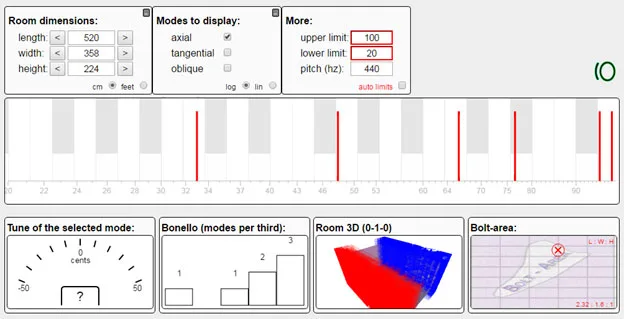
Room resonance (the physical phenomenon of standing waves forming between parallel surfaces) is why two rooms built from identical materials can sound completely different, and it is determined almost entirely by dimensions rather than by how much treatment is applied. The frequencies at which a room resonates are fixed by the distances between its parallel surfaces. Absorption can reduce how audible those resonances are.
It cannot move them. This is the single most common misunderstanding in small-room acoustics, and it is why treatment budgets sometimes produce disappointing results in rooms with unfortunate proportions.
Calculating a Room's Resonance Frequencies
A typical listening room has three pairs of parallel surfaces: floor and ceiling, front and back wall, left and right wall, each generating its own resonance series. The fundamental for any pair is:
Fr = c / (2 × L), where c is the speed of sound in air (approximately 343 m/s at room temperature) and L is the distance between the two surfaces. Each fundamental is followed by harmonics at whole-number multiples.
| Dimension | Fundamental | Harmonic series (Hz) |
|---|---|---|
| 3 m width | 57.2 Hz | 57, 114, 171, 229, 286, 343 |
| 6 m length | 28.6 Hz | 29, 57, 86, 114, 143, 171, 200, 229, 257, 286, 314, 343 |
The 6 m room's second harmonic lands on exactly the 3 m room's fundamental: the overlap repeats at 114, 171, 229, 286 and 343 Hz. Every coincidence gets reinforced twice.
Why Simple Ratios Sound Uneven
In the example above, the room's length is exactly double its width. Every frequency where the two series coincide is excited by both dimensions and becomes disproportionately dominant, while frequencies falling between coincidences are comparatively weak. The audible result is bass that booms on some notes and thins on others, varying with listening position.
That coloration is a form of distortion introduced by the room itself. A source, amplifier and speaker chain each behaving well individually will still produce audibly unnatural sound once it passes through a room whose resonances pile up, and the listener usually attributes it to the equipment.
What Treatment Can and Cannot Do
A persistent misconception holds that adding absorptive material solves room resonance. It does not. Resonance is the vibration of air trapped between parallel surfaces at frequencies set by their separation.
Absorption reduces the amplitude and shortens the decay of a resonance. It does not remove the frequency at which the room resonates, and thin porous absorbers are largely ineffective at the long wavelengths involved anyway.
Spreading Room Resonance Evenly: Room Ratios
Because the problem is coincidence rather than room resonance itself, the solution is proportions that avoid coincidence. Acoustic researcher M. M. Louden published reference ratios between height, width and length selected specifically to distribute resonance frequencies evenly rather than piling them up. Louden's first-quality ratio is 1 : 1.4 : 1.9.
Applied to a 2.2 m ceiling height, that gives a width of 3.08 m and a length of 4.18 m. Modelling a room at those dimensions shows room resonance spread across the range rather than concentrated, and correspondingly less room-induced coloration than a room built to simple whole-number proportions. This is the same principle ALTA Integra examined in its RECAV 2017 research comparing five room-ratio methods, and the reason room ratio is treated as the first decision in a listening room.
When the Room Cannot Be Rebuilt
Matching an existing building to a ratio table is rarely possible. Three approaches shift a room's effective proportions without full reconstruction: a raised floor platform to adjust usable height, a partition wall to adjust effective length or width, and a sloped ceiling (lower near the speakers, rising toward the listening position) which removes one pair of parallel surfaces entirely rather than retuning it.
The sloped ceiling is the strongest of the three, because it addresses the mechanism rather than the dimensions: no parallel pair, no standing wave between them.
FAQ
Does adding soundproofing fix room resonance?
No. Resonance is air vibrating between parallel surfaces at frequencies set by their separation. Absorption reduces the amplitude and shortens the decay but does not move the resonance frequencies, and thin porous absorbers do little at the long wavelengths involved.
How do you calculate a room's resonance frequency?
Fr = c / (2 × L), where c is the speed of sound in air, approximately 343 m/s at room temperature, and L is the distance between a pair of parallel surfaces. Each fundamental is followed by harmonics at whole-number multiples.
Why do rooms with simple length-to-width ratios sound boomy?
Because their resonance series coincide. When length is a simple multiple of width, both dimensions excite the same frequencies, reinforcing them well above frequencies that fall between coincidences. The result is bass that booms on some notes and thins on others.
What is the Louden ratio used for?
It gives height-to-width-to-length proportions chosen to spread resonance frequencies evenly rather than concentrate them. The first-quality ratio is 1 : 1.4 : 1.9, which for a 2.2 m ceiling gives roughly 3.08 m wide by 4.18 m long.
What if the room cannot be rebuilt to an ideal ratio?
A raised floor platform, an added partition wall or a sloped ceiling can shift effective proportions. The sloped ceiling is strongest because it removes a parallel pair entirely rather than retuning it: no parallel surfaces, no standing wave between them.
Diagnosing and correcting room modes at this level of detail is routine work within ALTA Integra’s acoustic engineering and design practice.