Music and Speech Hall Acoustics: Resolving Two Opposite Requirements in One Room
Speech needs short decay and distinct consonants. Music needs the opposite. A shared hall has to be engineered for both or it fails at one.
A multi-purpose hall used for speeches, live music, choirs, ceremonies and screenings faces a genuine acoustic conflict: getting speech and music both right in the same room means satisfying two different, often opposing, sets of conditions. Speech needs short reverberation and controlled early reflections so consonants stay distinct. Music generally benefits from longer, warmer decay that blends and supports.
A hall designed for one will underperform at the other unless it is deliberately engineered for both. The most common complaint in multi-purpose halls is that the audience cannot follow a lecture or sermon even when the sound system is working.
The Four Parameters Used to Design a Speech and Music Hall
| Parameter | What it measures | Which use it serves |
|---|---|---|
| SPL | How evenly sound is distributed across seats | Both: uneven SPL means some seats are too loud, others too quiet |
| RT60 | Time for sound to decay by 60 dB after the source stops | The core conflict: short favours speech, long favours music |
| D50 (definition) | Energy arriving in the first 50 ms as a share of total energy | Speech (the 50 ms window is the boundary of useful clarity) |
| C80 (clarity) | Early energy in the first 80 ms against later reflections | Music. It distinguishes defined instrumental detail from blur |
D50 and C80 use different time windows for a reason: 50 ms is where speech clarity is decided, 80 ms is where musical detail is. A hall serving both is being asked to satisfy two different clocks.
Why the Conflict Is Structural
Reverberant energy (the reverberation that persists after a sound source stops) is simultaneously what warms music and what smears speech. There is no setting of a single reverberation target that optimises both, which is why a shared hall must resolve two genuinely opposite acoustic requirements.
Three practical factors then determine how badly the conflict bites. Seating arrangement (standing audience, portable seating, or a conference layout) changes how sound reaches different parts of the room and how much absorption the audience itself provides.
The sound reinforcement system, and how well it is configured, strongly affects intelligibility in larger rooms. And room geometry and surface treatment determine where sound decays, where echoes form, and where dead spots appear.
When an important message fails to reach the audience because of these, the event's purpose is undermined. This is the argument for designing acoustics before construction rather than patching afterwards.
What SPL, RT60, D50 and C80 Each Tell You
SPL describes how level varies from seat to seat. Even SPL at every seat means every audience member and performer perceives comparable clarity, from the front rows to the back.
RT60 is the time for an impulse to decay by 60 decibels. It affects comfort for performers as much as audience, and the correct value depends entirely on intended use: getting it wrong measurably affects mood, engagement and intelligibility.
D50, definition, is the ratio of energy received in the first 50 milliseconds to total energy received. That window is generally treated as the boundary of useful speech clarity: energy arriving inside it helps intelligibility, energy arriving after it works against.
C80, clarity, compares early energy in the first 80 milliseconds against later reflections. The longer window reflects that musical detail tolerates (and benefits from) later-arriving energy that would blur a consonant.
Designing the Room as a System
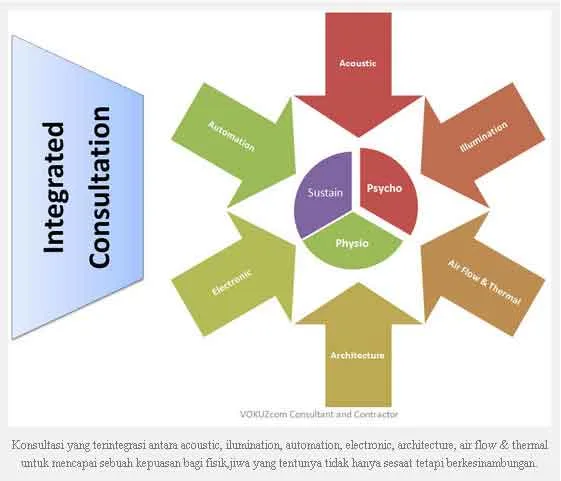
A hall works when it is treated as a single interacting system, coordinated as a whole. Physical elements (acoustics, lighting, airflow, temperature) interact with architectural form, texture and colour, and with the audio and video systems. Together these shape both whether people can hear and the psychological and physiological comfort of everyone present, which is what determines whether an audience stays engaged through a two-hour programme.
Modelling Before Building
Rather than estimating these parameters, room acoustic modelling for a speech and music hall predicts SPL, RT60, D50 and C80 at design stage, before a wall is built. That is what allows the speech-versus-music balance to be tested and adjusted while adjustment is still free, and it lets an owner see the trade-off explicitly, long before the first event.
A sound reinforcement system helps distribute speech and music more evenly, but it complements good room acoustics: raising level in a reverberant hall raises the reverberant field along with the direct sound. ALTA Integra applies this modelling approach to multi-purpose halls through its acoustic engineering and design practice: the same method used on the Mandiri Club function hall.
FAQ
Why is one hall for both speech and music hard to design?
Because reverberant energy is simultaneously what warms music and what smears speech. Speech needs short decay and distinct consonants. Music benefits from longer, blending decay. No single reverberation target optimises both, so the room has to resolve two genuinely opposite briefs.
What is RT60 and why does it matter?
The time for sound to decay by 60 decibels after the source stops. It affects comfort and clarity for both performers and audience, and the right value depends on the room's primary use. Getting it wrong measurably affects engagement and intelligibility together.
What do D50 and C80 measure?
Both compare early useful energy against later reflections, but over different windows. D50 uses the first 50 milliseconds and governs speech clarity. C80 uses the first 80 milliseconds and governs musical definition. The different windows are why a hall serving both is satisfying two clocks.
Can acoustic problems be fixed after a hall is built?
Partially, through added absorptive or diffusive treatment, sound system adjustment or seating changes. But it is considerably more effective and cheaper to model and design the acoustics before construction, while geometry is still changeable.
Does a sound system solve poor room acoustics?
No. It distributes speech and music more evenly but complements good room acoustics: raising level in a reverberant hall raises the reverberant field along with the direct sound, so intelligibility does not improve.
Resolving this exact conflict is routine on ALTA Integra’s cultural and performing arts projects, where one hall regularly has to serve both a choir and a keynote speaker.