Outdoor Lighting Without Light Pollution: Four Components and How to Design Them Out
Misdirected light is wasted light. The two problems have the same fix, which is unusual and worth exploiting.
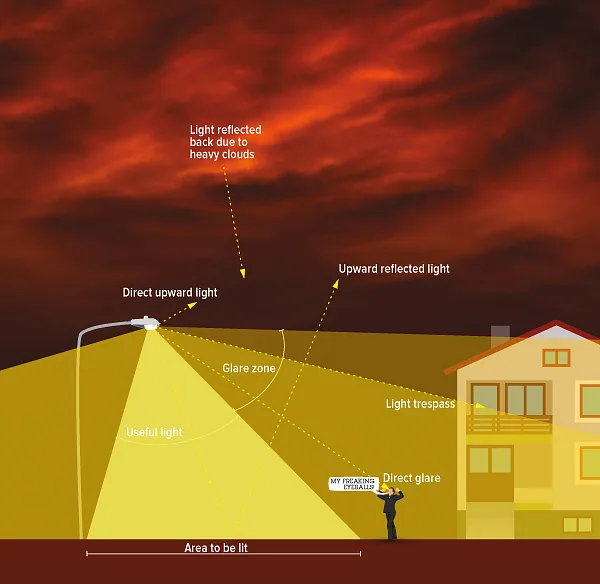
Light pollution is one of the few environmental problems a building owner can largely solve at source, and one of the fewer still where the fix also saves money. Misdirected light is, by definition, light that was paid for and did not do its job — so shielding and aiming a fixture correctly reduces skyglow, trespass and glare while cutting the energy bill. The two objectives point the same direction, which is not true of most environmental design trade-offs.
Light-pollution-free outdoor lighting design means placing, aiming and shielding exterior light so it illuminates the intended area and nothing more.
The Four Components of Light Pollution
| Component | What it is | Assessment question |
|---|---|---|
| Glare | Excessive brightness causing visual discomfort | Is glare visible from typical viewing angles? |
| Skyglow | Light illuminating the night sky above an occupied area | Does any light escape upward? |
| Light trespass | Light spilling where it was never intended to reach | Does light cross the property line? |
| Clutter | Clusters of overly bright, confusing light sources | Do fixtures read as purposeful or as visual noise? |
The right-hand column is a usable review checklist. Running a lighting plan against these four questions before installation costs nothing; retrofitting fixtures afterward does not.
Why Light Becomes a Pollutant
Light pollution — photopollution — is anthropogenic light at night produced by excessive emission and incorrect directivity or placement. Like air, water and land pollution, light crosses from resource to pollutant when there is too much of it in the wrong place. Sources range from building exterior and interior lighting through advertising and signage, offices and factories, to street and park lighting.
A large share of outdoor lighting in use at night is inefficient, too bright, poorly directed, inadequately shielded and emitting far more than the task requires. That is worth restating in commercial terms: light pollution is usually also an energy waste problem, and the building owner is paying for both halves of it.
What Excess Light Costs
Before artificial lighting, darkness at night was simply a feature of the environment. Removing that constraint carried consequences that are now reasonably well documented: increased energy consumption, disruption to ecosystems and wildlife behaviour, effects on human health through circadian exposure, effects on crime and perceived security, and loss of night sky visibility.
The crime and security item deserves a note, because it is the one most often assumed to run the other way. More light is not reliably safer light — glare from poorly shielded fixtures reduces visibility by overwhelming the eye's adaptation, and the relationship between illumination and crime is considerably more contested than lighting specifications usually assume.
Five Design Measures
Five measures reduce light pollution at the design stage. Use covers or reflectors so fixtures direct light onto the intended area. Position and aim fixtures so the beam points downward rather than skyward. Minimise or eliminate upward-facing spotlights. Use planting to reduce stray reflection. And reduce reliance on high-glare sources in favour of better-shielded, better-directed fixtures.
On light pollution and light source selection specifically: sodium lighting scatters broadly and is harder to shield precisely, while a properly shielded, correctly aimed and appropriately bright LED gives better control over where light goes. That is a control argument rather than a technology argument — an unshielded LED aimed at the sky pollutes more efficiently than a shielded sodium lamp. Colour temperature is a separate decision again, covered in our article on energy-efficient city lighting choices.
Why This Belongs in Healthy Building Practice
Outdoor lighting sits inside healthy building design because it affects circadian light exposure for occupants and neighbours, energy performance, and the building's relationship to its surroundings. A lighting design reviewed against light-pollution criteria — proper shielding, correct aiming, appropriate brightness for the task — is simultaneously a healthy-building measure and an energy measure.
Reviewing a plan against the four assessment questions before installation also gives a project a defensible basis for claiming its outdoor lighting is genuinely light-pollution-conscious rather than nominally so — which matters where that claim feeds a certification submission. ALTA Integra reviews outdoor lighting on this basis as part of its healthy building advisory work.
FAQ
What counts as light pollution?
Excessive, misdirected or poorly shielded artificial light at night, conventionally divided into four components: glare, skyglow, light trespass and clutter. Each has a distinct assessment question, which makes a lighting plan reviewable against them before installation.
Does reducing light pollution mean using less light?
Not necessarily — it means directing the light more precisely so it reaches only the intended area rather than spilling upward or sideways. In practice it usually does reduce consumption too, because misdirected light is light that was paid for and did no work.
Is more outdoor lighting safer?
Not reliably. Glare from poorly shielded fixtures reduces visibility by overwhelming the eye's adaptation, and the relationship between illumination levels and crime is more contested than lighting specifications typically assume. Shielding and aiming matter more than quantity.
What is the simplest first step to reduce light pollution?
Correct fixture aiming and shielding — pointing light downward and covering or reflecting it onto the intended area. That addresses most glare, skyglow and trespass at no added cost, and it is available on existing installations as well as new ones.
Are sodium lights worse than LED for light pollution?
Sodium scatters more broadly and is harder to shield precisely, so a properly shielded and aimed LED gives better control over where light goes. But this is a control argument, not a technology one — an unshielded LED aimed skyward pollutes more efficiently than a shielded sodium lamp.
Balancing visual impact against light pollution at this level of detail is core to ALTA Integra’s urban air, sound and light work, alongside its dedicated lighting design practice.