Resources
Kalkulator teknik, daftar standar acuan, glosarium istilah, dan tanya jawab dari konsultan akustik, pencahayaan, dan audiovisual untuk tim desain Indonesia.
Table of Contents
Resources
These engineering resources are free to use, need no sign-up, and each one answers a specific early-project question quickly.
This resources section collects the reference material ALTA Integra works from every day, published openly for design teams in Indonesia. It holds browser-based calculators, the measurement instruments and simulation software behind our reports, the Indonesian and international standards our work is held to, a plain-language glossary, and straight answers to the questions clients ask most. The resources are organised as five sections so you can go directly to the one you need rather than reading through material that does not apply to your project.
Publishing these engineering resources is a deliberate choice. Acoustic, lighting and audiovisual consulting produces numbers that a client is usually asked to accept on trust: a reverberation target, a wall rating, an illuminance figure, an envelope value. Setting out the standards those numbers are derived from, the instruments used to verify them, and the vocabulary they are written in makes the work checkable. A client who can look up what NC 35 means, and which standard defines it, is in a better position to hold any consultant to account, including us.
Calculator
The calculator section holds six browser-based tools. The Lumen Method calculator estimates luminaire counts for a target illuminance. PAG/NAG checks whether a live sound system can reach the level it needs before feedback. Room Mode maps the standing waves a rectangular room will resonate at. RT60 predicts reverberation time per octave band from surface materials, by both the Sabine and Eyring equations. OTTV models envelope heat gain per facade against the compliance ceiling. A point-by-point photometric calculator finds the illuminance one fitting delivers to one specific point.
Each calculator in these resources runs entirely in the browser. Nothing is uploaded and no project data leaves the device, which matters when the room dimensions you are testing belong to a client under a confidentiality agreement.

Tools
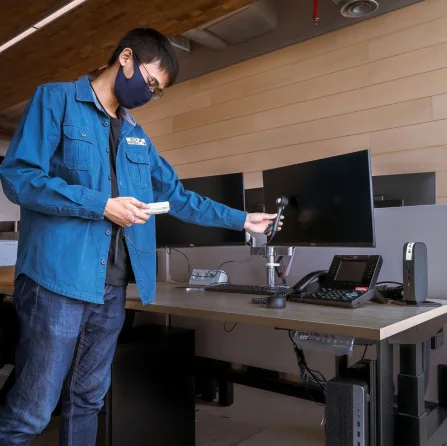
The tools section lists the physical instruments and simulation software we verify designs with: sound level meters, illuminance and luminance meters, and the acoustic and lighting modelling packages our engineers run before anyone visits site. It is published for the same reason the rest of these resources are: a number is only as good as the instrument and the method behind it, and a client is entitled to know both.

Standards
The standards section sets out the fifty standards and regulations our acoustic, lighting, audiovisual and building-envelope work is measured against, grouped by discipline. Indonesian requirements such as Permen PUPR 21/2021 form the compliance baseline on an Indonesian project. International standards from ISO, IEC, ASTM, CEN and ANSI/AVIXA are used alongside them as the higher design target, or where a project needs a metric that Indonesian standards do not define.
Edition years appear in that list only where the current edition was verified against the issuing body. A stale year on a consultant's standards page is worse than no year at all, so where an edition was not confirmed, only the stable designation is given.

Terminology
The terminology section defines the terms that appear in our reports, RT60, STC, Rw, NC, STI, UGR, lux, OTTV and twenty-six more, in plain language, with a search box and a filter per discipline. It is written for clients and architects reading an engineering report, not for engineers who already know. Where a quantity has both an ISO and an ASTM equivalent, both appear, because specifications in Indonesia routinely mix the two systems in a single document.
FAQ
The FAQ section answers what clients actually ask: when to bring a consultant in, the difference between acoustic treatment and sound insulation, why a wall rated STC 55 can underperform once built, how a noise complaint from a neighbour is assessed, and what information we need in order to start.

How to Use These Resources
Treat the calculators as screening tools, not as deliverables. They assume idealised geometry and cannot see flanking paths, existing services, site context or how a space will really be occupied, so a result is a question worth asking rather than an answer to build from. Read a calculator output alongside the standards section, which tells you what the target should have been in the first place.
When a project needs numbers that carry weight, our acoustic consulting, lighting design and audiovisual teams model them at design stage and then measure them on the finished building. Prediction and measurement check each other: a prediction nobody measures is an assumption, and a measurement with nothing predicted behind it has no benchmark to be judged against.
Related Work
These resources come out of built work, not theory. See the project portfolio for the buildings behind them, the insights archive for longer technical writing, or get in touch to discuss a specific space. Professional context for much of this material comes from bodies such as the Illuminating Engineering Society.