Indoor Air Quality in Jakarta Buildings: What LEED v5 and WELL v2 Require
ALTA Integra's green building consultants explain how ventilation, filtration and certification protect indoor air from Jakarta's persistent pollution.
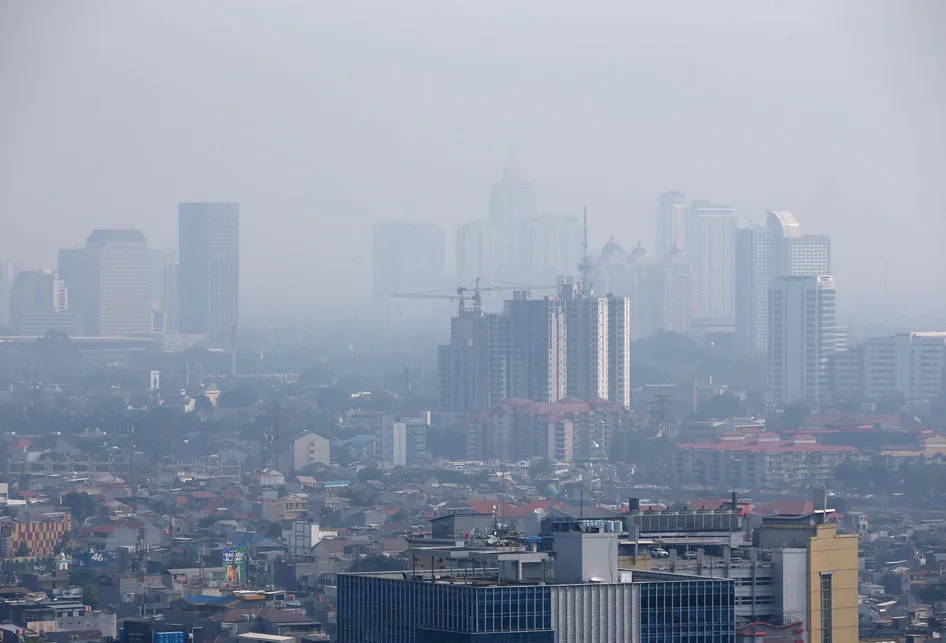
Jakarta's annual average PM2.5 concentration was 41.7 µg/m³ in 2024, or 8.3 times the World Health Organization's annual guideline of 5 µg/m³. That pollution does not stop at the building envelope. Research across industrialized Asian countries has found indoor PM2.5 concentrations that exceed outdoor levels, driven by limited ventilation, envelope infiltration, and inadequate filtration.
For building owners in Jakarta, this makes indoor air quality a design and operations problem to manage directly. Both LEED and WELL treat it as a certification criterion: LEED v5, released in April 2025, and WELL v2 both build indoor air quality into their core requirements, and LEED v4.1 registration remains open through June 30, 2027 for owners already on that path.
ALTA Integra advises building owners in Jakarta and across Indonesia on the building physics behind those requirements. This article covers where Jakarta's pollution originates, why indoor concentrations can be worse than outdoor, and what filtration and design measures measurably reduce occupant exposure.
WHO 2021 Air Quality Guidelines vs. Jakarta
The World Health Organization revised its air quality guidelines in September 2021, tightening most limits significantly from the 2005 version: the annual PM2.5 guideline was halved, from 10 to 5 µg/m³.
| Pollutant | WHO 2021 annual limit | WHO 2021 24-hour limit | Previous 2005 limit (annual) |
|---|---|---|---|
| PM2.5 | 5 µg/m³ | 15 µg/m³ | 10 µg/m³ |
| PM10 | 15 µg/m³ | 45 µg/m³ | 20 µg/m³ |
| NO2 | 10 µg/m³ | 25 µg/m³ | 40 µg/m³ |
| O3 | 60 µg/m³ (peak season) | 100 µg/m³ (8-hour) | - |
Jakarta's 2024 annual PM2.5 average was 41.7 µg/m³, or 8.3× the current WHO guideline.
Why Air Quality Is Primarily a Matter of Building Design and Operations
The Special Capital Region of Jakarta (Jakarta Raya) is the most polluted province in Indonesia: the average resident there could live 2.6 years longer if particulate concentrations met the WHO guideline, according to the University of Chicago's Air Quality Life Index (AQLI), based on 2023 PM2.5 data. That outdoor pollution burden is exactly why air quality has become a core criterion in green building certifications such as LEED and WELL: the WHO's threshold values are commonly measured across four pollutants, namely particulate matter (PM), ozone (O3), nitrogen dioxide (NO2), and sulfur dioxide (SO2). Buildings sit directly in that exposure pathway.
Public awareness of air quality in Indonesia has been rising alongside growing recognition that clean, safe air is a basic human right. Jakarta's air quality index has historically exceeded WHO exposure limits often enough that the city's air is classified as unhealthy for extended periods of the year.
Where Jakarta's Air Pollution Comes From
Motor vehicle exhaust is the dominant source of Jakarta's air pollution. A study by Bandung Institute of Technology (ITB), funded by the Toyota Clean Air Project, measured PM2.5 at Gelora Bung Karno, Kebon Jeruk, and Lubang Buaya across the 2018–2019 rainy and dry seasons.
After vehicle exhaust, the largest contributors were asphalt road dust, open burning, construction activity, sea salt, soil, and coal combustion. Sea salt, carried inland by onshore sea breezes, was the leading non-vehicle source at all three sites.
The study also found a clear seasonal pattern: rainy-season concentrations ran consistently below dry-season levels, because rainfall precipitates airborne particles and carries them into drainage, a process called wet deposition.
Why Indoor Air Quality Can Be Worse Than Outdoor Air
Indoor PM2.5 concentrations can exceed outdoor levels, according to research by Jones et al. in China and India, both, like Indonesia, industrialized Asian countries, found exactly this. Three factors drive it: a lack of ventilation openings during working hours, outdoor PM2.5 infiltrating through the building envelope, and higher ventilation exchange rates without adequate filtration. Many building ventilation systems also maintain positive pressure during peak hours to reduce cooling load, which lowers fresh-air exchange and lets indoor PM2.5 accumulate.
A study by Pramitha and Haryanto on indoor PM2.5 exposure and lung function in Jakarta's Pulo Gadung industrial area found that when occupants inhale PM2.5-laden air that reaches the alveoli, the resulting interaction between particles and oxygen metabolites can overwhelm the body's ability to neutralize free radicals, producing oxidative stress that inflames the lungs and limits lung expansion, with long-term exposure linked to reduced indoor lung function.
How to Reduce Indoor PM2.5 in Jakarta Office Buildings
Filtering ventilation air through a MERV 13-rated filter or better measurably reduces indoor PM2.5 concentration, according to research by Jones et al. across office buildings in four countries. Supplementary air purifiers positioned near a pollution source, operated in a mode that directs clean air to the breathing zone, add further reduction.
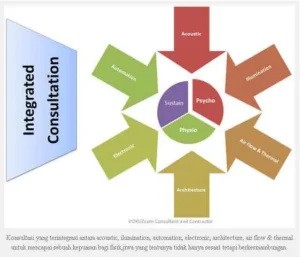
At the building level, LEED Operations and Maintenance (O+M) and the WELL Building Standard both give owners a structured way to verify and improve indoor air quality: LEED with a focus on sustainable, efficient buildings, and WELL with a focus on occupant well-being, comfort, and health. Good indoor air quality supports human productivity, health, and welfare, and helps fulfill the basic right to a healthier living environment. Integrating building architecture with building physics is what makes that possible in practice, which is the core of what ALTA Integra does for clients pursuing LEED and WELL certification for buildings in Jakarta and beyond.
FAQ
How bad is Jakarta's air quality?
Jakarta's annual average PM2.5 concentration reached 41.7 µg/m³ in 2024, or 8.3 times the World Health Organization's annual guideline of 5 µg/m³. The WHO tightened that guideline in September 2021, halving it from the previous 10 µg/m³. Indoor concentrations inside Jakarta buildings can be higher still, because outdoor particulate infiltrates the building envelope and accumulates where ventilation and filtration are inadequate.
What is the main source of Jakarta's air pollution?
Motor vehicle exhaust is the dominant source. A Bandung Institute of Technology study funded by the Toyota Clean Air Project measured PM2.5 at three Jakarta sites and identified vehicle emissions as the largest contributor, followed by asphalt road dust, open burning, construction activity, sea salt, soil, and coal combustion. Sea salt, carried by onshore breezes, was the leading non-vehicle source at every site.
Can indoor air be more polluted than outdoor air?
Yes. Research by Jones et al. across office buildings in four countries found indoor PM2.5 concentrations that exceeded outdoor levels. Three factors drive this: ventilation openings kept closed during working hours, outdoor particulate infiltrating through the building envelope, and ventilation systems held at positive pressure to reduce cooling load, which lowers fresh-air exchange and lets particulate accumulate indoors.
What MERV rating is needed to reduce indoor PM2.5?
A minimum MERV 13 rating. Research by Jones et al. found that filtering ventilation air at MERV 13 or above measurably reduces indoor PM2.5 concentration in office buildings. Lower ratings such as MERV 8 capture coarser particles but pass a substantial fraction of PM2.5. Portable air purifiers near identified pollution sources provide additional reduction where central filtration alone is insufficient.
What is the difference between LEED and WELL certification?
LEED and WELL measure different things. LEED, from the U.S. Green Building Council, certifies environmental performance. LEED v5, released April 2025, organizes credits around decarbonization, quality of life, and ecological conservation. WELL, from the International WELL Building Institute, certifies occupant health, comfort, and wellbeing. Both include indoor air quality as a criterion, and many Jakarta projects pursue them together.
Acknowledgment
This article draws on research originally contributed by Angela Michelle Sutopo (Universitas Multimedia Nusantara) during an internship with ALTA Integra.
This gap between outdoor pollution and required indoor performance is the same problem ALTA Integra addresses at a city scale through its urban air, sound and light work.
Sources
- IQAir, "2020 World Air Quality Report," 2020.
- D. R. Boyd, "The Human Right to Breathe Clean Air," Annals of Global Health, 2019, vol. 85, no. 1.
- WHO, "Health for All in the 21st Century," 1997.
- LEED, "LEED v4 User Guide," U.S. Green Building Council, 2014.
- International WELL Building Institute, "The WELL Certification Guidebook," 2021.
- WHO, Air Quality Guidelines: Global Update 2021 (particulate matter, ozone, nitrogen dioxide, sulfur dioxide), WHO, Geneva, 2021.
- IQAir, "2024 World Air Quality Report" for Jakarta annual PM2.5, 2024.
- M. Greenstone and Q. Fan, "Air Quality Life Index Update: Indonesia's Worsening Air Quality and its Impact on Life Expectancy," 2019.
- Bandung Institute of Technology, "Main Sources of Air Pollution in Jakarta" (Toyota Clean Air Project).
- BMKG, "Informasi Konsentrasi Partikulat (PM2.5)."
- S. Pramana, D. Y. Paramartha, Y. Adhinugroho, and M. Nurmalasari, "Air Pollution Changes of Jakarta, Banten, and West Java, Indonesia During the First Month of COVID-19 Pandemic," Journal of Business, Economics and Environmental Studies, 2020, vol. 10, no. 4.
- E. R. Jones, J. G. Cedeño Laurent, A. S. Young, P. MacNaughton, B. A. Coull, J. D. Spengler, and J. G. Allen, "The Effects of Ventilation and Filtration on Indoor PM2.5 in Office Buildings in Four Countries," Building and Environment, 2021, vol. 200.
- B. Haryanto and E. Pramitha, "Effect of Exposure to 2.5 μm Indoor Particulate Matter on Adult Lung Function in Jakarta", Osong Public Health and Research Perspectives, 2019, vol. 10, no. 2.
- H. Park, S. Park, and J. Seo, "Evaluation on Air Purifier's Performance in Reducing the Concentration of Fine Particulate Matter for Occupants According to its Operation Methods," International Journal of Environmental Research and Public Health, 2020, vol. 17, no. 15.
- Energy Policy Institute at the University of Chicago (EPIC), "Air Quality Life Index — Indonesia Fact Sheet", AQLI Annual Update 2025 (2023 PM2.5 data).
- U.S. Green Building Council, "LEED v5", released April 2025. LEED v4/v4.1 certification deadlines (registration open through June 30, 2027).
For more information about LEED and WELL certification for industrial buildings, please contact us at:
ALTA Integra
Indonesia Stock Exchange Building, Tower 1, Level 3 Unit 304
SCBD Senayan, Kebayoran Baru, South Jakarta, DKI Jakarta 12190
Tel: +62 818 826 036
Email: customer@altaintegra.com