ALTA Integra at RECAV 2017: Two Acoustics Papers on Room Modes and Sound Insulation
Two of the 122 abstracts submitted to the conference came from ALTA Integra — one on room geometry, one on panel construction.
In November 2017 ALTA Integra submitted two research abstracts to RECAV 2017, the Regional Conference on Acoustics and Vibration, in Denpasar, Bali — one on how room modes behave in small rooms, one on the transmission loss performance of sound insulation panels. As of 18 August 2017 the conference had received 122 abstracts in total; two of them were ALTA Integra's. Between them the papers cover the two levers available on any small-room isolation problem: the geometry of the room, and the construction of the partition around it.
The Two Papers at a Glance
| Paper | Question | Method | Authors |
|---|---|---|---|
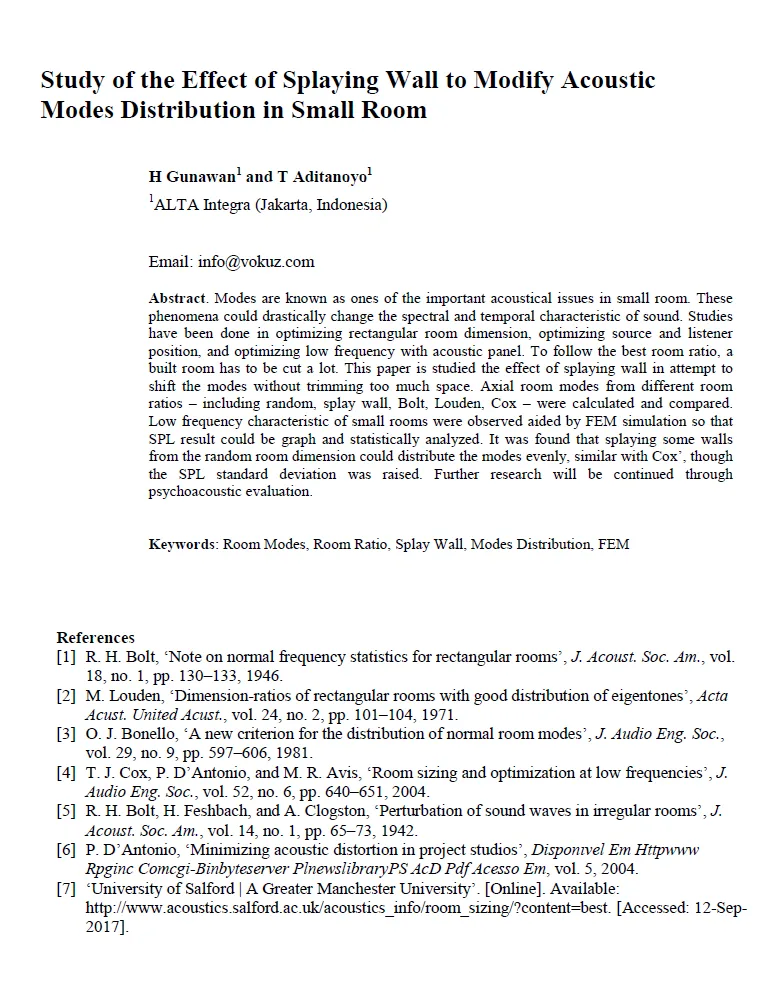
| Study of the Effect of Splaying Wall to Modify Acoustic Modes Distribution in Small Room | Can angling a wall even out low-frequency mode distribution without consuming floor area? | Finite Element Method simulation across five room-ratio approaches | Herwin Gunawan (first author), Teguh Aditanoyo |
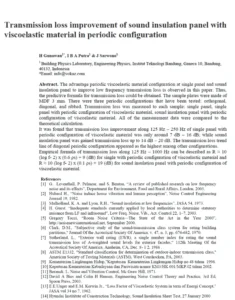
| Transmission Loss Improvement of Sound Insulation Panel with Viscoelastic Material in Periodic Configuration | Does a viscoelastic layer in a periodic arrangement raise a panel's transmission loss? | Measurement across three sample types, validated against theoretical calculation | Herwin Gunawan (first author), Ida Bagus Ardhana Putra, Joko Sarwono |
Full method and results for each paper are on the linked pages. This post covers the conference and the relationship between the two studies.
Why These Two Papers Belong Together
The pairing of ALTA Integra's two RECAV 2017 papers is not accidental. A small room with a low-frequency problem has two independent routes to a fix, and they act on different physics.
The first paper addresses geometry: room modes are standing-wave resonances forming between parallel reflective surfaces, and they are the main reason bass response is uneven in a small room. Changing the room's shape changes where those resonances land. The second addresses construction: transmission loss measures how effectively a partition stops sound crossing to the other side, and adding a damping layer changes how much energy the panel passes rather than where it resonates.
On a real project — a control room, a broadcast studio, a meeting room next to a plant room — both usually apply, and knowing which one a given complaint calls for is the difference between a fix and an expense. That is the same diagnostic discipline set out in our article on structure-borne versus airborne noise.
About RECAV 2017
RECAV 2017 was a regional conference combining research paper publication with acoustics and vibration workshops, held 27–28 November 2017 in Denpasar, Bali. It was organised by the Indonesian Acoustics and Vibration Association (AAVI) together with the Society of Acoustics (Singapore), in collaboration with the Acoustical Society of America, the International Commission on Acoustics, Institut Teknologi Sepuluh Nopember and Institut Teknologi Bandung, with support from a number of institutions in Indonesia and abroad.
Attendees included Jeong Guon Ih, then President Emeritus of the Acoustical Society of Korea; Dr Woon Siong Gan, then President of the Society of Acoustics (Singapore) and its founding president; and Prof. Kazuya Takeda, then Vice-President of the Acoustical Society of Japan.
Why ALTA Integra Publishes Research
Publishing at RECAV 2017 reflects a working preference for grounding consulting practice in tested research rather than rule of thumb. The room mode and insulation panel principles examined in these two papers continue to inform how ALTA Integra approaches small-room acoustic design and partition specification through its acoustic engineering and design practice — from meeting rooms and recording studios through to performance and broadcast spaces.
FAQ
What was RECAV 2017?
The Regional Conference on Acoustics and Vibration 2017, held 27–28 November 2017 in Denpasar, Bali. It combined research paper publication with acoustics and vibration workshops, organised by the Indonesian Acoustics and Vibration Association (AAVI) with the Society of Acoustics (Singapore), in collaboration with the ASA, ICA, ITS and ITB.
Which papers did ALTA Integra publish at RECAV 2017?
Two. "Study of the Effect of Splaying Wall to Modify Acoustic Modes Distribution in Small Room," on room mode behaviour, and "Transmission Loss Improvement of Sound Insulation Panel with Viscoelastic Material in Periodic Configuration," on sound insulation panel performance.
Who authored the two papers?
Herwin Gunawan was first author on both. Teguh Aditanoyo co-authored the room modes paper; Ida Bagus Ardhana Putra and Joko Sarwono co-authored the sound insulation panel paper.
How many abstracts did RECAV 2017 receive?
As of 18 August 2017, the conference had received 122 abstracts, two of which came from ALTA Integra. That figure is a submission-window snapshot rather than a final count.
How do the two papers relate to each other?
They address the two independent routes to a small-room low-frequency problem. The first changes the room's geometry so resonances land differently; the second changes the partition's construction so it passes less energy. On most real projects both apply, and diagnosing which one a complaint calls for is what makes the fix work.
Who provides research-grounded acoustic consulting in Indonesia?
ALTA Integra provides acoustic consulting across Indonesia and Southeast Asia for small-room design, partition specification, and performance and broadcast spaces, applying the same modal and transmission loss principles examined in this research.
Sources
1. Asosiasi Akustik dan Vibrasi Indonesia (AAVI), organiser of RECAV 2017.