Home Theatre Acoustic Design: Room Modes, Reflections and the Four Disciplines That Have to Agree
Acoustics, lighting, interior and AV all compete for the same surfaces in a small dark room. Whichever discipline is designed last loses.
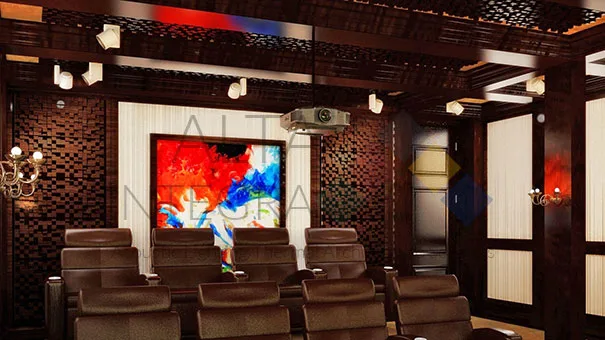
Home theatre acoustic design determines three things a viewer notices immediately: whether dialogue stays intelligible, whether effects carry real, physical impact, and whether music sounds enveloping. All three trace back to the same four parameters: room modes, reverberation time, early reflections, and how much sound transmits between the theatre and the rest of the house. None of them is improved by a larger screen or a better processor.
The harder problem is that acoustics, lighting, interior design and AV all compete for the same wall and ceiling surfaces in what is usually a small, dark, enclosed room. Whichever discipline is resolved last inherits whatever surfaces the others left. This article covers what each parameter does, the mistakes that recur most often, and why the sequencing matters more than the equipment budget.
The Four Disciplines and What Each Controls
| Discipline | What it decides | What it competes for |
|---|---|---|
| Acoustics | Room modes, reverberation time, early reflection control, transmission loss to adjoining rooms | Wall and ceiling surface area, room proportions |
| Lighting | Illumination level relative to screen brightness, colour, luminaire selection and placement | Ceiling and wall positions: the same surfaces treatment wants |
| Interior | Theme, colour, material, furniture and seating comfort | Visible surfaces and finish materials |
| Audio-video | Speaker and subwoofer position, screen brightness, viewing distance and angle | Floor plan, seating rows, front wall |
The third column is the reason these cannot be sequenced. Every discipline wants the same surfaces, and a decision made by one closes options for the others.
What Acoustic Design Actually Controls in a Home Theatre
Four parameters carry most of the outcome. Room modes govern whether bass is even from seat to seat or wildly different between the front row and the back. Reverberation time governs whether dialogue stays crisp or smears.
Early reflections govern imaging: whether an effect appears to come from a defined location or from a vague direction. Transmission loss governs how loud the system can be played before it becomes everyone else's problem.
The last one is worth stating plainly because it is the parameter most often discovered after handover. A dedicated isolated room is not strictly required. Transmission loss to adjoining spaces is a design parameter that directly limits usable volume, and a theatre that can only be run at half its intended level on a weekday evening has not delivered what was paid for.
Why Lighting Design Belongs in an Acoustics Conversation
Lighting does not affect sound. It affects whether the immersion that good acoustics creates survives contact with the room. Ambient light that competes with the screen image undermines the same sense of being somewhere else that acoustic treatment is working to produce, so the two disciplines succeed or fail together even though they operate through different senses.
There is also a direct physical conflict. Luminaires occupy ceiling and upper-wall positions, and so does acoustic treatment at first reflection points. If the lighting layout is resolved first, the acoustician is left placing panels wherever space happens to remain available.
Five Home Theatre Design Mistakes That Recur
Most underperforming home theatres share the same small set of problems. Speakers and subwoofers are often placed for convenience, which comes at the cost of even bass response: a subwoofer in a corner is convenient and acoustically the worst available position. No treatment on parallel walls produces flutter echo that muddies dialogue.
Ambient light positioned where it washes out the image. Seating rows placed without regard to viewing angle and distance. And, underlying all four, a room whose proportions were never checked, so the modal distribution was fixed before anything else was decided.
All five are cheaper to address at design stage than to retrofit, and the last one is effectively not retrofittable at all. This point is covered in more depth in our article on high-end audio room design.
Balancing Absorption and Diffusion
In a home theatre, absorptive materials (thick fabrics, upholstered seating, purpose-made panels) reduce flutter echo and control reverberation. Diffusive surfaces scatter reflections into many smaller ones rather than removing the energy. The correct balance depends on room size and on the content typically watched, and it is a calculation made at the design stage itself, before construction begins.
Over-absorbing is the common error in small rooms, because absorption is the easier material to buy and the easier effect to hear. A theatre damped until it is acoustically dead loses the sense of space that surround formats are mixed to produce. This balance is part of ALTA Integra's acoustic engineering and design work on private cinema rooms.
FAQ
What does home theatre design and build include?
Acoustic design covers room modes, reverberation and sound isolation. Lighting design covers illumination levels and fixture selection. Interior design covers layout, materials and furniture. Audio-video system design covers equipment configuration, speaker placement and viewing geometry.
Why does acoustic treatment matter in a home theatre?
Without it, reflections and reverberation blur dialogue and bass response becomes uneven from seat to seat, so even high-end speakers deliver well below their potential. Acoustic treatment is what lets the equipment perform to its full rated specification.
Can lighting design really affect a home theatre's sound?
Only indirectly, and in two separate ways. Poor lighting competes with the screen image and undermines the immersion acoustics is creating, and luminaires physically occupy the ceiling and upper-wall positions that acoustic treatment needs. The two have to be laid out together.
Does a home theatre need a dedicated isolated room?
A dedicated isolated room isn't strictly necessary, though transmission loss to adjoining rooms directly limits how loud the system can be played without disturbing the rest of the house. A theatre usable only at half volume on a weekday evening has not delivered what was specified.
What is the most common home theatre design mistake?
Placing speakers and subwoofers for convenience compromises even bass response, closely followed by leaving parallel walls untreated. Underlying both is the mistake that cannot be retrofitted: never checking the room's proportions, which fixes the modal distribution before anything else is decided.
Who designs home theatres in Indonesia?
ALTA Integra designs private cinema rooms across Indonesia and Southeast Asia, coordinating acoustics, lighting, interior and AV system design from concept stage so the four disciplines resolve together from the outset.
Home theatre briefs of this kind are a regular part of ALTA Integra’s work on residential complex and private house projects.
Sources
1. ITU-R BS.1116-3, Methods for the subjective assessment of small impairments in audio systems, including reference listening room acoustic conditions.