Audio Quality vs Room Acoustics: Which One Actually Limits What You Hear
A world-class system in a poor room and a perfect room fed by weak equipment fail in the same way: the listener hears the weaker of the two.
For unamplified music especially, listening satisfaction is limited by whichever is worse: the audio equipment producing the sound, or the room acoustics of the space it travels through. A world-class system in a poorly designed room and an excellent room fed by weak equipment both fall short, and they fall short in the same way.
The listener experiences the weaker of the two. That is why arguments about which matters more are usually the wrong question, and why upgrading the one that was already adequate produces so little audible change.
This article works through the distinction using a real concert in Jakarta, drawing on Herwin Gunawan's account of the evening, and ends with what it implies for anyone specifying a listening or performance space.
Unamplified vs Amplified: What Each Costs and Delivers
| Unamplified in a good room | Amplified | |
|---|---|---|
| What determines quality | Almost entirely the room's acoustics | The room, plus the character of the whole signal chain |
| Dynamics | Full: no compression anywhere in the path | Mild compression introduced between microphone and amplifier |
| Coloration | The room only | The room, plus tweeter and woofer character |
| Main risk | Ambient noise becomes highly audible, a poor room degrades the instruments directly | Mix balance errors, system character overlaid on the performance |
Amplification is not a downgrade. It is a different set of trade-offs, chosen when the room cannot support the performance on its own acoustics.
Why Audio Quality and Room Acoustic Quality Are Different Things
Audio quality describes how faithfully a system (speakers, amplifiers, source equipment) reproduces a signal. Room acoustic quality describes how a space behaves: how it reflects, absorbs and reinforces sound travelling from source to ear.
This distinction matters most for unamplified performance. A recording can be pristine and a system excellent, and the listener will still not hear the music as intended if the room has poor reverberation control, uneven sound pressure distribution or high background noise.
The reverse holds equally: a beautifully designed concert hall cannot rescue a bad recording or a poorly configured system. Neither is a substitute for the other, and neither can compensate for the other's failure.
A Case in Point: A 2009 Concert at JCC Plenary Hall
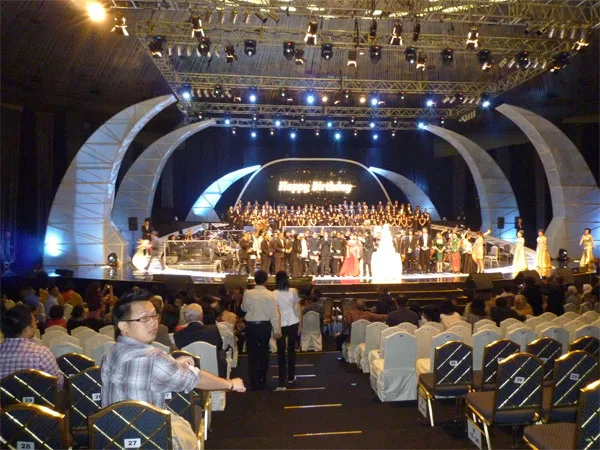
In 2009, Music Odyssey of Addie MS was staged at the Plenary Hall of the Jakarta Convention Center (a concert tracing Addie MS's musical career, organised by friends to mark thirty years in Indonesian music and his birthday).
Plenary Hall is a round conference room with a large dome ceiling and a smaller inverted dome at its centre. It has reasonable damping against echo, but it was not built to host unamplified classical performance on its own acoustics. The production team compensated with a line-array system to distribute sound evenly across the audience, a reasonable engineering response to a room that could not do the job unassisted.
The compensation had audible costs. Higher frequencies were noticeably absorbed by the room's damping material. That made it hard to hear the full clarity and shimmer of the piano.
The mix balance compounded it: the piano sat lower than the strings, and vocals were recessed relative to drums and bass. Neither problem was the musicians'. The limiting factors were an imperfect mix and a room whose acoustic character was not built for the performance it was hosting.
What an Unamplified Performance Actually Requires
The ideal for most listeners is a genuinely unamplified performance: hearing music as it was played, in a hall with genuinely good acoustics and no amplification at all, so what reaches the ear is the instruments themselves, shaped only by the room. In that scenario the room's acoustic quality determines almost everything about what the audience hears.
It carries two exposures. Ambient noise, from the audience, ventilation or nearby plant, becomes far more noticeable, because there is no amplified signal raising the level above it.
And if the room's acoustics are inadequate, the instruments themselves sound worse regardless of how well they are played. An unamplified performance does not forgive a room: it reveals it.
Live Amplified vs Home Playback
A comparison worth making, distinct from the unamplified case above, is between a live amplified concert and the same music through a good home system. Counterintuitively, home playback is often more compressed and lower in resolution than even an imperfect live amplified performance. The live setting retains more of the original instrumental detail, because it has been through fewer stages of processing and delivery.
That does not make a live mix automatically better in every respect, as the Plenary Hall balance issues show. It does mean the comparison is not the one most people assume.
What This Means for Specifying a Listening or Performance Space
Audio quality and room acoustic quality cannot be evaluated separately: together they determine whether an audience leaves satisfied or disappointed. Addie MS said at the concert that he hoped one day to present his work in a genuinely proper concert hall, noting that Indonesia lacked a truly suitable room for classical music at the time. Sixteen years on, that observation is the argument for treating acoustic design as a capital decision rather than a finishing one.
A hall, studio or home listening room built to the right acoustic parameters from the start gives every piece of equipment installed afterwards a fair chance of sounding as good as it is capable of sounding. Built the other way round, the equipment budget subsidises a problem it cannot solve. That principle underlies ALTA Integra's work on high-end audio rooms and performance venues alike, through its acoustic engineering and design practice.
FAQ
Does better audio equipment always improve the listening experience?
Not on its own. If the room has excessive reverberation, uneven sound distribution or high background noise, even excellent equipment cannot overcome those limitations. Listening satisfaction is limited by whichever is worse: the system or the room. Upgrading the one that was already adequate changes little.
Why do some concert venues need amplification for classical music?
Because multi-purpose venues such as conference-style halls are not built with the reflective and absorptive surfaces unamplified classical music needs. Amplification, typically a line-array system, distributes sound evenly across the audience, at the cost of introducing the system's own coloration and mild compression.
What is the difference between an unamplified and an amplified performance?
An unamplified performance in a well-designed room delivers the instruments' own sound, shaped only by the room, with full dynamics. An amplified performance always adds some coloration and compression from microphones, mixer and speakers. Unamplified does not forgive a poor room. It reveals it.
Is a live concert always better sounding than a home system?
Live sound generally carries more original instrumental detail and dynamic range than home playback, which is typically more compressed and lower in resolution, though not in every respect. A live mix can still have balance problems that a well-mastered recording does not.
What should be prioritised when designing a listening space?
Room acoustic quality, addressed at design stage together with equipment selection. A room designed for its intended use gives any system a genuine chance to perform as intended. Built the other way round, the equipment budget subsidises a problem it cannot solve.
Who advises on concert hall and listening room acoustics in Indonesia?
ALTA Integra provides acoustic design for concert halls, performance venues, studios and private listening rooms across Indonesia and Southeast Asia, working from concept stage so the room's acoustic parameters are set before equipment is specified.
The same room-acoustics-versus-amplification question comes up repeatedly on ALTA Integra’s convention & exhibition projects, where a single hall is booked for both spoken and musical programming.
For acoustic quality consultation, please contact us at:
ALTA Integra
Indonesia Stock Exchange Building, Tower 1, Level 3 Unit 304
SCBD Senayan, Kebayoran Baru, South Jakarta, DKI Jakarta 12190
Tel: +62 818 826 036
Email: customer@altaintegra.com