Why Thermal Comfort Is Scored as a Green Building Criterion
Under-investing in thermal comfort to save capital cost is usually more expensive than the investment avoided. The research has said so since 1989.
Thermal comfort is treated as a green building criterion in its own right because its effects are measurable in three areas that matter to an owner: occupant health, cognitive and physical performance, and energy consumption. The research on the middle one is the least known and the most commercially relevant. Under-investing in thermal comfort to save capital cost has been argued since the late 1980s to be more expensive than the investment avoided, once lost productivity and business disruption are counted.
This article covers why thermal comfort matters. For the comfort models themselves and which applies to which building, see static versus adaptive thermal comfort models.
What the Research Establishes
| Finding | Source | Implication |
|---|---|---|
| Intellectual, physical and sensory performance peak in thermally comfortable conditions | Fanger (1982) | Concentrated work, study and creative output all depend on it |
| Repetitive factory and office work declines in productivity at high temperature and humidity | Altman and Stokol (1987) | The effect is measurable in data |
| Investment in thermal comfort is cheaper than the productivity lost without it | Edward (1989) | The capital saving is usually a false economy |
| Core body temperature above 37°C raises stroke and heat exhaustion risk | Evan and Cohen (1987) | At extremes this stops being a comfort question |
These are decades-old references and should be verified before publication, but the direction of the evidence has been consistent and later work has not reversed it.
Comfort as a Condition of Function
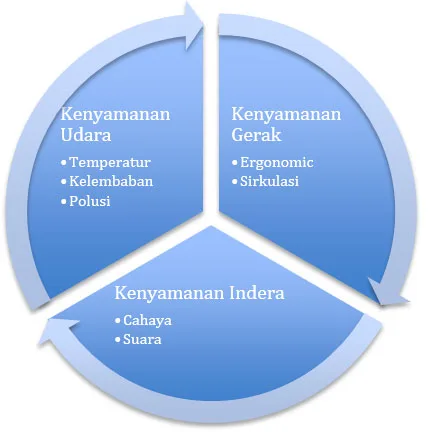
Vitruvius, writing around 15 BC, held that architecture rests on three qualities: firmitas (strength), utilitas (function) and venustas (beauty). Genuine functional quality in a room means satisfying several categories of comfort at once: comfort of motion through ergonomics and circulation, comfort of air through temperature, humidity, circulation and pollutant levels, and sensory comfort for eyes and ears through lighting and acoustics.
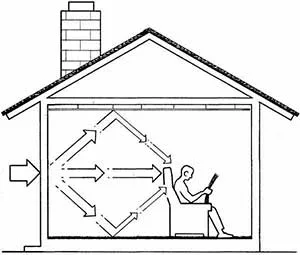
Thermal comfort sits inside the second category and interacts with nearly everything else the building does. A room serves a protective function against the elements, a container function supporting work, study, exercise and rest, and a social function. Thermal conditions bear on all three.
As shelter, a room must protect against weather extremes severe enough to cause illness. As a container for activity, it needs conditions suited to whatever happens inside it, so occupants are not spending attention fighting their environment.
Where the Health Stakes Become Serious
Above a certain point this stops being about productivity. Core body temperature exceeding 37°C raises the risk of stroke and heat exhaustion, with extreme cases proving fatal. Room temperatures above 40°C can raise body temperature and heart rate together, and prolonged heat exposure also causes dehydration and fatigue.
In a tropical climate this is not a hypothetical range. It is the reason thermal design in Indonesia is a safety consideration in some building types before it is a comfort one.
Natural Strategies Before Mechanical Ones
Thermal comfort is reached through natural and mechanical strategies in that order. Natural strategies reduce energy demand while improving comfort: building orientation, shelter and shading, natural ventilation, humidity control, construction type, and the thermal properties of the envelope. Mechanical strategies (dehumidification, heating and cooling) supplement natural ones where they fall short.
The ordering is the whole argument for passive design, covered in our article on passive thermal design and natural ventilation: every degree the envelope handles is a degree the plant does not have to.
On Indonesian standards, note what actually applies. SNI 03-6572-2001 governs ventilation and air-conditioning system design and contains thermal comfort provisions. The frequently quoted comfort band of roughly 20.5–27.1°C effective temperature comes from SK SNI T-14-1993-03, which is a technical procedure for energy conservation in buildings rather than a thermal comfort standard. For envelope and system energy performance the current references are SNI 6389:2020 and SNI 6390:2020.
How Thermal Comfort Became a Green Building Criterion
Green building as a concept took shape from around 1960, amid concern over fossil energy depletion, with Rachel Carson's Silent Spring (1962) widely credited among the works that catalysed it. Research by Clement and Croome later demonstrated a green building correlation between the level of thermal comfort achieved and investment cost, meaning a designer has to balance long-term investment against performance for the best return across the building's operating life.
That balance is now formalised. Greenship (GBCI), EDGE and BGH all assess thermal comfort and energy performance as part of certifying a building, which is what turned thermal comfort from a design preference into a measurable, auditable criterion. ALTA Integra works to these through its green building advisory and certification practice.
FAQ
What is thermal comfort?
The state of a room's temperature, humidity and air movement being within the range the human body perceives as comfortable for the activity taking place (neither too hot nor too cold for what occupants are doing there).
How does thermal comfort affect productivity?
Fanger (1982) found intellectual, physical and sensory performance all peak in thermally comfortable conditions, and Altman and Stokol (1987) found repetitive factory and office work declines in productivity at high temperature and humidity. Edward (1989) argued the investment costs less than the productivity lost without it.
When does poor thermal comfort become a health risk?
Core body temperature above 37°C raises stroke and heat exhaustion risk, with extreme cases fatal. Room temperatures above 40°C can raise body temperature and heart rate, and prolonged heat exposure causes dehydration and fatigue. This is a real range in tropical climates.
What is the difference between natural and mechanical thermal strategies?
Natural strategies (orientation, shading, natural ventilation, construction type, envelope properties) reduce the need for mechanical intervention by design. Mechanical strategies such as air conditioning and dehumidification supplement them where design alone is insufficient. The order matters.
How does thermal comfort relate to Greenship or EDGE?
Greenship (GBCI), EDGE and BGH all assess thermal comfort and energy performance as certification criteria, which is what turned thermal comfort from a design preference into a measurable, auditable requirement that owners must now meet.
For thermal comfort in building architecture consultation, please contact us at:
ALTA Integra
Indonesia Stock Exchange Building, Tower 1, Level 3 Unit 304
SCBD Senayan, Kebayoran Baru, South Jakarta, DKI Jakarta 12190
Tel: +62 818 826 036
Email: customer@altaintegra.com